

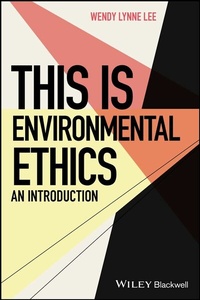
This is Environmental Ethics: An Introduction
Description

Mitigating the effects of climate change will require global cooperation and lasting commitment. Of the many disciplines addressing the ecological crisis, philosophy is perhaps best suited to develop the conceptual foundations of a viable and sustainable environmental ethic. This is Environmental Ethics provides an expansive overview of the key theories underpinning contemporary discussions of our moral responsibilities to non-human nature and living creatures.
Adopting a critical approach, author Wendy Lynne Lee closely examines major moral theories to discern which ethic provides the compass needed to navigate the social, political, and economic challenges of potentially catastrophic environmental transformation, not only, but especially the climate crisis. Lee argues that the ethic ultimately adopted must make the welfare of non-human animals and plant life a priority in our moral decision-making, recognizing that ecological conditions form the existential conditions of all life on the planet. Throughout the text, detailed yet accessible chapters demonstrate why philosophy is relevant and useful in the face of an uncertain environmental future.
* Questions which environmental theory might best address the environmental challenges of climate change and the potential for recurring pandemic
* Discusses how inequalities of race, sex, gender, economic status, geography, and species impact our understanding of environmental dilemmas
* Explores the role of moral principles in making decisions to resolve real-world dilemmas
* Incorporates extensive critiques of moral extensionist and ecocentric arguments
* Introduces cutting-edge work done by radical "deep green" writers, animal rights theorists, eco-phenomenologists, and ecofeminists
This is Environmental Ethics is essential reading for undergraduate students in courses on philosophy, geography, environmental studies, feminist theory, ecology, human and animal rights, and social justice, as well as an excellent graduate-level introduction to the key theories and thinkers of environmental philosophy.
More details
Other editions
Additional editions
Person
WENDY LYNNE LEE is a Professor of Philosophy at Bloomsburg University of Pennsylvania, where she has taught for 30 years. She is the author of more than 45 scholarly essays in areas such as philosophy of mind, feminist theory, non-human animal welfare, ecological aesthetics, and philosophy of ecology. She has contributed to the Stanford Encyclopaedia of Philosophy and Oxford Bibliography and authored several books, including Eco-Nihilism: The Philosophical Geopolitics of the Climate Change Apocalypse.
Content
Acknowledgments x
About the Companion Website xii
Introduction: Environmental Ethics in the Era of Ecological Crisis 1
One Planet, Many Worlds 1
The Time Is Now 4
Environmental Ethics Is about the Present and the Future 7
The Climate Crisis Is the Greatest Moral Challenge Humanity Has Ever Faced 10
We Can Change 14
Seven Basic Premises 17
Seven Key Objectives 20
Summary and Questions 22
Annotated Bibliography 24
Online Resources 25
1 Moral Principles and the Life Worth Living 30
1.1 Philosophy and the Environment 30
1.1.1 Philosophy and the Life Worth Living 30
1.1.2 The Precautionary Principle 35
1.2 Human Chauvinism versus Responsible Human-Centeredness 37
1.2.1 Human-Centeredness: Taking Responsibility 37
1.2.2 The Desirable Future 38
1.3 An Aerial View of Moral Extensionism 40
1.3.1 Is Moral Extensionism a Good Idea? 40
1.3.2 The Problem of Sentience 42
1.3.3 What Counts as a Living Thing? 44
1.3.4 Summary and Questions 49
Annotated Bibliography 50
Online Resources 54
2 Two Examples of Moral Extensionism: Peter Singer, Tom Regan, and Their Critics 58
2.1 The Capacity to Suffer: The Utilitarian Extensionism of Peter Singer 58
2.1.1 What Is Moral Extensionism? 58
2.1.2 Peter Singer's Animal Liberation and the Principle of Equality 61
2.1.3 Weighing Interests and Predicting Consequences 64
2.1.4 Moral Extensionism and the Climate Crisis 67
2.1.5 How Do I Know a Thing Can Suffer? 68
2.2 "Subject-of-a-life": The Kantian Extensionism of Tom Regan 72
2.2.1 The Case for Animal Rights and Immanuel Kant's Categorical Imperative 72
2.2.2 A Subject-of-a-life 74
2.2.3 Whose Subject-of-a-life Matters? 82
2.2.4 Subjecthood, Intellectual Wherewithal- and Zombies 85
2.2.5 A Feminist Critique of the Subject-of-a-life Criterion for Moral Considerability 86
2.2.6 Summary and Questions 89
Annotated Bibliography 92
Online Resources 95
3 Two More Examples of Moral Extensionism: Christopher Stone, Holmes Rolston III, and Their Critics 99
3.1 The Rights of Trees: The "Moral Standing" Extensionism of Christopher Stone 99
3.1.1 Moral Extensionism, the Concept of "Wilderness," and Human Chauvinism 99
3.1.2 Do Trees Have Rights? The Portability of Moral Standing 106
3.1.3 Moral Standing versus Consequences/Rights versus Goals: What Matters More? 111
3.1.4 Moral Standing and the Concept of the Future 114
3.1.5 The Interests and Rights of the Voiceless 119
3.2 Respect for Life: The "Good of Its Own" Extensionism of Holmes Rolston III 123
3.2.1 Respect for Life and an "Ethic for Species" 123
3.2.2 Valuing the Threat of Extinction over the Capacity for Suffering 126
3.2.3 Is a "Species Line" a Living System? 131
3.3 Summary and Questions 133
Annotated Bibliography 136
Online Resources 138
4 Two Examples of an Ecocentric Ethic: Aldo Leopold, Arne Naess, and Their Critics 143
4.1 Human-Centeredness, Human Chauvinism, and Ecocentrism 143
4.1.1 Ecocentrism and the Limits of Moral Extensionism 143
4.1.2 Ecocentrism as Psychic Transformation and Moral Paradigm Shift 147
4.2 Aldo Leopold, Ecological Conscience, and the "Plain Citizen" 152
4.2.1 The Role of Language in Ecocentric Thinking 152
4.2.2 Scientific Knowledge and the Ecocentric Disposition 156
4.2.3 Thinking Like a Mountain, or Not 160
4.2.4 Ecocentrism, the Principle of Utility, and the Patriarchal Social Order 164
4.3 Arne Naess: Deep Ecology and the Eight-point Platform 168
4.3.1 The Eight-point Platform 168
4.3.2 The Ecocentric Dichotomy 176
4.4 The Authoritarian Politics of the Eight-point Platform 182
4.4.1 Ecocentric Tyranny and Human Population Control 182
4.4.2 Does Environmental Crisis Justify Ecocentric Policies or Laws? 185
4.4.3 Summary and Questions 190
Annotated Bibliography 194
Online Resources 198
5 From the Ecocentric Endgame to Eco-phenomenology202
5.1 The Radicalized Ecocentrism of Derrick Jensen 202
5.1.1 Blow up the Dams 202
5.1.2 The Environmentalism of the Civilized 207
5.1.3 The Ethics of Human Population, of Life and Death 212
5.2 Worth: A Value Intrinsic to Living Things or a Weapon of Consent? 218
5.2.1 "We Are at War." 218
5.2.2 After the End 226
5.3 Why Experience Matters: John Dewey, David Wood, and Kath Weston 229
5.3.1 What Is Eco-phenomenology? 229
5.3.2 John Dewey and the Aesthetic in Experience 233
5.3.3 David Wood's Eco-phenomenology 238
5.3.4 Kath Weston: The Feel of Experience versus the Force of Principle 244
5.3.5 Animate Planet and the Menace of Moral Relativism 246
5.4 Eco-phenomenology and the Problem of Pseudoscience: Why Ethics Must Be Rooted in Knowledge 252
5.5 Summary and Questions 256
Annotated Bibliography 260
Online Resources 263
6 Environmental Justice: Ecological Feminism, Social Justice, and Animal Rights 268
6.1 Climate Change and Environmental Justice 268
6.2 Ecological Feminism: Intersectional Analysis and Environmental Justice 271
6.2.1 Environmental Crisis and Structural Inequality 271
6.2.2 Threads of Moral Extensionism and of Ecocentrism 274
6.3 Groundbreaking Frameworks: Karen Warren and Carol Adams 275
6.3.1 Laying Bare the Logic of Domination 275
6.3.2 The Naturalized Fictions that Imperil Us 279
6.4 The Logic of Domination, Nostalgia, Resentment, and Privilege: Jordan Peterson 280
6.4.1 Antithesis of "The Unexamined Life Is Not Worth Living" 280
6.4.2 Sophism in Defense of Climate Change "Skepticism" 283
6.4.3 12 Rules for Life: Human Chauvinism, Speciesism, and Heteropatriarchy 285
6.5 Inseparable: Environmental Ethics and the Quest for Social and Economic Justice 288
6.5.1 The Deep Roots of the "Dominance Hierarchy" 288
6.5.2 Environmental Ethics and the Quest to De-naturalize the Logic of Domination 290
6.6 Human-Centeredness, the Aesthetic in Experience, and the Desirable Future 294
6.6.1 The Aesthetic Value of Natural Objects as a Vital Element of an Ecofeminist Ethic 294
6.6.2 The Standpoint of the Subjugated 299
6.6.3 We Must Do Better 302
6.7 Summary and Questions 302
Annotated Bibliography 306
Online Resources 310
Index 317
INTRODUCTION: ENVIRONMENTAL ETHICS IN THE ERA OF ECOLOGICAL CRISIS
One Planet, Many Worlds
What may be most striking about the incredibly dynamic terrain of contemporary environmental ethics is that while its many, sometimes competing, ideas, theories, and principles are grounded in philosophical thinking about moral issues, they're also driven by a deep-going sense of duty to speak to a world whose planetary conditions are changing in potentially ruinous ways that demand urgent, deliberate, informed, and collective action.1 There are three basic truths to keep at the forefront: first, ecological conditions are existential conditions. Second, the crises we currently face, especially the climate crisis, mass human and nonhuman migration, war over access to clean water, and the potential for future pandemic, clarify the relationship of the ecological to the existential in ways pressing and paralyzing.2 Third, like most other emergencies, environmental, economic, social, and geopolitical, the climate crisis impacts some in dramatically disproportionate ways. Global North and global South, human and nonhuman, rich and poor, women and men, brown, black, and white-no single metric of impact will be comprehensive save the obvious: exceeding the tipping points to measurable irreversible change signaled by Amazon rainforest die-back, Greenland Ice Sheet disintegration, Arctic permafrost melt, West African and Indian monsoon shift, extreme and more frequent weather events, and their ancillary impacts on human and nonhuman migration, food security, geopolitical violence, and species extinction.
Still, we tend to compartmentalize "environmental," segregating it from other domains of moral concern. Yet some of our most difficult moral questions erupt from our reflections in one domain that hemorrhages onto others: trash incinerators built in working-class neighborhoods, mining leases on indigenous lands, food deserts, economically stressed communities washed away by tsunamis or burnt to the ground by firenadoes. We can't avoid these social, economic, and geopolitical intersections. The climate crisis is no more solely an environmental emergency than exploring for oil in the Arctic is solely the province of energy demand, or that the Covid-19 pandemic and its many evolving variants is merely a matter of public health.3 Each threatens serious environmental consequences for every living thing that dwells on the planet's surface, under its soils, in its waters, over its lands, or within the bodies of every creature, living and dead. But as impact is unequal, it may be that our greatest moral crisis is not, at least in the first place, the failure to act, but the refusal to know. A realistic environmental ethic must then make a priority epistemic responsibility, that is, an understanding of the current state of the planet's environmental conditions and its atmospheric integrity is key to formulating personal moral compass, just social and economic policy, and ultimately global consensus about the future sustainability of the only home most of us will ever know: Earth.
Put another way: we may be tempted to think narrowly about climate change, reserving our concern to its environmental impacts, themselves enormous, of melting polar ice caps, shifting bread-baskets, habitat loss, extinctions, firenadoes, extended drought, bomb cyclones, vanishing shore lines, and the like. This seems like quite enough. But the fact is that climate change is a crisis because it poses at least as great a challenge to the ways in which we think about the planet's capacity to support life, its limited resources, vulnerable tenants, and its geopolitical stability as it poses to more immediate and tangible concerns like combatting firenadoes, bomb cyclones, or rapid viral spread. We tend, in other words, to be geared to the crisis right in front of us, but the climate crisis is also, and fundamentally, about the future. It disrupts many of the comforts and conveniences we take for granted in the privileged global "North," and it exacerbates much of the hardship that renders life in the developing world of the global "South" tenuous.4 It raises critically important questions about who all counts as "we" with respect to access to critical resources like clean air, potable water, and food. Dividing those agents, institutions, and governments most culpable for the crisis from those most harmed, climate change makes it all the harder to ignore what we already know about social and economic inequality.5 It alters the planet's capacity to recuperate from the abuse to which we subject it, enthralled as we remain by the myth of its endless treasure trove of resources and inexhaustible atmospheric toilet. It forces us to rethink whether it makes sense to conceive everything as a potential commodity. The climate crisis, in other words, disrupts not only the planet, but the world, or more precisely, the many and diverse worlds of human culture, religion, government, economy, politic-each interwoven with the ecologies upon which their tenants, human and nonhuman, wealthy and poor, entitled and disenfranchised depend.
In short, the climate crisis raises crucial, but difficult questions not only about what we value and why, but about who gets to decide value-and with what authority. Five observations seem certain:
- The climate crisis will impact all of us one way or another.
- Some human communities will bear its brunt in far greater ways than others.
- Environmental crisis tends to provoke new geopolitical antagonisms and worsen old ones. This includes war, as well as the ecological ruin and greenhouse emissions that come with war.
- Capitalism, a system of economic exchange rooted in the largely unchallenged assumption that all value can be converted to exchange or commodity value, plays a central role in environmental destruction, pollution, geopolitical violence, species extinction, and the climate crisis.
- An unprecedented number of nonhuman animal species will confront loss of habitat, starvation, and migration. But one of the most ethically troubling legacies of the Anthropocene, the age of human industrial domination, is extinction.
Climate change simply is the greatest challenge of our times. Yet, for too many it seems not to feel that way. Despite the fact that it's human-made, an anthropogenic crisis, despite the fact that we have decades of science apprising us of its implications, sustained attention to it tends to be eclipsed by emergencies experienced as more immediate, urgent, and visceral: food insecurity, gun violence, human migration, human trafficking, the opioid crisis, pollution, terrorism, viral outbreaks. In one way, it's not hard to see why: compared to the sheer terror evoked by the Covid-19 pandemic, the climate crisis feels like a problem that can safely be put off to the future.
We often hear the common refrain that we have always had fires, hurricanes, tsunamis; that climate "alarmists" are simply using weather as a rhetorical tool to argue for more restrictive "one-world" government whose aim is to control what we eat, how we live, where we travel. Or, as this line of thinking has begun to fade in the face of more frequent and more extreme weather events, we're invited to replace outright denial with the idea that, just as we put a man on the moon, brought back the Kihansi Spray Toad from the brink of extinction, and developed a highly effective vaccine for SARS-CoV-2 (Covid-19) at warp speed, we can "techno-wizard" our way out of the climate crisis. For too many, of course, climate change isn't a future crisis but a daily confrontation with drought, water shortage, food insecurity, and disease-a confrontation whose message is clear: to put off to the future what demands action in the now is nihilistic. That is, insofar as we know that today's emergencies are a harbinger of tomorrow's, and that tomorrow's can only be mitigated, if they can be, by what we do today, failure to act is effectively a concession to death for every living thing on the planet. Ecological nihilism is neither hyperbole nor reckless speculation. It's reality can be made gut-wrenching in the obliteration of towns like Greenville or Paradise California, charred beyond recognition by drought-fueled firenados. Its impacts are inescapable to any objective survey of the capitalist endeavor to monetize human and nonhuman life. Consider the slaughter of Sumatran Elephants for their tusks, toxic chemical dumping by industry to avoid more costly pollution statutes, or outsourcing human labor to the developing world's lower wages and lax safety and environmental regulations.
The Time Is Now
If this assessment of our current planetary state of affairs seems dark, it's because the necessity for a robust, courageous, inclusive, and deeply self-reflective ethic could not be more urgent. Consider a rough analogy: we know that left untreated cancer will metastasize and become calamitous for the patient. Treatment may not eradicate the disease, but early aggressive attention can mitigate against damage to tissues and organs. Imagine, however, that early on in a treatment regimen a patient tests positive for Covid-19, becomes sick, decides to suspend the cancer treatment, recovers from the virus, and then, feeling better, doesn't return to the chemotherapy. Will the patient live? No; and we rightly regard her behavior as self-defeating. Indeed, we'd urge her to return to...
