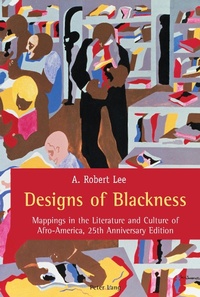
Designs of Blackness
Description

Across more than two centuries Afro-America has created a huge and dazzling variety of literary self-expression. Designs of Blackness provides less a narrative literary history than, precisely, a series of mappings-each literary-critical and comparative while at the same time offering cultural and historical context. This carefully re-edited version of the 1998 publication opens with an estimation of earliest African American voice in the names of Phillis Wheatley and her contemporaries. It then takes up the huge span of autobiography from Frederick Douglass through to Maya Angelou. "Harlem on My Mind," which follows, sets out the literary contours of America's premier black city. Womanism, Alice Walker's presiding term, is given full due in an analysis of fiction from Harriet E. Wilson to Toni Morrison. Richard Wright is approached not as some regulation "realist" but as a more inward, at times near-surreal, author. Decadology has its risks but the 1940s has rarely been approached as a unique era of war and peace and especially in African American texts. Beat Generation work usually adheres to Ginsberg and Kerouac, but black Beat writing invites its own chapter in the names of Amiri Baraka, Ted Joans and Bob Kaufman. The 1960s has long become a mythic change-decade, and in few greater respects than as a black theatre both of the stage and politics. In Leon Forrest African America had a figure of the postmodern turn: his work is explored in its own right and for how it takes its place in the context of other reflexive black fiction. "African American Fictions of Passing" unpacks the whole deceptive trope of "race" in writing from Williams Wells Brown through to Charles Johnson. The two newly added chapters pursue African American literary achievement into the Obama-Trump century, fiction from Octavia Butler to Darryl Pinkney, poetry from Rita Dove to Kevin Young.
Reviews / Votes
"This erudite compilation sets out to cover no less than the whole of what could be called the African American literary canon."-European Association for American Studies NewsletterMore details
Other editions
Additional editions