

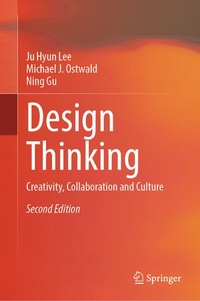
Design Thinking
Description

This book presents new ways of facilitating design thinking, through the combination of cognitive design strategies and information technologies. It provides readers with an in-depth understanding of the traditional and digital design processes and activities that are employed in architecture, computational design, communication design and graphic design. In response to evolving design practices, including the growing use of artificial intelligence (AI), this fully updated and expanded edition features a new chapter on digital design collaboration, along with extended discussions on the role of technology in shaping creative and collaborative processes.
The book is divided into three parts: Part I, which focuses on creativity, uses evidence derived from empirical studies to develop an understanding of the way computational environments shape design thinking and may lead to more inventive outcomes. Part II considers the cognitive, sociotechnical dimensions of design teams, crowds and collectives. It investigates the ways digital design platforms promote interactive and collective thinking. Lastly, Part III addresses culture, examining the linguistic and cultural context of the globalised design ecosystem.
Providing valuable insights into design thinking, this book helps readers engage with their local and global environments. It will appeal to academics, researchers and professionals with an interest in understanding design thinking in the context of creativity, collaboration and culture.
More details
Other editions
Additional editions
Persons
Dr Ju Hyun Lee is an Associate Professor of Architecture and Computational Design at UNSW Sydney. He has published over 100 research papers and made significant contributions to the fields of design computing and design cognition. Ju Hyun is Co-Director of Advanced Architectural Analytics lab (A 3 LAB) and Chair of AKA.Network. He has held multiple academic roles in Australia and South Korea. As a Senior Lecturer, he completed a five-year postdoctoral fellowship at the University of Newcastle and a Senior Research Fellowship at the University of South Australia. He is co-author, with Michael J. Ostwald, of Grammatical and Syntactical Approaches in Architecture (IGI Global 2020), and co-author, with Michael J. Ostwald and Michael J. Dawes, of Mathematical Thinking and Properties in Architecture (Birkhäuser 2025).
Dr Michael J. Ostwald is Scientia Professor of Architectural Analytics at UNSW Sydney. He has previously been a Distinguished EU Professor, a Professorial Fellow at Victoria University Wellington (New Zealand), an Adjunct Professor at RMIT University, an Australian Research Council (ARC) Future Fellow at Newcastle and a Visiting Fellow at ANU, MIT, HKU and UCLA. He holds adjunct Professorial positions at XJTLU (China) and the University of Liverpool (UK). Michael has a PhD in architectural history and theory and a DSc in design mathematics and computing. He completed postdoctoral research on geometry at the CCA (Canada), UCLA (USA) and Harvard (USA). Michael is Editor-in-Chief of the Nexus Network Journal: Architecture and Mathematics (Springer) and on the editorial boards of ARQ (Cambridge) and Architectural Theory Review (Taylor and Francis). He has authored 19 books and more than 300 research articles and chapters.
Dr Ning Gu is a Professor in Architecture at Adelaide University (anteceded by the University of South Australia and the University of Adelaide). He has been a visiting scholar/professor at Columbia University, Massachusetts Institute of Technology, Eindhoven University of Technology, and Tianjin University. Professor Gu's most significant contributions have been to research in design computing and cognition. The outcomes of his research have been documented in over 200 peer-reviewed publications. He has been supported by prestigious Australian research funding schemes from the Australian Research Council, Department of Education, and Cooperative Research Centres. He is an Associate Editor of Architectural Science Review (Taylor & Francis) and has guest edited/chaired major international journals/conferences in the field.
