

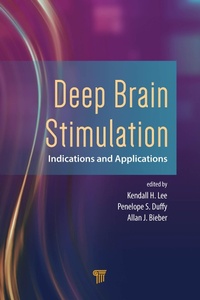
Deep Brain Stimulation
Indications and Applications
Published on 8. December 2016
486 pages
978-981-4669-90-0 (ISBN)
Description

Deep brain stimulation (DBS) is a widely used therapy for movement disorders such as Parkinson's disease, essential tremor, and dystonia. Its therapeutic success has led to the application of DBS for an increasing spectrum of conditions. However, the fundamental relationships between neural activation, neurochemical transmission, and clinical outcomes during DBS are not well understood.
Drawing on the clinical and research expertise of the Mayo Clinic Neural Engineering Laboratories, this book addresses the history of therapeutic electrical stimulation of the brain, its current application and outcomes, and theories about its underlying mechanisms. It reviews research on measures of local stimulation-evoked neurochemical release, imaging research on stimulation-induced neural circuitry activation, and the state of the art on closed-loop feedback devices for stimulation delivery.
Drawing on the clinical and research expertise of the Mayo Clinic Neural Engineering Laboratories, this book addresses the history of therapeutic electrical stimulation of the brain, its current application and outcomes, and theories about its underlying mechanisms. It reviews research on measures of local stimulation-evoked neurochemical release, imaging research on stimulation-induced neural circuitry activation, and the state of the art on closed-loop feedback devices for stimulation delivery.
Reviews / Votes
"Kendall Lee and colleagues have curated an approachable and comprehensive overview of deep brain stimulation (DBS), with topics ranging from the biophysics of neural stimulation to applications of DBS for both established and emerging clinical indications, including memory dysfunction. Also notable are discussions of active research, such as closed loop stimulation and in vivo neurochemical monitoring. This text provides an invaluable companion for clinicians, neuroscientists, engineers, and others with an interest in the current practice and frontiers of DBS."-Dr. Emad Eskandar, Massachusetts General Hospital, Harvard Medical School, USA
"The field of therapeutic deep brain stimulation is undergoing explosive growth, fueled by its early success in movement disorders and promise for many other common and debilitating brain disorders. Yet the mechanisms underlying its effects remain mysterious. This book covers diverse topics of relevance for current practitioners as well as newcomers to the field, including theoretical and mechanistic aspects, results of important clinical trials, and potential new brain targets and new indications."
-Dr. Philip A. Starr, University of California, San Francisco, USA
"This book is an important reference to the field of stereotactic and functional neurosurgery and covers the most important aspects of clinical practice and research in deep brain stimulation. It will be of great interest to those who are new to this field as well as experienced clinicians and investigators. Among many important topics, the book covers biophysical fundamentals of electrical stimulation, anatomy and physiology of neural networks relevant to movement disorders, chronic pain and behavioral disorders, ethical considerations, current indications of deep brain stimulation, and many areas of active clinical investigation."
-Dr. Andre Machado, Cleveland Clinic, USA
"This book provides a comprehensive, up-to-date description of deep brain stimulation, including its history, scientific basis, and clinical application across a vast array of neurological disorders. Although the authors are primarily from a single institution, they have done a terrific job of summarizing the state of the art, including the victories, the disappointments, and the opportunities where breakthroughs are likely next to occur. This book has tremendous value for the novice and experienced practitioner alike."
-Dr. Jonathan Miller, University Hospitals, USA
More details
Language
English
Place of publication
Singapore
Singapore
Target group
Professional and scholarly
College/higher education
Illustrations
47 Illustrations, color; 6 Illustrations, black and white
File size
12,08 MB
ISBN-13
978-981-4669-90-0 (9789814669900)
Copyright in bibliographic data and cover images is held by Nielsen Book Services Limited or by the publishers or by their respective licensors: all rights reserved.
Schweitzer Classification
Other editions
Additional editions
Kendall H. Lee | Penelope S. Duffy | Allan J. Bieber
Deep Brain Stimulation
Indications and Applications
Book
12/2016
1st Edition
Pan Stanford Publishing Pte Ltd
€192.50
Shipment within 3-4 weeks
Persons
Kendall H. Lee is a stereotactic and functional neurosurgeon at Mayo Clinic with internationally recognized expertise in deep brain stimulation. His MD and PhD are from Yale University. He is a professor in the Departments of Neurosurgery, Physiology & Biomedical Engineering, and Physical Medicine and Rehabilitation. He is director of the Neural Engineering Laboratories, focused on understanding the mechanisms of action of DBS and developing novel devices for neuromodulation.
Penelope S. Duffy is an associate director of the Neural Engineering Laboratories at Mayo Clinic with a PhD from the University of Minnesota. Dr. Duffy had a 27-year research and clinical career in neurologically based communication disorders and is the author of a graduate textbook on right hemisphere cognitive impairments. She has scientific papers in that area and in deep brain stimulation, and two books in the trade press.
Allan J. Bieber is an associate professor of Neurologic Surgery, associate director of the Neural Engineering Laboratories and of the Neurobiology of Disease Graduate Program in the Mayo Clinic College of Medicine. His PhD is in cellular and developmental biology from Harvard Medical School.
Penelope S. Duffy is an associate director of the Neural Engineering Laboratories at Mayo Clinic with a PhD from the University of Minnesota. Dr. Duffy had a 27-year research and clinical career in neurologically based communication disorders and is the author of a graduate textbook on right hemisphere cognitive impairments. She has scientific papers in that area and in deep brain stimulation, and two books in the trade press.
Allan J. Bieber is an associate professor of Neurologic Surgery, associate director of the Neural Engineering Laboratories and of the Neurobiology of Disease Graduate Program in the Mayo Clinic College of Medicine. His PhD is in cellular and developmental biology from Harvard Medical School.
Content
Introduction to Deep Brain Stimulation. Overview of the History and Application of Deep Brain Stimulation. Biophysical Fundamentals of Neural Excitation. Motor Circuit Activity in Parkinson's Disease. Neuroimaging in Deep Brain Stimulation. Ethical Considerations in the Use of Deep Brain Stimulation. Clinical Applications. Deep Brain Stimulation for Parkinson's Disease. Deep Brain Stimulation for Tremor. Deep Brain Stimulation for Dystonia. Deep Brain Stimulation for Obsessive-Compulsive Disorder. Deep Brain Stimulation for Tourette Syndrome. Deep Brain Stimulation for Treatment-Resistant Depression. Deep Brain Stimulation for Chronic Pain. Deep Brain Stimulation for Medically Refractory Epilepsy. Deep Brain Stimulation for Memory Dysfunction. Deep Brain Stimulation for Cluster Headache. Functional Electrical Stimulation for Spinal Cord Injury. Research on Mechanisms of DBS and Neuromodulation. Theories of Deep Brain Stimulation Mechanisms. The Role of Astrocytes in Deep Brain Stimulation. Electrochemical Measurements of Neurochemical Concentration. Electrodes for Neural Stimulation and Monitoring. Closed-Loop Control Systems for Deep Brain Stimulation Therapy. Molecular and Cellular Neuromodulation for Central Nervous System Injury.
