

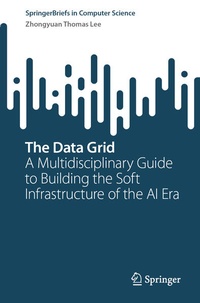
The Data Grid
Description

As industries transition from the automation focus of Industry 4.0 to the human-AI collaboration of Industry 5.0, artificial intelligence stands at the forefront. Yet the lasting capability of intelligent systems is rooted in a deeper layer: robust data infrastructures. The Data Grid argues that AI's true scalability and reliability hinge not just on algorithms, but on stable, governed, and semantically structured data systems. Across industries, fragmented and inconsistent data foundations constrain AI's potential. By redefining data as infrastructure' imbued with stability, scalability, and lifecycle continuity, this volume establishes the structural foundation for sustainable intelligence.
Drawing from systems engineering, industrial engineering, reliability theory, and risk management, this book offers a cross-disciplinary framework for building AI-native data infrastructures. While data engineering originates from computer and software engineering, in the infrastructure context, it is not and should not be confined to these disciplines. It shows how principles such as determinism, fault isolation, boundary control, and semantic layering can be adapted for enterprise-level data environments. Supported by engineering analysis and practical case studies, the book redefines data not as a static resource but as a continuously flowing soft infrastructure: an engineered backbone for resilient, long-term intelligent systems.
More details
Other editions
Additional editions
Person
Zhongyuan Thomas Lee (formerly Zhongyuan Li) is a doctoral researcher in Multidisciplinary Engineering at Texas A&M University. He also serves as a Staff Data Engineer at Compass, where he works on enterprise-scale data infrastructure. His research focuses on Industry 4.0/5.0 systems, digital twins, and AI-ready data infrastructures. He has published over twenty-five peer-reviewed papers in journals and conferences. With more than fifteen years of professional experience as a Data Engineer, he has worked across multiple industries including power grids, telecommunications, finance, and healthcare.
Content
.- Data as Soft Infrastructure in the AI Era.
.- The Foundations of Soft Data Infrastructure.
.- The Components of Soft Data Infrastructure.
.- Architecting the Soft Data Infrastructure - A Cross-Disciplinary Blueprint.
.- Data Modeling.
.- Data Lineage and Documentation.
.- Data Quality and Integrity.
.- Data Governance and Security.
.- Data Orchestration.
.- Data Consumption.
.- The Data Grid - A Forward-Looking Synthesis.
