

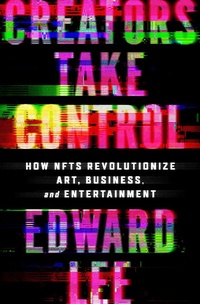
Creators Take Control
Description

A leading legal scholar offers a compelling new theory to explain the meteoric rise of non-fungible tokens (NFTs) and their impact on art, business, entertainment, and society, and explains how they are revolutionizing our understanding of ownership.
If you buy an NFT, do you own anything? Critics say no. Then why are people spending so much money to own them?to the tune of $27 billion in 2021? And why are big businesses and venture capital firms investing hundreds of millions to develop NFTs for people's use in the metaverse, a purely imaginary world?
In Creators Take Control, Edward Lee offers a compelling new theory he calls ?Tokenism? that answers these perplexing questions. Using vivid examples, Lee lucidly explains how NFTs operate?and how they fundamentally change our understanding of ownership. Tokenism is an artistic, cultural, and technological movement that creates value in a new kind of ownership of a new type of property?symbolized by a virtual token?through a process of technological abstraction and artificial scarcity effectuated by NFTs. Ownership becomes virtual. What Cubism did in radically changing the twentieth-century perspective of creating and viewing art through cubes, Tokenism does today in altering our perspective of owning art and other things through tokens. Both movements radically reimagine what's possible.
Creators and businesses have seized upon this profound transformation. In a short time, they have developed a new market for digital art, important new rights for creators, innovative business models based on decentralized collaboration, and a new type of interactive ownership that enables identity, community, and patronage through NFTs. These innovations are just the start of revolutionary changes to society. Lee shows how NFTs create a new form of decentralized intellectual property, or De-IP. Comparable to the movement to decentralized finance (DeFi), De-IP empowers creators to take control of their artistic productions and livelihood.
Lee's intellectual tour de force is filled with practical insights?and hope?for fostering creativity and a Virtual Renaissance for the ages.
More details
Other editions
Additional editions
Person
Edward Lee is a leading legal expert on NFTs and intellectual property. He is a professor of law and codirector of Illinois Institute of Technology Chicago-Kent College of Law's Center for Design, Law, and Technology, the first U.S. institution devoted to research of creativity, technology, design, and the law. His website, nouNFT.com, analyzes the latest developments in NFTs. He founded The Free Internet Project, a nonprofit whose mission is to protect Internet freedoms. He is a former contributor to the Huffington Post, and his work has been featured in outlets such as the Washington Post and Billboard. He worked on public-interest litigation as an attorney for Stanford Law School's Center for Internet and Society. An accomplished photographer, he has shown his works in group exhibitions and art fairs in New York City, Chicago, Miami, Amsterdam, and Dubai. He lives in Chicago, Illinois.
