

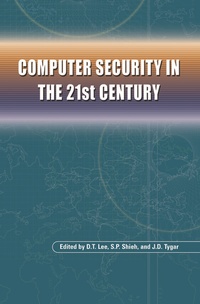
Computer Security in the 21st Century
Description

Computer Security in the 21 st Century shares some of the emerging important research trends reflected in recent advances in computer security, including: security protocol design, secure peer-to-peer and ad hoc networks, multimedia security, and intrusion detection, defense and measurement.
Highlights include presentations of :
- Fundamental new security
- Cryptographic protocols and design,
- A new way of measuring network vulnerability: attack surfaces,
- Network vulnerability and building impenetrable systems,
- Multimedia content protection including a new standard for photographic images, JPEG2000.
Researchers and computer security developers will find in this book interesting and useful insights into building computer systems that protect against computer worms, computer viruses, and other related concerns.
More details
Other editions
Additional editions
Persons
Computer Security in the 21 st Century
Edited by D.T. Lee, S.P. Shieh, and J.D. Tygar
Computer Security in the 21 st Century shares some of the emerging important research trends reflected in recent advances in computer security, including: secure security protocol design, secure peer-to-peer P2P and ad hoc networks Ad Hoc Networks, multimedia security, and intrusion detection, defense and measurement.
Highlights include presentations of:
* Fundamental new security
* Cryptographic protocols and design,
* A new way of measuring network vulnerability: attack surfaces,
* Network vulnerability and building impenetrable systems,
* Multimedia content protection including a new standard for photographic images, JPEG2000.
Researchers and computer security developers will find in this volume book interesting and useful insights into building computer systems that protect against computer worms, computer viruses, and other related concerns.
ABOUT THE AUTHORS
D. T. Lee is a Distinguished Research Fellow and Director of the Institute of Information Science at Academia Sinica. He is also a Professor in the Department of Computer Science and Information Engineering at National Taiwan University. His research interests include design and analysis of algorithms, algorithm visualization and software security.
S. P.hiuh-Pyng Shieh is a Professor in the Department of Computer Science and Information Engineering at National Chiao Tung University, and the President of Chinese Cryptographic and Information Security Association. His research interests include network security and distributed systems.
J. D. Tygar is a Professor of Computer Science and Information Management at UC Berkeley. He served as chair of the Defense Department's Study Group on Security with Privacy. Heworks in the areas of computer security, privacy, and electronic commerce. His current research includes strong privacy protections, security issues in sensor webs, and digital rights management.
