

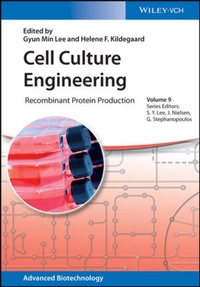
Cell Culture Engineering
Description

In Cell Culture Engineering: Recombinant Protein Production, editors Gyun Min Lee and Helene Faustrup Kildegaard assemble top class authors to present expert coverage of topics such as: cell line development for therapeutic protein production; development of a transient gene expression upstream platform; and CHO synthetic biology. They provide readers with everything they need to know about enhancing product and bioprocess attributes using genome-scale models of CHO metabolism; omics data and mammalian systems biotechnology; perfusion culture; and much more.
This all-new, up-to-date reference covers all of the important aspects of cell culture engineering, including cell engineering, system biology approaches, and processing technology. It describes the challenges in cell line development and cell engineering, e.g. via gene editing tools like CRISPR/Cas9 and with the aim to engineer glycosylation patterns. Furthermore, it gives an overview about synthetic biology approaches applied to cell culture engineering and elaborates the use of CHO cells as common cell line for protein production. In addition, the book discusses the most important aspects of production processes, including cell culture media, batch, fed-batch, and perfusion processes as well as process analytical technology, quality by design, and scale down models.
-Covers key elements of cell culture engineering applied to the production of recombinant proteins for therapeutic use
-Focuses on mammalian and animal cells to help highlight synthetic and systems biology approaches to cell culture engineering, exemplified by the widely used CHO cell line
-Part of the renowned "Advanced Biotechnology" book series
Cell Culture Engineering: Recombinant Protein Production will appeal to biotechnologists, bioengineers, life scientists, chemical engineers, and PhD students in the life sciences.
More details
Other editions
Additional editions
Persons
Helene Faustrup Kildegaard, PhD, is a senior researcher and Co-PI for the CHO Cell Line Engineering and Design section at the Novo Nordisk Foundation Center for Biosustainability at the Technical University of Denmark (DTU).
Content
2. Cell line development for therapeutic protein production
3. Development of a transient gene expression upstream platform
4. CHO genome: Enhancing product and bioprocess attributes using genome-scale models of CHO metabolism
5. Epigenetics and stability: An investigation on genome heterogeneity and stability and on what controls cell behavior
6. CHO synthetic biology
7. Omics data and mammalian systems biotechnology: an integrative framework for combining in silico modeling and multi-omics datasets in different CHO parental cell lines
8. Mammalian gene editing tools
9. Cell Engineering
10. Metabolite Profiling of Mammalian Cells
11. Application of 13C flux analysis for cell engineering
12. Host cell protein impurity
13. Batch and fed-batch culture
14. Perfusion culture
15. Process analytical technology and quality-by-design for animal cell culture
16. Development of a scale down cell culture model using multivariate analysis as a qualification tool
1
Platform Technology for Therapeutic Protein Production
Tae Kwang Ha1,*, Jae Seong Lee 1,2,*, and Gyun Min Lee 1,3
1 Technical University of Denmark, The Novo Nordisk Foundation Center for Biosustainability, Kemitorvet, 2800 Kgs. Lyngby, Denmark
2 Ajou University, Department of Molecular Science and Technology, 206 Worldcup-ro, Yeongtong-gu, 16499 Suwon, Republic of Korea
3 KAIST, Department of Biological Sciences, 291 Daehak-ro, Yuseong-gu, Daejeon, 305-701, Republic of Korea
1.1 Introduction
In 1987, the human tissue plasminogen activator (trade name: Activase®) was the first therapeutic protein produced in Chinese hamster ovary (CHO) cells to receive US Food and Drug Administration (FDA) approval, which triggered the emergence of mammalian cell culture for production of biopharmaceuticals [1]. Therapeutic proteins are effective drugs for many diseases including diabetes, rheumatoid arthritis, clotting disorders, and cancers because of their highly specific functions with reduced side effects and no immune response [2,3]. With the increasing number of therapeutic proteins, the biopharmaceutical market has expanded dramatically over the past few decades. The global market value of therapeutic proteins reached $140 billions in 2014, and AbbVie's Humira® (adalimumab), one of the profitable drugs in the biopharmaceutical industry, generated worldwide sales of $13.9 billions in 2015 [4,5].
From 2011 to 2015, 40 novel therapeutic proteins were approved by the FDA, and nearly 70% of therapeutic proteins are produced in mammalian cells, particularly CHO cells, because of their capability for humanlike post-translation modification (PTM) including glycosylation and protein folding [6]. Notably, 7 out of 10 top-selling blockbuster therapeutic proteins were produced in mammalian cells in 2015 (Table 1.1), and this trend of the prominence of mammalian manufacturing platforms over microbial manufacturing platforms will continue with the steady increase in the proportion of complex molecules in the pipeline at both the qualitative and quantitative levels [5].
Table 1.1 The 10 top-selling therapeutic proteins in 2015.
Source: Adapted from Morrison 2016 [4] and Walsh 2014 [5].
Ranking Product (active ingredient) Product category Targeta Therapeutic indication Company Approved/expiry (EU, US) 2015 Sales ($ millions) Host 1 Humira (adalimumab) Human mAb Anti-TNF Rheumatoid arthritis AbbVie & Eisai 2003, 2002/2018, 2016 13 932.00 CHO 2 Enbrel (etanercept) Fusion protein (receptor - IgG fragment) Anti-TNF Rheumatoid arthritis Amgen, Pfizer, Takeda Pharmaceuticals 2000, 1998/2015, 2028 9008.70 CHO 3 Rituxan/Mabthera (rituximab) Chimeric mAb Anti-CD20 Non-Hodgkin's lymphoma Biogen-IDEC, Roche 1998, 1997/2013, 2016 7395.00 CHO 4 Lantus (insulin glargine) Peptide rh insulin analog Diabetes mellitus Sanofi 2000, 2000/2014, 2014 7095.40 E. coli 5 Avastin (bevacizumab) Humanized mAb Anti-VEGF Metastatic colorectal cancer, glioblastoma, metastatic renal carcinoma Roche/Genentech 2005, 2004/2019, 2017 7014.20 CHO 6 Herceptin (trastuzumab) humanized mAb Anit-HER2 Breast cancer, gastric cancer Roche/Genentech 2000, 1998/2014, 2019 6862.60 CHO 7 Remicade (infliximab) Chimeric mAb Anti-TNF Crohn's disease J&J, Merck & MitsubishiTanabe Pharma 1999, 1998/2015, 2018 6826.10 Sp2/0 8 Neulasta (pegfilgrastim) Peptide PEGylated rh G-CSF Chemotherapy-induced neutropenia Amgen 2002, 2002/2015, 2014 4715.10b E. coli 9 Eylea (aflibercept) Fusion protein (receptor - IgG Fc) Anti-VEGF Neovascular (wet) age-related macular degeneration Regeneron, Bayer 2012, 2011/2020, 2021 4089.00b CHO 10 Lucentis (ranibizumab) Humanized IgG fragment Anti-VEGF Neovascular (wet) age-related macular degeneration Roche/Genentech, Novartis 2007, 2006/2016, 2016 3580.00b E. coli
a In the case of peptide products, other general names of products, not generic and trade names, are described.
b Full-year 2015 financial reports of Amgen, Regeneron, Bayer, Roche/Genentech, and Novartis.
Therapeutic protein production, however, requires time-consuming and complicated processes. In a mammalian manufacturing platform of therapeutic proteins that includes the cloning of a target gene into an appropriate expression vector, the selection of a suitable host cell line for the target product, and final processing for commercialization, many resources are required to ensure quality control at every step [6]. Furthermore, the mammalian cell culture that involves CHO cells is considered to be difficult because of low yield, complexity, price of media, and obstacles to optimization of culture conditions. Traditionally, various parameters in the production processes have had to be independently optimized for each target product because of clonal variability and product dependency. The effect of each parameter, such as the type of the host cell line, expression vector design, screening and selection methods, media composition, feed media, and culture conditions, including temperature, pH, and agitation speed, on protein productivity and product quality is highly dependent on the specific cell lines [7,8].
Along with the technical advances in the upstream process development, specific productivity of over 20 pg/cell/day and product titer of over 10 g/l have been reached in many cases in the biopharmaceutical industry [8 ,9]. The improvement of specific productivity and final yield has been achieved not only through expression vector and clone selection methods but also through the enhancement of commercial culture media and optimization of operational conditions. Today, the focus in mammalian cell culture process development has changed from higher productivity to proper and consistent quality with higher productivity at all developmental stages and at large scales [10].
In the following sections, we provide a general overview of platform technology for therapeutic protein production that has been commonly used in mammalian cell culture. Because of the complexity and diversity of the field, there is limited room to cover all the details in this chapter. Rather, we include references for more detailed information, and we devote special attention to general guidelines and considerations for bioprocess development. Then, we introduce the trends in platform technology development that are applied recently in this field (Figure 1.1).
Figure 1.1 Optimization parameters in upstream and downstream process.
1.2 Overall Trend Analysis
1.2.1 Mammalian Cell Lines
Recombinant therapeutic proteins are mainly produced in mammalian host cell lines , including NS0 murine myeloma, CHO, and human embryonic kidney (HEK) 293 cells. Humans and other mammals share a closer evolutionary lineage compared to microorganisms such as Escherichia coli (E. coli), which means that mammalian cells are suitable for the generation of complex and highly valuable humanlike proteins [11,12].
Murine NS0 cells were initially used in the production of therapeutic antibodies in the biopharmaceutical industry. NS0 cells lack endogenous glutamine synthetase (GS) enzyme activity, which makes them suitable for the use of the GS/methionine sulfoximine (MSX) amplification system. Although high antibody productivity has been achieved in GS-NS0 cells, N-glycolylneuraminic acid-bound proteins produced from NS0 cells led to an immunogenicity concern in humans. Therefore, NS0 cells have limited use in therapeutic protein production today [8 ,13].
Human cell lines including HEK293 have the ability to produce proteins mostly like natural human products, which is their main advantage over other expression systems. Recently, several therapeutic proteins produced from HEK293 cells have been...
