

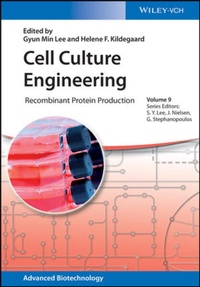
Cell Culture Engineering
Recombinant Protein Production
1st Edition
Published on 10. September 2019
440 pages
978-3-527-81138-0 (ISBN)
Description

Offers a comprehensive overview of cell culture engineering, providing insight into cell engineering, systems biology approaches and processing technology
In Cell Culture Engineering: Recombinant Protein Production, editors Gyun Min Lee and Helene Faustrup Kildegaard assemble top class authors to present expert coverage of topics such as: cell line development for therapeutic protein production; development of a transient gene expression upstream platform; and CHO synthetic biology. They provide readers with everything they need to know about enhancing product and bioprocess attributes using genome-scale models of CHO metabolism; omics data and mammalian systems biotechnology; perfusion culture; and much more.
This all-new, up-to-date reference covers all of the important aspects of cell culture engineering, including cell engineering, system biology approaches, and processing technology. It describes the challenges in cell line development and cell engineering, e.g. via gene editing tools like CRISPR/Cas9 and with the aim to engineer glycosylation patterns. Furthermore, it gives an overview about synthetic biology approaches applied to cell culture engineering and elaborates the use of CHO cells as common cell line for protein production. In addition, the book discusses the most important aspects of production processes, including cell culture media, batch, fed-batch, and perfusion processes as well as process analytical technology, quality by design, and scale down models.
-Covers key elements of cell culture engineering applied to the production of recombinant proteins for therapeutic use
-Focuses on mammalian and animal cells to help highlight synthetic and systems biology approaches to cell culture engineering, exemplified by the widely used CHO cell line
-Part of the renowned "Advanced Biotechnology" book series
Cell Culture Engineering: Recombinant Protein Production will appeal to biotechnologists, bioengineers, life scientists, chemical engineers, and PhD students in the life sciences.
In Cell Culture Engineering: Recombinant Protein Production, editors Gyun Min Lee and Helene Faustrup Kildegaard assemble top class authors to present expert coverage of topics such as: cell line development for therapeutic protein production; development of a transient gene expression upstream platform; and CHO synthetic biology. They provide readers with everything they need to know about enhancing product and bioprocess attributes using genome-scale models of CHO metabolism; omics data and mammalian systems biotechnology; perfusion culture; and much more.
This all-new, up-to-date reference covers all of the important aspects of cell culture engineering, including cell engineering, system biology approaches, and processing technology. It describes the challenges in cell line development and cell engineering, e.g. via gene editing tools like CRISPR/Cas9 and with the aim to engineer glycosylation patterns. Furthermore, it gives an overview about synthetic biology approaches applied to cell culture engineering and elaborates the use of CHO cells as common cell line for protein production. In addition, the book discusses the most important aspects of production processes, including cell culture media, batch, fed-batch, and perfusion processes as well as process analytical technology, quality by design, and scale down models.
-Covers key elements of cell culture engineering applied to the production of recombinant proteins for therapeutic use
-Focuses on mammalian and animal cells to help highlight synthetic and systems biology approaches to cell culture engineering, exemplified by the widely used CHO cell line
-Part of the renowned "Advanced Biotechnology" book series
Cell Culture Engineering: Recombinant Protein Production will appeal to biotechnologists, bioengineers, life scientists, chemical engineers, and PhD students in the life sciences.
More details
Other editions
Additional editions
Book
11/2019
1st Edition
Wiley-VCH
€165.00
Shipment within 5-7 days
Gyun Min Lee | Helene Faustrup Kildegaard
Cell Culture Engineering - Recombinant Protein Production
Software
09/2019
Wiley-VCH
€223.05
No shipping information available
Persons
Gyun Min Lee, PhD, is Professor at the Department of Biological Sciences at KAIST, South Korea, and heads the Animal Cell Engineering Laboratory. He is also Scientific Director at the Novo Nordisk Foundation Center for Biosustainability at the Technical University of Denmark.
Helene Faustrup Kildegaard, PhD, is a senior researcher and Co-PI for the CHO Cell Line Engineering and Design section at the Novo Nordisk Foundation Center for Biosustainability at the Technical University of Denmark (DTU).
Helene Faustrup Kildegaard, PhD, is a senior researcher and Co-PI for the CHO Cell Line Engineering and Design section at the Novo Nordisk Foundation Center for Biosustainability at the Technical University of Denmark (DTU).
Editor
Series Editor
Content
1. A platform technology for therapeutic protein production
2. Cell line development for therapeutic protein production
3. Development of a transient gene expression upstream platform
4. CHO genome: Enhancing product and bioprocess attributes using genome-scale models of CHO metabolism
5. Epigenetics and stability: An investigation on genome heterogeneity and stability and on what controls cell behavior
6. CHO synthetic biology
7. Omics data and mammalian systems biotechnology: an integrative framework for combining in silico modeling and multi-omics datasets in different CHO parental cell lines
8. Mammalian gene editing tools
9. Cell Engineering
10. Metabolite Profiling of Mammalian Cells
11. Application of 13C flux analysis for cell engineering
12. Host cell protein impurity
13. Batch and fed-batch culture
14. Perfusion culture
15. Process analytical technology and quality-by-design for animal cell culture
16. Development of a scale down cell culture model using multivariate analysis as a qualification tool
2. Cell line development for therapeutic protein production
3. Development of a transient gene expression upstream platform
4. CHO genome: Enhancing product and bioprocess attributes using genome-scale models of CHO metabolism
5. Epigenetics and stability: An investigation on genome heterogeneity and stability and on what controls cell behavior
6. CHO synthetic biology
7. Omics data and mammalian systems biotechnology: an integrative framework for combining in silico modeling and multi-omics datasets in different CHO parental cell lines
8. Mammalian gene editing tools
9. Cell Engineering
10. Metabolite Profiling of Mammalian Cells
11. Application of 13C flux analysis for cell engineering
12. Host cell protein impurity
13. Batch and fed-batch culture
14. Perfusion culture
15. Process analytical technology and quality-by-design for animal cell culture
16. Development of a scale down cell culture model using multivariate analysis as a qualification tool
