

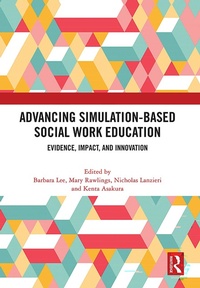
Advancing Simulation-Based Social Work Education
Evidence, Impact, and Innovation
Published on 29. May 2026
406 pages
978-1-040-94133-1 (ISBN)
Description

This book highlights the expansive and evolving developments of simulation-based learning and research in social work education and practice. Simulation-based learning is a deliberate teaching approach that uses structured, interactive, realistic scenarios, with trained actors or staged environments or with virtual or technology-enhanced platforms, that replicate real-world practice situations. These immersive experiential opportunities allow learners to develop and practice skills, receive feedback, reflect critically, and strengthen professional competencies.
This edited volume brings together leading scholars, practitioners, and educators, showcasing the innovations and emerging advancements in simulation pedagogy. The chapters in this collection explore the diverse simulation modalities used across social work education, including generalist and specialized practice contexts, interprofessional education, and cutting-edge virtual and technological applications. It offers insights into how in-person, hybrid, and fully online simulations expand teaching possibilities, enhances learning and application, and shapes the advancement of simulation-based pedagogy in social work.
This book is a valuable resource for educators, trainers, and practitioners committed to advancing evidence-informed social work education and practice in today's complex and rapidly evolving practice landscape.
The chapters in this book were originally published as a special issue in Studies in Clinical Social Work: Transforming Practice, Education, and Research.
This edited volume brings together leading scholars, practitioners, and educators, showcasing the innovations and emerging advancements in simulation pedagogy. The chapters in this collection explore the diverse simulation modalities used across social work education, including generalist and specialized practice contexts, interprofessional education, and cutting-edge virtual and technological applications. It offers insights into how in-person, hybrid, and fully online simulations expand teaching possibilities, enhances learning and application, and shapes the advancement of simulation-based pedagogy in social work.
This book is a valuable resource for educators, trainers, and practitioners committed to advancing evidence-informed social work education and practice in today's complex and rapidly evolving practice landscape.
The chapters in this book were originally published as a special issue in Studies in Clinical Social Work: Transforming Practice, Education, and Research.
More details
Language
English
Place of publication
London
United Kingdom
Publishing group
Taylor & Francis Ltd
Target group
College/higher education
Professional and scholarly
File size
7,65 MB
ISBN-13
978-1-040-94133-1 (9781040941331)
Copyright in bibliographic data and cover images is held by Nielsen Book Services Limited or by the publishers or by their respective licensors: all rights reserved.
Schweitzer Classification
Other editions
Additional editions
Barbara Lee | Mary Rawlings | Nicholas Lanzieri
Advancing Simulation-Based Social Work Education
Evidence, Impact, and Innovation
Book
05/2026
1st Edition
Routledge
€191.50
Shipment within 15-20 days
Persons
Barbara Lee is Assistant Professor at the University of British Columbia, School of Social Work. Her research focuses on evidence-informed practice with diverse children, youth, and families, and on advancing simulation-based learning to strengthen social work education.
Mary Rawlings is Professor at Azusa Pacific University in the Department of Social Work. Research interests are in competency-based social work education and the development and testing of the use of simulation in assessment of clinical practice skills.
Nicholas Lanzieri is Clinical Professor at NYU's Silver School of Social Work. His current research and scholarship is centered on the development, implementation and evaluation of simulation and online teaching and pedagogy. Dr. Lanzieri also teaches Human Behavior, Practice and Practicum related courses.
Kenta Asakura is Associate Professor at Smith College School for Social Work. Dr. Asakura's scholarly work focuses on the use of simulation in teaching and learning as well as on practice competencies informed by both clinical and critical theory.
Mary Rawlings is Professor at Azusa Pacific University in the Department of Social Work. Research interests are in competency-based social work education and the development and testing of the use of simulation in assessment of clinical practice skills.
Nicholas Lanzieri is Clinical Professor at NYU's Silver School of Social Work. His current research and scholarship is centered on the development, implementation and evaluation of simulation and online teaching and pedagogy. Dr. Lanzieri also teaches Human Behavior, Practice and Practicum related courses.
Kenta Asakura is Associate Professor at Smith College School for Social Work. Dr. Asakura's scholarly work focuses on the use of simulation in teaching and learning as well as on practice competencies informed by both clinical and critical theory.
Content
Introduction PART 1: In-person Simulation in Social Work 1. The Experiences of Peer-To-Peer Role-Play for Online Undergraduate Social Work Students 2. The Use of Simulation-Inspired Techniques as a Strategy for Onboarding Social Work Instructors 3. Training Actors: A Primer for Social Work Educators Working with Standardized Clients (SCs) in Classroom Simulations 4. Simulation-Based Learning and Relational Suicide Assessment Skills: Embodying Social Work Values in Education and Clinical Practic 5. Developing Social Work Skills Through Simulation: Exploring Student Engagement with Immigrant Youth 6. Neuroscience and Social Work: A Simulation-Based Workshop for Social Work Students 7. Clinical Simulation in Social Work: Lessons Learned From an Interprofessional End-of-Life Simulation 8. Empowering Assertiveness: Integrating Confidence into Practice to Prevent Future Burnout Through Interprofessional Simulation PART 2: Virtual Technology-enhanced Simulation in Social Work 9. Harnessing New Technology and Simulated Role Plays for Enhanced Engagement and Academic Success in Online Social Work Education 10. Impact of Simulation on Social Work Students' Attunement and Self-Awareness Skills 11. Using Simulation to Predict Clinical Practice Performance: Examining the Predictive Validity of a Virtual and In-Person OSCE 12. Teaching Note: Training the Next Generation of Social Workers Using Actors and Technology-Based Simulations 13. Enhancing Simulations: The Promise of Skills Practice for Achieving Competence in Child Welfare Work 14. Exploring the Effectiveness of Virtual Simulation-Based Learning in Enhancing Clinical Skills in Social Work Education 15. Using Experiential and Simulation-Based Learning for a Digital Field Education Lab 16. Using a Health Equity Simulation as a Teaching Tool in Social Work and Public Health Courses 17. Exploring Virtual Clinical Simulation-Based Learning with MSW Students: A Mixed-Methods Study 18. Exploring De-Escalation Through Simulation-Based Education in U.S. and Australian Social Work
