

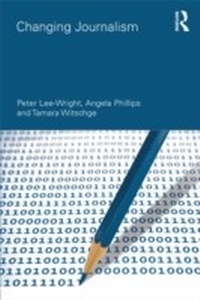
Changing Journalism
1st Edition
Published on 14. July 2011
192 pages
978-1-136-67270-5 (ISBN)
Description

Journalism is in transition. Irrevocable decisions are being made, often based on flimsy evidence, which could change not only the future of journalism, but also the future of democracy. This book, based on extensive research, provides the opportunity to reflect upon these decisions and considers how journalism could change for the better and for the good of democracy. It covers:
the business landscape
work and employment
the regulatory framework
audiences and interaction
the impact of technology on practices and content
ethics in a converged world
The book analyses research in both national and local journalism, broadcast, newspaper and online journalism, broadsheet and tabloid, drawing comparisons between the different outlets in the field of news journalism, making this essential reading for scholars and students of journalism and media studies.
the business landscape
work and employment
the regulatory framework
audiences and interaction
the impact of technology on practices and content
ethics in a converged world
The book analyses research in both national and local journalism, broadcast, newspaper and online journalism, broadsheet and tabloid, drawing comparisons between the different outlets in the field of news journalism, making this essential reading for scholars and students of journalism and media studies.
Reviews / Votes
'Although its focus is the UK, the content is pertinent for US-based readers interested in journalism, mass media, or communication. The chapters are well written, and a helpful bibliography is provided. Summing Up: Recommended. Upper-division undergraduates through faculty and professionals.' - R. A. Logan, Emeritus, University of Missouri, Columbia, CHOICE'Changing Journalism provides a solid and well-developed analysis of past predictions of change and crisis, and evaluates how those predictions have measured up. It steeps past prognostication in more critical review, and provides a platform to advance studies. Going forward, Changing Journalism has set the stage for more measured discussions about journalism in many respects, and should provide a useful reference point and resource for academics and observers of the ever-shifting changes journalism faces.' Scott Eldridge II, Digital Journalism
More details
Series
Language
English
Place of publication
London
United Kingdom
Publishing group
Taylor & Francis Ltd
Target group
College/higher education
Product notice
Reflowable
File size
1,58 MB
ISBN-13
978-1-136-67270-5 (9781136672705)
Copyright in bibliographic data and cover images is held by Nielsen Book Services Limited or by the publishers or by their respective licensors: all rights reserved.
Schweitzer Classification
Other editions
Additional editions
Peter Lee-Wright | Angela Phillips | Tamara Witschge
Changing Journalism
Book
07/2011
1st Edition
Routledge
€60.90
Shipment within 15-20 days
Peter Lee-Wright | Angela Phillips | Tamara Witschge
Changing Journalism
Book
07/2011
1st Edition
Routledge
€206.00
Shipment within 15-20 days
Persons
Peter Lee-Wright is Senior Lecturer in the Department of Media and Communications at Goldsmiths, University of London. His career as a journalist/producer ranges from the BBC World Service, the BBC Caribbean Service, the Overseas Regional Service, BBC Continuing Education, the Open University and BBC Documentaries. As an independent and freelance producer, his work ranged from award-winning documentaries to a critically acclaimed feature drama for Working Title.
Angela Phillips is Senior Lecturer in the Department of Media and Communications at Goldsmiths, University of London, where she teaches feature writing and journalism studies. She has been a journalist for over thirty years and has worked for national newspapers, magazines, television, radio and online. She is also a member of the Leverhulme Media Research Group at Goldsmiths.
Tamara Witschge is a lecturer at the Cardiff School of Journalism, Media and Cultural Studies. Tamara is the General Secretary of the European Communication Research and Education Association and is a member of the editorial board of the international journals New Media and Society, PLATFORM: Journal of Media and Communication and the Global Media Journal: German Edition.
Angela Phillips is Senior Lecturer in the Department of Media and Communications at Goldsmiths, University of London, where she teaches feature writing and journalism studies. She has been a journalist for over thirty years and has worked for national newspapers, magazines, television, radio and online. She is also a member of the Leverhulme Media Research Group at Goldsmiths.
Tamara Witschge is a lecturer at the Cardiff School of Journalism, Media and Cultural Studies. Tamara is the General Secretary of the European Communication Research and Education Association and is a member of the editorial board of the international journals New Media and Society, PLATFORM: Journal of Media and Communication and the Global Media Journal: German Edition.
Content
Introduction Part I: Changing political and economic structures of journalism Ch. 1 The changing business of news: Sustainability of news journalism Angela Phillips & Tamara Witschge Ch. 2: The Return of Hephaestus: Journalists' Work Recrafted Peter Lee-Wright Ch. 3: Who guards the gateway? Regulating journalism in fluid times Peter Lee-Wright Part II: Changing Practices Ch. 4 Doing it all in the multi-skilled universe Peter Lee-Wright & Angela Phillips Ch. 5 Faster and shallower: Homogenization, cannibalization and the death of reporting Angela Phillips Ch. 6 The 'tyranny' of technology Tamara Witschge Part III: Changing Journalism Ch. 7 Changing audiences, changing journalism? Ch. 8 Transparency and the ethics of new journalism Angela Phillips Conclusion: Changing the future of the news
