

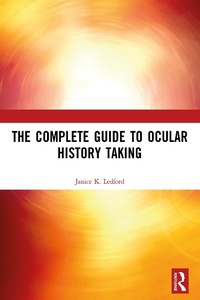
The Complete Guide to Ocular History Taking
1st Edition
Published on 28. June 2024
156 pages
978-1-040-14247-9 (ISBN)
Description

The Complete Guide to Ocular History Taking discusses many questions involved in obtaining a complete history of the patient. It offers specific questions for the technician to ask the patient in the exam room and during the history-taking process. This book advises you on condensing a narrative, patient confidentiality, and developing patient rapport. It also provides notes on ocular and systemic medications which will help you look up medications in pharmaceutical references.
This text discusses questions regarding ocular and systemic disorders, visual and physical symptoms, and medications. It also covers questions on trauma, gout, arthritis, and diabetes as well as questions for specific groups of patients such as postoperative, pregnant, geriatric, or children. Over 40 common ocular diagnoses are listed with questions to ask at follow-up visits. This text is ideal for on-the-job training or can be used as a handy reference tool while administering an exam.
Special Features
List of common ophthalmic abbreviations used in history taking. Provides notes on Health Care Financing Administration (HCFA) coding. List of systemic diseases and where they fit under review of systems. Discusses drugs that affect the eye.
This text discusses questions regarding ocular and systemic disorders, visual and physical symptoms, and medications. It also covers questions on trauma, gout, arthritis, and diabetes as well as questions for specific groups of patients such as postoperative, pregnant, geriatric, or children. Over 40 common ocular diagnoses are listed with questions to ask at follow-up visits. This text is ideal for on-the-job training or can be used as a handy reference tool while administering an exam.
Special Features
List of common ophthalmic abbreviations used in history taking. Provides notes on Health Care Financing Administration (HCFA) coding. List of systemic diseases and where they fit under review of systems. Discusses drugs that affect the eye.
More details
Series
Edition
1. Auflage
Language
English
Place of publication
London
United Kingdom
Publishing group
Taylor & Francis Ltd
Target group
Professional and scholarly
ISBN-13
978-1-040-14247-9 (9781040142479)
Copyright in bibliographic data and cover images is held by Nielsen Book Services Limited or by the publishers or by their respective licensors: all rights reserved.
Schweitzer Classification
Other editions
Additional editions
Janice K. Ledford
The Complete Guide to Ocular History Taking
Book
12/1998
1st Edition
SLACK Incorporated
€99.80
Shipment within 3-4 weeks
Person
When Janice K. Ledford (she prefers to be called Jan) began her career in ophthalmic assisting in 1982, she had very little idea of what to expect. But she wanted something she could stick with.
Her college days had been marked by excellent grades but frequent changes of her major. After 5 years of "higher learning" she graduated from Columbus College in Columbus, Georgia with an A.S. in General Studies (biology emphasis, 1978) and an A.S. in Dental Hygiene (1980). After a 2-year break to stay at home with her first child, she decided to enter the work force. But dental jobs were not forthcoming. She answered an ad for an ophthalmic assistant, after looking up "ophthalmic" in the dictionary.
She still recalls the excitement she felt when she learned there were certification levels. Here were goals to achieve! It didn't matter that she had to study on her own. With the encouragement of her employer and family, she became a Certified Ophthalmic Assistant in 1983. The next year she took the exam for Certified Ophthalmic Technician, and passed. One child, one move, and 4 years later she earned her certification as an Ophthalmic Medical Technologist.
Jan has been busy writing in the field of eye care since 1985. Eventually she formed her own company, EyeWrite Productions, and now concentrates more on the writing aspect of her career. She is the author of three ophthalmic assisting review books and the coauthor of a lay-oriented eye care book (The Crystal Clear Guide to Sight for Life, Starburst Publishers, 1996). Her work has been published in Ophthalmology, Ophthalmology World News, Annals of Ophthalmology and Glaucoma, Contact Lens Spectrum, Ophthalmic Plastic and Reconstructive Surgery, Phaco & Foldables, Ophthalmic Surgery, and The Journal of Ophthalmic Nursing and Technology, among others.
She currently works several days a month at a satellite eye clinic with Dr. Charles Kirby of Western North Carolina Eye Care Associates, and has no plans to retire. At this point it seems safe to say that she's stuck with it! Jan has expanded her writing to include nonfiction of a non-ophthalmic sort, plus fiction. Her first novel was published in 1998 (Hannah, available from Guideposts Books). For her next novel, she drew on her years of experience in researching and writing medical material. After three years of study and rewrites, The Cloning was published in 2001 (check it out at www.millenniatech.info).
Her college days had been marked by excellent grades but frequent changes of her major. After 5 years of "higher learning" she graduated from Columbus College in Columbus, Georgia with an A.S. in General Studies (biology emphasis, 1978) and an A.S. in Dental Hygiene (1980). After a 2-year break to stay at home with her first child, she decided to enter the work force. But dental jobs were not forthcoming. She answered an ad for an ophthalmic assistant, after looking up "ophthalmic" in the dictionary.
She still recalls the excitement she felt when she learned there were certification levels. Here were goals to achieve! It didn't matter that she had to study on her own. With the encouragement of her employer and family, she became a Certified Ophthalmic Assistant in 1983. The next year she took the exam for Certified Ophthalmic Technician, and passed. One child, one move, and 4 years later she earned her certification as an Ophthalmic Medical Technologist.
Jan has been busy writing in the field of eye care since 1985. Eventually she formed her own company, EyeWrite Productions, and now concentrates more on the writing aspect of her career. She is the author of three ophthalmic assisting review books and the coauthor of a lay-oriented eye care book (The Crystal Clear Guide to Sight for Life, Starburst Publishers, 1996). Her work has been published in Ophthalmology, Ophthalmology World News, Annals of Ophthalmology and Glaucoma, Contact Lens Spectrum, Ophthalmic Plastic and Reconstructive Surgery, Phaco & Foldables, Ophthalmic Surgery, and The Journal of Ophthalmic Nursing and Technology, among others.
She currently works several days a month at a satellite eye clinic with Dr. Charles Kirby of Western North Carolina Eye Care Associates, and has no plans to retire. At this point it seems safe to say that she's stuck with it! Jan has expanded her writing to include nonfiction of a non-ophthalmic sort, plus fiction. Her first novel was published in 1998 (Hannah, available from Guideposts Books). For her next novel, she drew on her years of experience in researching and writing medical material. After three years of study and rewrites, The Cloning was published in 2001 (check it out at www.millenniatech.info).
Content
Contents Chapter 1 How to Take an Ophthalmic History Chapter 2 Basic History Questions Chapter 3 Notes on Ocular and Systemic Medications Chapter 4 Systemic Disease-Related Questions Chapter 5 Symptom-Related Questions Chapter 6 Ocular Disorders-Related Questions for Follow-up Exams Chapter 7 Exam-Prompted Questions Chapter 8 Ocular Disorder-Related Questions for Follow-up Exams Chapter 9 Postoperative Questions Appendix A. Common Ophthalmic Abbreviations Appendix B. Spelling and Reference Guide for Common Drugs Bibliography Index
