

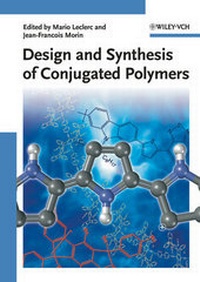
Design and Synthesis of Conjugated Polymers
1st Edition
Published on 24. June 2010
XVI, 363 pages
978-3-527-62979-4 (ISBN)
Description

This first systematic compilation of synthesis methods for different classes of polymers describes well-tested and reproducible procedures, thus saving time, money and chemicals.
Each chapter presents the latest method for a specific class of conjugated polymers with a particular emphasis on the design aspects for organo-electronic applications. In this concise and practically oriented manner, readers are introduced to the strategies of influencing and controlling the polymer properties with respect to their use in the desired device.
This style of presentation quickly helps researchers in their daily lab work and prevents them from reinventing the wheel over and over again.
Each chapter presents the latest method for a specific class of conjugated polymers with a particular emphasis on the design aspects for organo-electronic applications. In this concise and practically oriented manner, readers are introduced to the strategies of influencing and controlling the polymer properties with respect to their use in the desired device.
This style of presentation quickly helps researchers in their daily lab work and prevents them from reinventing the wheel over and over again.
More details
Other editions
Additional editions
M. Leclerc
Design and Synthesis of Conjugated Polymers
Software
05/2010
Wiley-VCH
€239.57
No shipping information available
Mario Leclerc | Jean-François Morin
Design and Synthesis of Conjugated Polymers
Book
04/2010
Wiley-VCH
€175.00
Article exhausted; check different version
Persons
Mario Leclerc was awarded a Ph.D. in chemistry from Université Laval, Quebec City, Canada, in 1987, under the guidance of Prof. R.E. Prud?homme. After a short post-doctoral stay at INRS-Energie et Matériaux near Montréal with professor L.H. Dao, he joined the Max-Planck-Institute for Polymer Research, in Mainz, Germany, as a post-doctoral fellow in the research group of Prof. Dr. G. Wegner. In 1989, he accepted a position of professor at the department of chemistry of Université de Montréal. He returned to Université Laval in 1998 where he holds since 2001 the Canada Research Chair on Electroactive and Photoactive Polymers. His current research activities include the synthesis and characterization of new conjugated oligomers and polymers for applications in micro- and nano-electronics, electro-optics, genomics, and proteomics.
Jean-François Morin is Assistant Professor at Université Laval in the Department of Chemistry. After his PhD in Chemistry under the supervision of Prof. Mario Leclerc, he went to the Tour group at Rice University in Houston, USA, as a post-doctoral research fellow and worked on the development of self-propelled nanomachines on surfaces. In 2006 he moved back to Laval where his current research activities include the synthesis and characterization of organic nanotubes, nanoscale machinery, n-type organic materials and rotaxane-based nanomaterials for surface modification.
Jean-François Morin is Assistant Professor at Université Laval in the Department of Chemistry. After his PhD in Chemistry under the supervision of Prof. Mario Leclerc, he went to the Tour group at Rice University in Houston, USA, as a post-doctoral research fellow and worked on the development of self-propelled nanomachines on surfaces. In 2006 he moved back to Laval where his current research activities include the synthesis and characterization of organic nanotubes, nanoscale machinery, n-type organic materials and rotaxane-based nanomaterials for surface modification.
Content
Polyacetylenes
Polyphenylenes
Polypyrroles
Polythiophenes
Polyphenylenevinylenes
Polyquinoxalines
Polyphenyleneethylynenes
Polyfluorenes
Polycarbazoles
Ladder-Conjugated Polymers
Conjugated Macrocycles
Polysiloles
Hybrid Conjugated Polymers
Exotic Conjugated Polymers
Polyphenylenes
Polypyrroles
Polythiophenes
Polyphenylenevinylenes
Polyquinoxalines
Polyphenyleneethylynenes
Polyfluorenes
Polycarbazoles
Ladder-Conjugated Polymers
Conjugated Macrocycles
Polysiloles
Hybrid Conjugated Polymers
Exotic Conjugated Polymers
