

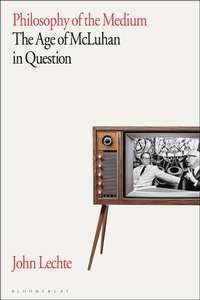
Philosophy of the Medium
The Age of Mcluhan in Question
1st Edition
Published on 19. October 2023
240 pages
978-1-350-29919-1 (ISBN)
Description

Taking the principle of the 'disappearance of the medium' into new territory, this book questions the pervasive influence of the principle that the 'medium is the message'. Bold and expansive, this book argues that we have for too long focused on the technical specificities of media, when we should have been focusing on what it is that mediums do, that is, on their 'content' rather than their formal and technical qualities.
With a re-reading of McLuhan, this volume offers a study of the conflicting views of technics as a medium in Bernard Stiegler's work as well as an investigation into the extent to which Michel Serres' work on communication sheds light on the nature of medium. Engaging also with the concept of Object-Oriented Ontology (OOO), and the notion of probabilistic objects in quantum physics and climate change, he explores the way in which measurement is perceived to 'create' reality. Concluding with a fascinating study of the implications of consciousness as a medium, this book ultimately reconsiders and offers a deeper understanding of what we mean by the term 'media': it is that which comes 'between' and which facilitates the transmission of content, essentially a creator of possibilities, yet never present as such in the light of its success as a vehicle for meaning.
With a re-reading of McLuhan, this volume offers a study of the conflicting views of technics as a medium in Bernard Stiegler's work as well as an investigation into the extent to which Michel Serres' work on communication sheds light on the nature of medium. Engaging also with the concept of Object-Oriented Ontology (OOO), and the notion of probabilistic objects in quantum physics and climate change, he explores the way in which measurement is perceived to 'create' reality. Concluding with a fascinating study of the implications of consciousness as a medium, this book ultimately reconsiders and offers a deeper understanding of what we mean by the term 'media': it is that which comes 'between' and which facilitates the transmission of content, essentially a creator of possibilities, yet never present as such in the light of its success as a vehicle for meaning.
More details
Edition
1. Auflage
Language
English
Place of publication
London
United Kingdom
Publishing group
Bloomsbury Publishing PLC
Target group
Professional and scholarly
ISBN-13
978-1-350-29919-1 (9781350299191)
Copyright in bibliographic data and cover images is held by Nielsen Book Services Limited or by the publishers or by their respective licensors: all rights reserved.
Schweitzer Classification
Other editions
Additional editions
Book
05/2025
Bloomsbury Academic
€43.70
Shipment within 15-20 days
Person
John Lechte is Professor Emeritus of Sociology at Macquarie University, Australia. He has published widely on French thought, particularly the work of Julia Kristeva. He is author of Genealogy and Ontology of the Western Image and its Digital Future (2013), which includes an analysis of Sartre's philosophy of the image. His most recent book is The Human: Bare Life and Ways of Life (Bloomsbury, 2018).
Content
Acknowledgements
Note on the Text
Introduction
1. The Meaning and Signification of 'Medium'
2. Revisiting the 'Medium is the Message': McLuhan and Medium Specificity
3. The Medium as 'Disappearance': The Work of Sybille Krämer
4. Discourse Networks, Time and Materiality: Kittler, Ernst, Krauss and the 'Post-Medium'
5. Michel Serres and Communication as Medium: Is it Possible?
6. Object and Medium: Technics in the Work of Bernard Stiegler
7. The Medium and Object-Oriented Ontology (OOO)
8. The Probabilistic Object as Hyperobject and Media Specificity
Conclusion: On Whether the Medium is Always Transparent
References
Index
Note on the Text
Introduction
1. The Meaning and Signification of 'Medium'
2. Revisiting the 'Medium is the Message': McLuhan and Medium Specificity
3. The Medium as 'Disappearance': The Work of Sybille Krämer
4. Discourse Networks, Time and Materiality: Kittler, Ernst, Krauss and the 'Post-Medium'
5. Michel Serres and Communication as Medium: Is it Possible?
6. Object and Medium: Technics in the Work of Bernard Stiegler
7. The Medium and Object-Oriented Ontology (OOO)
8. The Probabilistic Object as Hyperobject and Media Specificity
Conclusion: On Whether the Medium is Always Transparent
References
Index
