

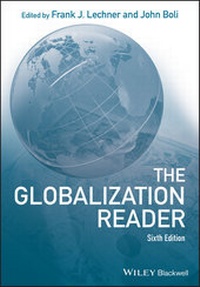
The Globalization Reader
Description

An introduction to the issues surrounding the complex and controversial realities of today's interconnected world, the revised sixth edition
Since its initial publication, The Globalization Reader has been lauded for its comprehensive coverage of the issues surrounding globalization. Now in its sixth edition, the Reader has been thoroughly revised and updated and continues to review the most important global trends. Including readings by a variety of authors, the text offers a wide-ranging and authoritative introduction to the political, economic, cultural, and experiential aspects of globalization.
The updated sixth edition presents the most accessible and comprehensive review of current debates and research. Contributions from scholars, activists, and organizations provide balanced viewpoints and expert coverage of the many aspects of globalization. The Globalization Reader offers readings on an exciting range of new topics as well as retaining key globalization topics such as the experience of globalization, economic and political globalization, the role of media and religion in cultural globalization, women's rights, environmentalism, global civil society, and the alternative globalization movement. This important resource:
- Covers the many complex dimensions of globalization
- Includes contributions from many of the most prominent globalization scholars
- Presents concise and informative introductions to each major topic
- Offers compelling discussion questions for each section
- Contains readings on a variety of new topics such as migration, medical tourism, state policy regarding abortion and same-sex sexual relations, the UN Global Compact, climate justice, and more
Written for students in undergraduate and graduate courses in sociology, political science, anthropology and geography, the revised sixth edition covers courses such as globalization, comparative political economy, international relations and similar topics.
More details
Other editions
Additional editions
Persons
Frank J. Lechner is Professor of Sociology at Emory University, USA. He is the author of The Netherlands: Globalization and National Identity (2008), Globalization: The Making of World Society (2009), and The American Exception (2017), among other publications.
John Boli is Professor Emeritus of Sociology at Emory University, USA. His publications cover world culture, global organizations, state authority, and education. He has co-authored a number of books including Constructing World Culture: International Nongovernmental Organizations Since 1875 (with George Thomas, 1999).
Content
Preface to the Sixth Edition xii
General Introduction 1
Part I Debating Globalization 7
Introduction 8
1 The Hidden Promise: Liberty Renewed 11
John Micklethwait and Adrian Wooldridge
2 How to Judge Globalism 19
Amartya Sen
3 The Elusive Concept of Globalisation 25
Cees J. Hamelink
4 The Clash of Civilizations? 32
Samuel P. Huntington
5 The Millennium Development Goals Report 2015 40
United Nations
Part I Questions 46
Part II Explaining Globalization 47
Introduction 48
6 The Modern World-System as a Capitalist World-Economy 52
Immanuel Wallerstein
7 Sociology of the Global System 59
Leslie Sklair
8 A Brief History of Neoliberalism 67
David Harvey
9 World Society and the Nation-State 73
John W. Meyer, John Boli, George M. Thomas, and Francisco O. Ramirez
10 Globalization as a Problem 82
Roland Robertson
11 Disjuncture and Difference in the Global Cultural Economy 90
Arjun Appadurai
Part II Questions 99
Part III Experiencing Globalization 101
Introduction 102
12 Waves in the History of Globalization 105
Frank J. Lechner
13 McDonald's in Hong Kong 112
James L. Watson
14 The Transnational Villagers 121
Peggy Levitt
15 Virtual Migration: The Programming of Globalization 129
Aneesh Aneesh
16 Fear and Money in Dubai 137
Mike Davis
17 Outpatients: The Astonishing New World of Medical Tourism 142
Sasha Issenberg
18 An Anthropology of Structural Violence 147
Paul Farmer
19 Crazy Like Us: The Globalization of the American Psyche 154
Ethan Watters
Part III Questions 159
Part IV Globalization and the World Economy 161
Introduction 162
20 China Makes, the World Takes 167
James Fallows
21 Commodity Chains and Marketing Strategies: Nike and the Global Athletic Footwear Industry 173
Miguel Korzeniewicz
22 The Sticky Superpower 184
The Economist
23 Global Income Inequality by the Numbers: In History and Now: An Overview 189
Branko Milanovic
24 The Bottom Billion: Why the Poorest Countries are Failing and What Can Be Done About It 194
Paul Collier
25 The Global Financial Crisis and Its Effects 200
Malcolm Edey
26 The Twin Excesses - Financialization and Globalization - Caused the Crash 207
Ashok Bardhan
27 Globalism's Discontents 210
Joseph E. Stiglitz
Part IV Questions 218
Part V Globalization and the Nation-State 219
Introduction 220
28 The Declining Authority of States 224
Susan Strange
29 Global Organized Crime 231
James H. Mittelman
30 Has Globalization Gone Too Far? 237
Dani Rodrik
31 The Individualization of Society and the Liberalization of State Policies on Same-Sex Sexual Relations, 1984-1995 244
David John Frank and Elizabeth H. McEneaney
32 Abortion Liberalization in World Society, 1960-2009 251
Elizabeth H. Boyle, Minzee Kim, and Wesley Longhofer
Part V Questions 258
Part VI Global Governance 261
Introduction 262
33 The International Monetary Fund 266
James Vreeland
34 ISO and the Infrastructure for a Global Market 273
Craig N. Murphy and JoAnne Yates
35 Global Health Governance: A Conceptual Review 280
Richard Dodgson, Kelley Lee, and Nick Drager
36 The Bill & Melinda Gates Foundation's Grant-Making Programmefor Global Health 286
David McCoy, Gayatri Kembhavi, Jinesh Patel, and Akish Luintel
37 IMPACT: Transforming Business, Changing the World - The United Nations Global Compact 291
DNV GL Group and United Nations Global Compact
Part VI Questions 297
Part VII Globalization, INGOs, and Civil Society 299
Introduction 300
38 NGOs and Climate Crisis: Fragmentation, Lines of Conflict and Strategic Approaches 304
Barbara Unmusig
39 The Evolution of Debates over Female Genital Cutting 313
Elizabeth Heger Boyle
40 Women's Human Rights and the Muslim Question: Iran's One Million Signatures Campaign 320
Rebecca L. Barlow
41 World Culture in the World Polity: A Century of International Non-Governmental Organization 328
John Boli and George M. Thomas
42 Closing the Corruption Casino: The Imperatives of a Multilateral Approach 336
Peter Eigen
43 Trading Diamonds Responsibly: Institutional Explanations for Corporate Social Responsibility 341
Franziska Bieri and John Boli
44 Poverty Capital: Microfinance and the Making of Development 348
Ananya Roy
Part VII Questions 354
Part VIII Globalization and Media 355
Introduction 356
45 Cultural Imperialism 360
John Tomlinson
46 Mapping Global Media Flow and Contra-Flow 370
Daya Kishan Thussu
47 Hybridity and the Rise of Korean Popular Culture in Asia 377
Doobo Shim
48 Landing of the Wave: Hallyu in Peru and Brazil 383
Nusta Corranza Ko, Song No, Jeong-Nam Kim, and Ronald Gobbi Simoes
49 Watching Big Brother at Work: A Production Study of Big Brother Australia 389
Jane Roscoe
50 Bollywood versus Hollywood: Battle of the Dream Factories 397
Heather Tyrrell
51 Why Hollywood Rules the World, and Whether We Should Care 405
Tyler Cowen
Part VIII Questions 411
Part IX Globalization and Religion 413
Introduction 414
52 Bin Laden and Other Thoroughly Modern Muslims 418
Charles Kurzman
53 Globalised Islam: The Search for a New Ummah 423
Olivier Roy
54 The Christian Revolution 429
Philip Jenkins
55 American Evangelicals: The Overlooked Globalizers and Their Unintended Gospel of Modernity 437
Joshua J. Yates
56 Religious Rejections of Globalization 443
Frank J. Lechner
57 The Decontexualization of Asian Religious Practices in the Context of Globalization 450
Brooke Schedneck
Part IX Questions 455
Part X Globalization and Identity 457
Introduction 458
58 Moral Choices and Global Desires: Feminine Identity in a Transnational Realm 461
Ernestine McHugh
59 Global/Indian: Cultural Politics in the IT Workplace 469
Smitha Radhakrishnan
60 Strategic Inauthenticity 476
Timothy D. Taylor
61 Orange Nation: Soccer and National Identity in the Netherlands 481
Frank J. Lechner
62 Cosmopolitans and Locals in World Culture 486
Ulf Hannerz
63 Cosmopolitanism & Humanism 492
C. Martin Centner
Part X Questions 495
Part XI Global Environmentalism 497
Introduction 498
64 Greenpeace and Political Globalism 502
Paul Wapner
65 Environmental Advocacy Networks 510
Margaret E. Keck and Kathryn Sikkink
66 Toward Democratic Governance for Sustainable Development: Transnational Civil Society Organizing around Big Dams 519
Sanjeev Khagram
67 Ozone Depletion 526
Pamela S. Chasek, David L. Downie, and Janet Welsh Brown
68 Movements for Climate Justice in the US and Worldwide 531
Brian Tokar
69 Speech of the IPCC Chairman, Rajendra K. Pachauri, at the Opening Session of the World Economic Forum, Davos, Switzerland 539
Rajendra K. Pachauri
Part XI Questions 542
Part XII Contesting Globalization: Alternatives and Opposition 545
Introduction 546
70 Counterhegemonic Globalization: Transnational Social Movements in the Contemporary Political Economy 550
Peter Evans
71 The Global Justice Movement 557
Geoffrey Pleyers
72 The Twelve Assumptions of an Alter-Globalisation Strategy 563
Gustave Massiah
73 The Global South: The WTO and Deglobalization 568
Walden Bello
74 Ecological Balance in an Era of Globalization 573
Vandana Shiva
75 Porto Alegre Call for Mobilization 582
World Social Forum
76 When and Why Nationalism Beats Globalism 585
Jonathan Haidt
77 The Globalization of Rage: Why Today's Extremism Looks Familiar 591
Pankaj Mishra
Part XII Questions 595
Index 597
General Introduction
Globalization means different things to different people. To a Korean Pentecostal missionary, it means new opportunities to spread the faith and convert lost souls abroad. To a Dominican immigrant in the United States, it means growing new roots while staying deeply involved in the home village. To an Indian television viewer, it means sampling a variety of new shows, some adapted from foreign formats. To a Chinese apparel worker, it means a chance to escape rural poverty by cutting threads off designer jeans. To an American shoe company executive, it means managing a far-flung supply chain to get products to stores. To a Filipino global justice advocate, it means rules of the global game that favor the rich North over the poor South. For all their diversity, these examples have something in common. They indicate some of the many ways in which more people become more closely connected across larger distances, and grow more aware of their connections as well. "Globalization" captures that process. Of course, new connections entail new risks, as the economic crisis that started in 2007 brought home to many people, when the troubles of Americans unable to pay their mortgages cascaded across the world economy. As the pull-back in trade and investment during that episode showed, connections can be broken, our shared awareness can be put to the test; globalization does not march forward along a smooth path. Caveats aside, however, the record of global change since World War II is quite striking: more people and places have become more interdependent and have organized their new connections in more intricate ways. For all the fault lines it still displays, a new global society, not just a world economy, has been growing all around us. How to guide its growth, how to make it work for most, and how to understand the process are key challenges of the years to come. As a way to help meet those challenges, the selections compiled in this Reader aim to describe and explain the course of globalization and the shape of its outcomes.
What does globalization involve? Globalization refers to the processes by which more people across large distances become connected in more and different ways. They can become connected very simply by doing or experiencing the same sort of thing. For example, Japanese cuisine "globalizes" when more people on different continents enjoy the taste of sushi. Since the nineteenth century soccer has become globalized as players and fans in many countries took an interest in the game. Though many people lack access to good medicine, parents the world over routinely decide to immunize their children against major diseases. These are instances of diffusion: ways of thinking, acting, or feeling spread widely. Such diffusion increased greatly in recent decades as the infrastructure for communication and transportation improved dramatically, connecting groups, institutions, and countries in new ways. The spread of sushi involved not just a shared consumer experience; it also made many American fishermen dependent on a Japanese market as tuna caught off the US coast is sold and shipped overseas. In soccer, the professional prospects of great players from South America depend on the demand from European teams. The health of many children depends on breakthroughs in distant laboratories and an intricate global system for dispensing medication; at the same time, the movement of people around the globe also exposes people to new health risks. For good and ill, such links make more people more interdependent. These links are molded into new organizational forms as regional institutions go global or new ones take shape on the world stage. For example, international law governs who can fish in coastal waters, and the World Trade Organization handles disputes between members, including the United States and Japan. FIFA is an international nongovernmental organization that sets the rules of soccer and organizes major tournaments such as the World Cup. The World Health Organization, as well as more informal networks of professionals and volunteers, organizes campaigns to address major health threats.
Such institutions, which have emerged in many areas of human activity, reflect increasingly common knowledge and awareness. Eating sushi, watching the World Cup, and getting a hepatitis B shot involve elements of world culture - the meaning of sushi, the application of the offside rule, or the reason for immunization are known to consumers, fans, and patients regardless of their location. Even if they do not know the larger structures, their everyday life is nevertheless embedded in a world culture that transcends their village, town, or country, and that becomes part of individual and collective identities. As people become more intricately connected to many others across large distances - not all people to the same extent, of course - the world is becoming a "single place." Globalization thus involves growing diffusion, expanding interdependence, more transnational institutions, and an emerging world culture and consciousness - all aspects of the connectedness at the heart of globalization, all elements of the world society globalization is creating.
Is globalization new? Many scholars point to sixteenth-century Europe as the original source of globalization. After all, the Europeans established worldwide trade connections on their own terms, brought their culture to different regions by settling vast areas, and defined the ways in which different peoples were to interact with each other. Economically and culturally, the modern world system already existed nearly five centuries ago. Others point to the late nineteenth century as a period of intense globalization, when millions migrated, trade greatly expanded, and new norms and organizations came to govern international conduct. At the beginning of the twentieth century, such scholars would stress, the movement of people, goods, and finance across national borders was at least as free and significant as it is today.
We agree that globalization has been happening for a long time. We also agree that specific features of world society have their roots in earlier periods. We add, however, that the second half of the twentieth century was a significant period of globalization in its own right. World War II gave globalization a new impetus. Obscured by Cold War divisions, the transformation of world society in the past seven decades - in terms of linkages, institutions, and culture and consciousness - was nevertheless profound. This Reader includes selections from scholars skeptical of this claim, but it also illustrates by many examples that globalization has entered a new phase.
Is globalization driven by the expanding market? The pursuit of economic opportunity has long sent merchants around the globe, and powerful states have supported their profit-seeking activities. Capitalism knows no bounds, as Marx noted more than a century ago. Marx expected the European economy to become a truly global system, and in many ways it has. In recent years, the integration of financial markets has added a new kind of interdependence. To us, this does not mean that globalization is first and foremost an economic project. While an economic system operating along capitalist lines now encompasses most regions of the world, and economic motives always have been important in creating global linkages, globalization takes place in many spheres for many reasons. The economy may be a driving force in creating global change in some periods, but its effects depend on what happens outside of world markets. To understand the world economy, then, one also needs to understand world society. Accordingly, this Reader presents a comprehensive picture of globalization, covering economic, political, cultural, and experiential dimensions.
Does globalization make the world more homogeneous? This question would seem to answer itself: If certain activities or institutions become global, they must displace existing, locally variable activities and institutions. If there are more global linkages, global institutions, and global values, presumably this means that more people will have more in common. To many critics of globalization, this seemingly neutral description is nefarious. Globalization is the work of the West, they argue. Markets set Western rules for economic activity; one kind of Western state has taken hold around the world; by controlling information flows, Western media companies shape global consciousness; the popular culture of "McWorld" is of mostly Western origin. Globalization thus entails cultural imperialism.
We agree that some things become more similar around the world as globalization proceeds. There is only one World Trade Organization and it enforces one set of trade rules; there is only one kind of bureaucratic state that societies can legitimately adopt. But we do not think this leads to a homogeneous world, for three reasons. First, general rules and models are interpreted in light of local circumstances. Thus, regions respond to similar economic constraints in different ways; countries still have great leeway in structuring their own policies; the same television program means different things to different audiences; McDonald's adapts its menu and marketing to local tastes. Second, growing similarity provokes reactions. Advocates for many cultures seek to protect their heritage or assert their identity. Witness the efforts of fundamentalists to reinstate what they consider orthodoxy, the actions of indigenous peoples to claim their right to cultural survival,...
