

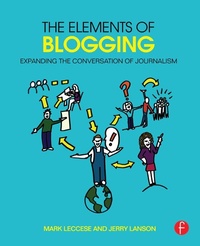
The Elements of Blogging
Expanding the Conversation of Journalism
Published on 16. July 2015
284 pages
978-1-317-69424-3 (ISBN)
Description

Becoming a blogger takes practice, hard work, and, ultimately, a passion for the craft. Whether you plan to blog on politics or parenting, The Elements of Blogging is designed to give you the skills and strategies to get started, to sustain your work, and to seek out a robust audience. This book is loaded with practical advice on important topics such as determining a niche, finding the best stories, and blogging effectively and ethically. It features examples from both amateur and professional bloggers that show the techniques for building an argument, finding a voice, crafting a headline, and establishing a brand.
Key features:
Real-world applicability. This book includes thumbnail profiles of bloggers and their sites, which illuminate key skills you will need to become an effective blogger
Interactivity. Each chapter features discussion points and exercises intended to get you to think about, reflect on, and apply the contents of each chapter
Creativity. While this book dives into software and plug-ins for bloggers, its main goal is to cover how to write blogs on a myriad of topics: news, opinion pieces, travel, politics, art, and more.
Visit the companion website: http://www.theelementsofblogging.com/
Key features:
Real-world applicability. This book includes thumbnail profiles of bloggers and their sites, which illuminate key skills you will need to become an effective blogger
Interactivity. Each chapter features discussion points and exercises intended to get you to think about, reflect on, and apply the contents of each chapter
Creativity. While this book dives into software and plug-ins for bloggers, its main goal is to cover how to write blogs on a myriad of topics: news, opinion pieces, travel, politics, art, and more.
Visit the companion website: http://www.theelementsofblogging.com/
More details
Language
English
Place of publication
London
United Kingdom
Publishing group
Taylor & Francis Ltd
Target group
College/higher education
Professional and scholarly
Illustrations
44 s/w Zeichnungen
44 Line drawings, black and white
File size
5,79 MB
ISBN-13
978-1-317-69424-3 (9781317694243)
Copyright in bibliographic data and cover images is held by Nielsen Book Services Limited or by the publishers or by their respective licensors: all rights reserved.
Schweitzer Classification
Other editions
Additional editions
Book
07/2015
1st Edition
Routledge
€209.00
Shipment within 10-20 days
Book
07/2015
1st Edition
Routledge
€64.40
Shipment within 10-20 days
Persons
Mark Leccese is an associate professor of Journalism at Emerson College. He has worked in print and online journalism for 35 years as a reporter, editor, and blogger. For several years, he was the media criticism blogger for The Boston Globe and WBUR-FM, a National Public Radio affiliate. His work has appeared in the Columbia Journalism Review, Quill, Journalism & Mass Communication Quarterly, Commonwealth, America, The Boston Globe, Boston Phoenix, and Boston Magazine.
Jerry Lanson is the author/co-author of Writing for Others, Writing for Ourselves; Writing and Reporting the News; and News in a New Century. He currently blogs for the Huffington Post and has posted several hundred blogs over the past five or six years on five different blogs. He was the first chair of the Department of Journalism at Emerson College (1999-2005) and has taught full-time on the faculties of NYU, Boston University, and Syracuse University.
Jerry Lanson is the author/co-author of Writing for Others, Writing for Ourselves; Writing and Reporting the News; and News in a New Century. He currently blogs for the Huffington Post and has posted several hundred blogs over the past five or six years on five different blogs. He was the first chair of the Department of Journalism at Emerson College (1999-2005) and has taught full-time on the faculties of NYU, Boston University, and Syracuse University.
Content
INTRODUCTION: Why Blog?
The changing blogging landscap
Who blogs and how
Blogs can be about almost anythin
Why expertise matter
Why audience matters
CHAPTER 1: Anatomy of a Blog Post
Finding a blog-worthy idea
Gathering information (with links!)
Writing a draft
Rewriting, tweaking and other improvements
Headlines, visuals, summaries
Making the text look inviting
Links and more links
Telling the world about your post
Chapter comments (linked to website)
CHAPTER 2: Two Models: Reporter Blogger vs. Op-ed Blogger
What kind of journalist do you want to be?
How to blog effectively
The basics of writing and reporting a news blog (being a reporter, organizing and writing your reporter blog post, the lede, the body)
Blogging your opinions
Tips for writing a strong opinion blog post
Reflective assignment & exercise
Chapter comments (linked to website)
CHAPTER 3: Getting Started
Choosing a blog topic (why a niche matters)
Naming your blog
Checking out the competition
Where to get ideas, find resources to tap regularly (social media, hub blog communities, finding experts)
Establishing a focus (carrowing your topic, writing a focus statement, outlining to help organize, looking ahead instead of behind
Finding and using links (getting to the original source, giving varied views)
Building an audience (the importance of regular posts, varying your pace, keeping a reserve file, pushing out, Rome wasn't built in a day: Be patient)
Chapter comments (linked to website)
CHAPTER 4: Blogging as rap
The pleasure of playing with words
Let's get loose: Stretching exercises
Hearing the written word (varying cadence and pace, alliteration, sibilance and all that linguistic rhythm, reading your work out loud)
Small scenes can deliver big stories
How to find your voice (the right tone for your subject; different blogs, different voices; how the pros establish a voice)
Chapter comments (linked to website)
CHAPTER 5: Striking up a Conversation
Giving your readers their say
When to engage those who comment - and how
Dealing with spammers, bots and other headaches
Chapter comments (linked to website)
CHAPTER 6: Why Headlines Matter
Two seconds and they're gone
Clear and direct trumps clever
Why keywords count
The elements of good headlines (specificity, S-V-O, watch for multiple meanings, look forward, tell it with a twist, bad breaks, on deck [how second decks supply more news])
Chapter breaks carry the reader forward
Chapter comments (linked to website)
CHAPTER 7: Beyond Words
Words aren't always best: Choosing the right medium
Picturebook: Telling a story with a photo blog (one picture can be an entire story, words and cutlines working together, slideshows)
I am a radio station: Podcasts (choosing a recording device, natural sound, sound and the imagination)
Some of this, some of that: tumbleblogs (how media can complement one another, each element is its own story, choosing the right media)
TV Reality: Video blogs
Chapter comments (linked to website)
CHAPTER 8: Making Universal Connections with Stories of Everyday Life
Inventorying your own life
Thinking small
The power of universal connections
Be a character in your own story
A little humor can go a long way
Chapter comments (linked to website)
CHAPTER 9: On the Road Again: The Travel Blog
Gathering string (connections can take time to sort)
Using the senses to take readers with you
Write about a place through its people
Don't be breezy, be specific
Using dialogue to tell story
Simple stories work best
Take lots of pictures: People like to see things
Chapter comments (linked to website)
CHAPTER 10: Blogging about Politics and Journalism
Read a lot and mix up your reading
Find a place to stand
Build a single, strong argument
How to structure an argument
Show your readers where your facts came from
Be a voice, not an echo
Chapter comments (linked to website)
CHAPTER 11: Consider This: Advice and Reviews
Remember the three S rule: Be succinct, simple and sincere
This is your show: Don't be afraid to offer an opinion
Do base that opinion on facts
Incorporate other experts and (once again) link like crazy
Mix advice and demonstration
Build your own club
Chapter comments (linked to website)
CHAPTER 12: Building your blogging brand
Picking a name that resonates
Twitter, Facebook, LinkedIn and who knows what's next
Johnny Blogseed: Wherever you go, spread your blog
You're not just a blog, you're a person
From pixels to ink: Getting your posts published in old media
Chapter comments (linked to website)
CHAPTER 13: Looking ahead
Going mobile
New tools for bloggers - and followers
Growing by collaborating
Subscription blogs
The supremacy of quality
Chapter comments (linked to website)
APPENDICES: Two bloggers & their work
The changing blogging landscap
Who blogs and how
Blogs can be about almost anythin
Why expertise matter
Why audience matters
CHAPTER 1: Anatomy of a Blog Post
Finding a blog-worthy idea
Gathering information (with links!)
Writing a draft
Rewriting, tweaking and other improvements
Headlines, visuals, summaries
Making the text look inviting
Links and more links
Telling the world about your post
Chapter comments (linked to website)
CHAPTER 2: Two Models: Reporter Blogger vs. Op-ed Blogger
What kind of journalist do you want to be?
How to blog effectively
The basics of writing and reporting a news blog (being a reporter, organizing and writing your reporter blog post, the lede, the body)
Blogging your opinions
Tips for writing a strong opinion blog post
Reflective assignment & exercise
Chapter comments (linked to website)
CHAPTER 3: Getting Started
Choosing a blog topic (why a niche matters)
Naming your blog
Checking out the competition
Where to get ideas, find resources to tap regularly (social media, hub blog communities, finding experts)
Establishing a focus (carrowing your topic, writing a focus statement, outlining to help organize, looking ahead instead of behind
Finding and using links (getting to the original source, giving varied views)
Building an audience (the importance of regular posts, varying your pace, keeping a reserve file, pushing out, Rome wasn't built in a day: Be patient)
Chapter comments (linked to website)
CHAPTER 4: Blogging as rap
The pleasure of playing with words
Let's get loose: Stretching exercises
Hearing the written word (varying cadence and pace, alliteration, sibilance and all that linguistic rhythm, reading your work out loud)
Small scenes can deliver big stories
How to find your voice (the right tone for your subject; different blogs, different voices; how the pros establish a voice)
Chapter comments (linked to website)
CHAPTER 5: Striking up a Conversation
Giving your readers their say
When to engage those who comment - and how
Dealing with spammers, bots and other headaches
Chapter comments (linked to website)
CHAPTER 6: Why Headlines Matter
Two seconds and they're gone
Clear and direct trumps clever
Why keywords count
The elements of good headlines (specificity, S-V-O, watch for multiple meanings, look forward, tell it with a twist, bad breaks, on deck [how second decks supply more news])
Chapter breaks carry the reader forward
Chapter comments (linked to website)
CHAPTER 7: Beyond Words
Words aren't always best: Choosing the right medium
Picturebook: Telling a story with a photo blog (one picture can be an entire story, words and cutlines working together, slideshows)
I am a radio station: Podcasts (choosing a recording device, natural sound, sound and the imagination)
Some of this, some of that: tumbleblogs (how media can complement one another, each element is its own story, choosing the right media)
TV Reality: Video blogs
Chapter comments (linked to website)
CHAPTER 8: Making Universal Connections with Stories of Everyday Life
Inventorying your own life
Thinking small
The power of universal connections
Be a character in your own story
A little humor can go a long way
Chapter comments (linked to website)
CHAPTER 9: On the Road Again: The Travel Blog
Gathering string (connections can take time to sort)
Using the senses to take readers with you
Write about a place through its people
Don't be breezy, be specific
Using dialogue to tell story
Simple stories work best
Take lots of pictures: People like to see things
Chapter comments (linked to website)
CHAPTER 10: Blogging about Politics and Journalism
Read a lot and mix up your reading
Find a place to stand
Build a single, strong argument
How to structure an argument
Show your readers where your facts came from
Be a voice, not an echo
Chapter comments (linked to website)
CHAPTER 11: Consider This: Advice and Reviews
Remember the three S rule: Be succinct, simple and sincere
This is your show: Don't be afraid to offer an opinion
Do base that opinion on facts
Incorporate other experts and (once again) link like crazy
Mix advice and demonstration
Build your own club
Chapter comments (linked to website)
CHAPTER 12: Building your blogging brand
Picking a name that resonates
Twitter, Facebook, LinkedIn and who knows what's next
Johnny Blogseed: Wherever you go, spread your blog
You're not just a blog, you're a person
From pixels to ink: Getting your posts published in old media
Chapter comments (linked to website)
CHAPTER 13: Looking ahead
Going mobile
New tools for bloggers - and followers
Growing by collaborating
Subscription blogs
The supremacy of quality
Chapter comments (linked to website)
APPENDICES: Two bloggers & their work
