

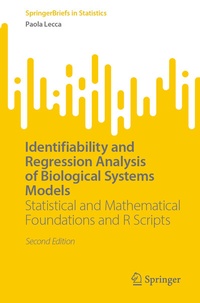
Identifiability and Regression Analysis of Biological Systems Models
Description

This richly illustrated book presents the latest techniques for the identifiability analysis and standard and robust regression analysis of complex dynamical models, and looks at their objectives. It begins by providing a definition of complexity in dynamic systems, introducing the concepts of system size, density of interactions, stiff dynamics, and the hybrid nature of determination. The discussion then turns to the mathematical foundations of model structural and practical identifiability analysis, multilinear and non-linear regression analysis, and best predictor selection, and their algorithmic procedures.
Although the featured examples mainly focus on applications to biochemistry and systems biology, the methodologies described can also be employed in other disciplines such as physics and the environmental sciences. Readers will learn how to determine identifiability conditions, how to search for an identifiable model, and how to conduct their own regression analysis and diagnostics without supervision.
This new edition includes a concise, yet comprehensive treatment of the main artificial intelligence methods which can be used for parameter inference in models of complex dynamic biological systems. It emphasizes the most efficient solutions for generating synthetic data that augment the training data and which are indispensable for machine learning procedures.
Featuring a wealth of real-world examples, exercises, and R codes, the book addresses the needs of doctoral students and researchers in bioinformatics, bioengineering, systems biology, biophysics, biochemistry, the environmental sciences and experimental physics. Familiarity with the fundamentals of probability and statistics (as provided in first-year university courses) and a basic grasp of R are assumed.
More details
Other editions
Additional editions
Person
Paola Lecca is a Theoretical Physicist trained in Computer Science and Telecommunications, with a long teaching experience at university level in mathematical analysis, probability and statistics. Dr. Lecca is Assistant Professor at the Faculty of Engineering of the Free University of Bozen-Bolzano, where she carries out research activities in the fields of graph theory, modelling and analysis of dynamic networks, statistical inference, mainly in the application domains of bioinformatics, computational biology, biophysics and drug development. Alongside her research activities, Paola Lecca carries out technology transfer activities at the Smart Data Factory laboratory of the Faculty of Engineering at the University of Bolzano-Bozen to promote the results of technological advances and transfer them from academia to industry. Dr. Lecca is a member of various national and international centres and institutions. She is member of the Advisory Board of the AIR Institute (International Research Institute Foundation for Artificial Intelligence and Computer, Salamanca, Spain). She is Senior Professional Member of Association for Computing Machinery (New York USA), where she contributes to the development and dissemination of numerical methods for high performing software for complex dynamical network simulation. Dr. Lecca is also a member of National Institute of High Mathematics 'Francesco Severi' (Rome, Italy) and Italian Society of Pure and Applied Biophysics. Dr. Lecca has authored over a hundred articles in international scientific journals and conference proceedings in computational biology, biophysics and applied mathematics, and carries on an intense editorial activity for various international journals and publishing houses.
Content
- 1. Complex Systems, Data and Inference.- 2. Dynamic Models.- 3. Model Identifiability.- 4. Regression and Variable Selection.- 5. Parameter Estimation using Artificial Intelligence.- 6. R Scripts.
