

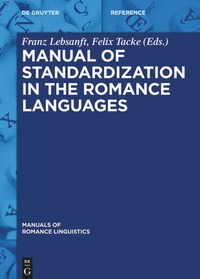
Manual of Standardization in the Romance Languages
Description

Language standardization is an ongoing process based on the notions of linguistic correctness and models. This manual contains thirty-six chapters that deal with the theories of linguistic norms and give a comprehensive up-to-date description and analysis of the standardization processes in the Romance languages.
The first section presents the essential approaches to the concept of linguistic norm ranging from antiquity to the present, and includes individual chapters on the notion of linguistic norms and correctness in classical grammar and rhetoric, in the Prague School, in the linguistic theory of Eugenio Coseriu, in sociolinguistics as well as in pragmatics, cognitive and discourse linguistics.
The second section focuses on the application of these notions with respect to the Romance languages. It examines in detail the normative grammar and the normative dictionary as the reference tools for language codification and modernization of those languages that have a long and well-established written tradition, i.e. Romanian, Italian, French, Catalan, Spanish, and Portuguese.
Furthermore, the volume offers a discussion of the key issues regarding the standardization of the 'minor' Romance languages as well as Creoles.
More details
Other editions
Additional editions
Persons
Content
- Intro
- Manuals of Romance Linguistics
- Preface
- Table of Contents
- Abbreviations
- Introduction
- 0. Romance Standardology: Roots and Traditions
- Theories of Linguistic Norm
- 1. Linguistic Norm in Classical Grammar and Rhetoric
- 2. Linguistic Norm in the Prague School of Linguistics
- 3. Linguistic Norm in the Linguistic Theory of Eugenio Coseriu
- 4. Linguistic Norm in Sociolinguistics
- 5. Linguistic Norm in Linguistic Pragmatics
- 6. Linguistic Norm in Cognitive Linguistics
- 7. Linguistic Norm in Discourse Linguistics
- 8. Romanian
- 8.1 Orthography and Orthoepy
- 8.2 Normative Grammars
- 8.3 Normative Dictionaries
- 8.4 Dictionaries of Language Difficulties
- 9. Italian
- 9.1 Orthography and Orthoepy
- 9.2 Normative Grammars
- 9.3 Normative Dictionaries
- 9.4 Dictionaries of Language Difficulties
- 10. French
- 10.1 Orthography and Orthoepy
- 10.2 Normative Grammars
- 10.3 Normative Dictionaries
- 10.4 Dictionaries of Language Difficulties
- 11. Catalan
- 11.1 Orthography and Orthoepy
- 11.2 Normative Grammars
- 11.3 Normative Dictionaries
- 11.4 Dictionaries of Language Difficulties
- 12. Spanish
- 12.1 Orthography and Orthoepy
- 12.2 Normative Grammars
- 12.3 Normative Dictionaries
- 12.4 Dictionaries of Language Difficulties
- 13. Portuguese
- 13.1 Orthography and Orthoepy
- 13.2 Normative Grammars
- 13.3 Normative Dictionaries
- 13.4 Dictionaries of Language Difficulties
- 14. "Minor" Romance Languages
- 14.1 "Minor" Italo-Romance Languages
- 14.2 "Minor" Gallo-Romance Languages
- 14.3 "Minor" Ibero-Romance Languages
- 14.4 Romance-based Creoles
- Index of subjects
