

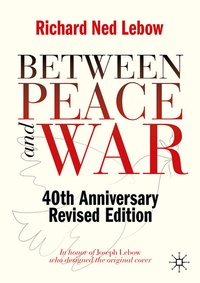
Between Peace and War
40th Anniversary Revised Edition
Published on 31. August 2020
XLIX, 519 pages
978-3-030-43443-4 (ISBN)
Description

This is an updated edition of the now-classic original of the same title. It has three new substantial chapters: a prologue, a chapter on new evidence on World War I, and an epilogue. The updated edition contains the now-famous typology of international crisis, the original critique of deterrence, the emphasis on agency, and the turn to political psychology to explain sharp departures from rational policy-making. The new chapters update and reevaluate these arguments and approach a critical hindsight assessment in light of post-Cold War developments.
Reviews / Votes
'The passage of time has underscored the importance of Between Peace and War, and this new addition includes valuable further developing the typology of crises, updating the analysis of the origins of World War I, strengthening the critique of deterrence, and discussing the evolution of Lebow's thinking. It deserves a place on every scholar's bookshelf-and in his or her thinking.' - Robert Jervis, author of How Statesmen Think 'Why write about a research project begun 50 years ago, resulting in a book published 40 years ago? Read this edition of Between Peace and War, and you will definitely know why. It is a treasure trove of thought about compelling questions of peace and war. Whether or not you agree with all or many of Lebow's angles, byways, and major conclusions, your ideas will be stimulated, sharpened, and enriched. The book is brilliant in its ambition and achievement.' - Ken Booth, Distinguished Research Professor, Department of International Politics, Aberystwyth University, UK 'Perhaps true wisdom is never conventional, and if so, then Ned Lebow's first opus is as wise as it is unconventional. He demonstrated, against the grain of the then-dominant model of rational deterrence theory, that not only do states challenge what are supposed to be credible deterrent threats, but deterrent threats themselves may be the source of such challenges. Many of the studies that exist now demonstrating the flaws of traditional deterrence theory were inspired by Between Peace and War, and its findings remain all too relevant today.' - Ted Hopf, Provost Chair Professor, Department of Political Science, National University of SingaporeMore details
Series
Edition
1st ed. 2020
Language
English
Place of publication
Cham
Switzerland
Publishing group
Springer International Publishing
Product notice
Reflowable
Illustrations
XLIX, 519 p. 3 illus.
File size
4,43 MB
ISBN-13
978-3-030-43443-4 (9783030434434)
DOI
10.1007/978-3-030-43443-4
Schweitzer Classification
Other editions
Additional editions
Book
09/2020
Palgrave Macmillan
€53.49
Shipment within 7-9 days
Person
Richard Ned Lebow
is Professor of International Political Theory at Kings College London, UK.
Content
1. Introduction.- Part I: The Origins of Crisis.- 2 Justification of Hostility.- 3. Spinoff Crises.- 4. Brinkmanships.- Part II: The Politics of Crisis.- 5. Cognitive Closure and Crisis Politics.- 6. The Sources of Misperception.- 7. The Context of Crisis.- 8. Crisis Management and Beyond.- Part III: Crisis and International Relations.- 9. Crisis as a Learning Experience.- 10. Conclusions.- 11. World War I, Crisis Management, and International Relations Theory (2020).
