

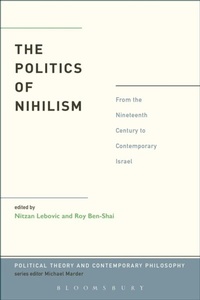
The Politics of Nihilism
From the Nineteenth Century to Contemporary Israel
1st Edition
Published on 25. September 2014
256 pages
978-1-62356-698-2 (ISBN)
Description

Contemporary politics is faced, on the one hand, with political stagnation and lack of a progressive vision on the side of formal, institutional politics, and, on the other, with various social movements that venture to challenge modern understandings of representation, participation,and democracy. Interestingly, both institutional and anti-institutional sides of this antagonism tend to accuse each other of "nihilism", namely, of mere oppositional destructiveness and failure to offer a constructive, positive alternative to the status quo. Nihilism seems, then, all engulfing.
In order to better understand this political situation and ourselves within it,The Politics of Nihilism proposes a thorough theoretical examination of the concept of nihilism and its historical development followed by critical studies of Israeli politics and culture. The authors show that, rather than a mark of mutual opposition and despair, nihilism is a fruitful category for tracing and exploring the limits of political critique, rendering them less rigid and opening up a space of potentiality for thought, action, and creation.
In order to better understand this political situation and ourselves within it,The Politics of Nihilism proposes a thorough theoretical examination of the concept of nihilism and its historical development followed by critical studies of Israeli politics and culture. The authors show that, rather than a mark of mutual opposition and despair, nihilism is a fruitful category for tracing and exploring the limits of political critique, rendering them less rigid and opening up a space of potentiality for thought, action, and creation.
Reviews / Votes
This original and challenging volume traces the development of the concept of nihilism from a stunning variety of perspectives and theoretical positions. Combining precision, erudition and intellectual commitment, The Politics of Nihilism makes a convincing case for a view of nihilism as a vital force in a political constellation increasingly hostile to dissonant voices. A lucidly argued and greatly enriching book for anyone interested in the past, present and future of radical political critique. * Vivian Liska, Professor of German Literature, University of Antwerp, Belgium * The Politics of Nihilism is a major contribution to critical studies, and a necessary book for anyone interested in the meaning and history of nihilism and its political relevance in our time. * Simon Critchley, Hans Jonas Professor, New School for Social Research, US. * Can a democratic and liberal politics not be nihilist-and be radically neutral with respect to the choice of values? This book is the result of a seminal work done by a group of Israeli intellectuals and philosophers who are sensible to the problem of equality of citizens in a society that, in as much as it does not accept in principle the polytheism of values to which nihilism leads, is also threatened by an internal revolt that often has wanted to claim equality through the use of the nihilistic weapon of suicide terrorism. Precisely these reasons give birth to the contemporary relevance of the topic in Israel, which is analyzed in these collected essays-with extreme critical balance and secular spirit-as much in its theoretical self-contradictions as in its ethical implications. But apart from the specific problem of the state of Israel as a "Jewish state," which is based upon the acceptance of a religious faith, the question of political nihilism has a general dimension, because it concerns all democratic societies that are continually confronted with the problem of finding a solid rational basis for the laws of their communities. * Gianni Vattimo, Emeritus Professor of Philosophy, University of Turin, Italy *More details
Series
Edition
1. Auflage
Language
English
Place of publication
New York
United States
Publishing group
Bloomsbury Publishing PLC (Digital)
ISBN-13
978-1-62356-698-2 (9781623566982)
Copyright in bibliographic data and cover images is held by Nielsen Book Services Limited or by the publishers or by their respective licensors: all rights reserved.
Schweitzer Classification
Other editions
Additional editions
Nitzan Lebovic | Roy Ben-Shai
The Politics of Nihilism
From the Nineteenth Century to Contemporary Israel
Book
11/2014
Bloomsbury Academic USA
€63.39
Shipment within 3-4 weeks
Persons
Nitzan Lebovic is the Apter Chair of Holocaust Studies and Ethical Values at Lehigh University (PA).
Roy Ben-Shai is a Mellon Post-Doctoral Fellow and Visiting Assistant Professor of Peace, Justice and Human Rights at Haverford College (PA).
Roy Ben-Shai is a Mellon Post-Doctoral Fellow and Visiting Assistant Professor of Peace, Justice and Human Rights at Haverford College (PA).
Content
Introduction (Roy Ben-Shai and Nitzan Lebovic)
Chapter 1 Nihilism as Stasis: A Plea for a New Hermeneutics of Exposure (Nitzan Lebovic)
Chapter 2 Less than Nihilism (Luca Di Blasi)
Chapter 3 Doing Nothing or Nothing Doing? (Michael Gillespie)
Chapter 4 A Concept of Nihilism for the Coming End of the World (Adi Ophir)
Chapter 5 Nihilism, Revolt, and the Spectacle (Buelent Diken)
Chapter 6 The Epistemology of Nihilism in Otto Weininger's Sex and Character (Bettina Bergo)
Chapter 7 In Sickness and in Health: Nietzsche, Amery and the "Moral Difference" (Roy Ben-Shai)
Chapter 8 Nihilism and Repetition. Dahlia Ravikovitch's Reiterations as Critique (Liron Mor)
Chapter 9 What is a "Manifestly Illegal" Order? Law and Politics after Yoram Kaniuk's Nevelot (Itamar Mann)
Chapter 10 To Be at Home: Spaces of Citizenship in the Community Settlements of the Galilee (Fatina Abreek-Zubeidat and Ronen Ben-Arie)
Bibliography
Index
Chapter 1 Nihilism as Stasis: A Plea for a New Hermeneutics of Exposure (Nitzan Lebovic)
Chapter 2 Less than Nihilism (Luca Di Blasi)
Chapter 3 Doing Nothing or Nothing Doing? (Michael Gillespie)
Chapter 4 A Concept of Nihilism for the Coming End of the World (Adi Ophir)
Chapter 5 Nihilism, Revolt, and the Spectacle (Buelent Diken)
Chapter 6 The Epistemology of Nihilism in Otto Weininger's Sex and Character (Bettina Bergo)
Chapter 7 In Sickness and in Health: Nietzsche, Amery and the "Moral Difference" (Roy Ben-Shai)
Chapter 8 Nihilism and Repetition. Dahlia Ravikovitch's Reiterations as Critique (Liron Mor)
Chapter 9 What is a "Manifestly Illegal" Order? Law and Politics after Yoram Kaniuk's Nevelot (Itamar Mann)
Chapter 10 To Be at Home: Spaces of Citizenship in the Community Settlements of the Galilee (Fatina Abreek-Zubeidat and Ronen Ben-Arie)
Bibliography
Index
