

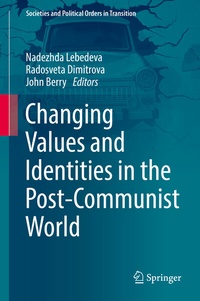
Changing Values and Identities in the Post-Communist World
Description

More details
Other editions
Additional editions
Persons
Content
Introduction.- Democratic Values in the Post-Communist Region: The Incidence of Traditionalists, Skeptics, Democrats, and Radicals.- Emancipative Values in a Post-Communist Society - The Case of Serbia.- Changes in Value Structure among the Estonian Majority and the Russian-speaking Minority in Post-socialist Estonia.- Intergenerational Value Differences in Latvia and Azerbaijan.- The Values and Social Identity of Russian Muslims.- Intergenerational Transmission of Values in Urban and Rural Areas of Russia: the Role of Perceived Psychological Closeness.- Parenting Values and Practices across Post-Communist Societies in Youth Identity Formation: A literature Review.- Values of Ethnic Russian Minority Members in North Caucasus Republics of the Russian Federation: An Inter- and Intragenerational Comparison.- Values and Religious Identity of Russian Students from Different Religions.- Value Similarity with Mothers and Peers, and Family Climate as Predictors of Well-Being of Russian Youth in Latvia.- Generational Belonging and Historical Ruptures: Continuity and Discontinuity of Values and Attitudes in Post-Communist Romania.- Multiple Social Identities in Relation to Self-Esteem of Adolescents in Post-Communist Albania, Bulgaria, Czech Republic, Kosovo and Romania.- Probing the relationship between group identities of Russians and Ossetians in the Republic of North Ossetia-Alania: Intergenerational analysis.- Ethnic Identity and Cultural Value Orientations of Moldavian Youth in Transitional Society.- The Influence of Identity Styles on Adolescents Psychological Problems in Post- Communist AlbaniaThe Influence of Identity Styles on Adolescents Psychological Problems in Post- Communist Albania.- The Kaleidoscope of Language, Ethnicity, and Identity in Uzbekistan.- The Role of Social Disidentification in Acculturation Preferences of Ethnic Majority and Minority Members in Kabardino-Balkar Republic.- The Great Escape: Linking Youth Identity Development to Growing Up in Post-communist Romania.- Negotiating Identity and Belonging after Regime Change: Hungarian Society and Roma in Post-Communist Hungary.- Cultural Identification among Immigrants from the Former USSR: Insights from Comparative Research with Five Groups in Germany and Israel.- Value changes in adolescents' anticipation of possible career selves in Slovenia and Serbia Identity and Work Ethic of Peasants in the Context of the Post-Soviet Socio-Economic Transformation.- Conclusion.
