

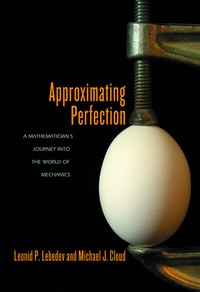
Approximating Perfection
A Mathematician's Journey into the World of Mechanics
1st Edition
Published on 5. December 2016
232 pages
978-1-4008-7325-8 (ISBN)
Description

This is a book for those who enjoy thinking about how and why Nature can be described using mathematical tools. Approximating Perfection considers the background behind mechanics as well as the mathematical ideas that play key roles in mechanical applications.
Concentrating on the models of applied mechanics, the book engages the reader in the types of nuts-and-bolts considerations that are normally avoided in formal engineering courses: how and why models remain imperfect, and the factors that motivated their development. The opening chapter reviews and reconsiders the basics of calculus from a fully applied point of view; subsequent chapters explore selected topics from solid mechanics, hydrodynamics, and the natural sciences.
Emphasis is placed on the logic that underlies modeling in mechanics and the many surprising parallels that exist between seemingly diverse areas. The mathematical demands on the reader are kept to a minimum, so the book will appeal to a wide technical audience.
Concentrating on the models of applied mechanics, the book engages the reader in the types of nuts-and-bolts considerations that are normally avoided in formal engineering courses: how and why models remain imperfect, and the factors that motivated their development. The opening chapter reviews and reconsiders the basics of calculus from a fully applied point of view; subsequent chapters explore selected topics from solid mechanics, hydrodynamics, and the natural sciences.
Emphasis is placed on the logic that underlies modeling in mechanics and the many surprising parallels that exist between seemingly diverse areas. The mathematical demands on the reader are kept to a minimum, so the book will appeal to a wide technical audience.
All prices
More details
Language
English
Place of publication
Princeton, NJ
United States
Publishing group
De Gruyter
Target group
Professional and scholarly
Edition type
Digital original
Product notice
Reflowable
Illustrations
35 line illus.
File size
1,43 MB
ISBN-13
978-1-4008-7325-8 (9781400873258)
Schweitzer Classification
Other editions
Additional editions

Leonid P. Lebedev | Michael J. Cloud
Approximating Perfection
A Mathematician's Journey into the World of Mechanics
Book
07/2015
Princeton University Press
€26.50
Shipment within 10-20 days

Leonid P. Lebedev | Michael J. Cloud
Approximating Perfection
A Mathematician's Journey into the World of Mechanics
Book
05/2004
Princeton University Press
€59.42
Article exhausted; check different version
Persons
Leonid P. Lebedev is Professor of Mathematics at the National University of Colombia and Professor of Mechanics and Mathematics at Rostov State University in Russia. He is the author of Functional Analysis in Mechanics and Functional Analysis: Applications in Mechanics and Inverse Problems. Michael J. Cloud is Professor of Electrical and Computer Engineering at Lawrence Technological University. He is the author of Inequalities with Applications to Engineering and Electromagnetics. Lebedev and Cloud also coauthored Tensor Analysis, and The Calculus of Variations and Functional Analysis with Optimal Control and Applications in Mechanics.
Content
Preface vii
Chapter 1. The Tools of Calculus 1
1.1 Is Mathematical Proof Necessary? 2
1.2 Abstraction, Understanding, Infinity 6
1.3 Irrational Numbers 8
1.4 What Is a Limit? 11
1.5 Series 15
1.6 Function Continuity 19
1.7 How to Measure Length 21
1.8 Antiderivatives 33
1.9 Definite Integral 35
1.10 The Length of a Curve 42
1.11 Multidimensional Integrals 44
1.12 Approximate Integration 47
1.13 On the Notion of a Function 52
1.14 Differential Equations 53
1.15 Optimization 59
1.16 Petroleum Exploration and Recovery 61
1.17 Complex Variables 63
1.18 Moving On 65
Chapter 2. The Mechanics of Continua 67
2.1 Why Do Ships Float? 67
2.2 The Main Notions of Classical Mechanics 71
2.3 Forces, Vectors, and Objectivity 74
2.4 More on Forces; Statics 76
2.5 Hooke's Law 80
2.6 Bending of a Beam 84
2.7 Stress Tensor 94
2.8 Principal Axes and Invariants of the Stress Tensor 100
2.9 On the Continuum Model and Limit Passages 102
2.10 Equilibrium Equations 104
2.11 The Strain Tensor 108
2.12 Generalized Hooke's Law 113
2.13 Constitutive Laws 114
2.14 Boundary Value Problems 115
2.15 Setup of Boundary Value Problems of Elasticity 118
2.16 Existence and Uniqueness of Solution 120
2.17 Energy; Minimal Principle for a Spring 126
2.18 Energy in Linear Elasticity 128
2.19 Dynamic Problems of Elasticity 132
2.20 Oscillations of a String 134
2.21 Lagrangian and Eulerian Descriptions of Continuum Media 137
2.22 The Equations of Hydrodynamics 140
2.23 D'Alembert-Euler Equation of Continuity 142
2.24 Some Other Models of Hydrodynamics 144
2.25 Equilibrium of an Ideal Incompressible Liquid 145
2.26 Force on an Obstacle 148
Chapter 3. Elements of the Strength of Materials 151
3.1 What Are the Problems of the Strength of Materials? 151
3.2 Hooke's Law Revisited 152
3.3 Objectiveness of Quantities in Mechanics Revisited 157
3.4 Plane Elasticity 159
3.5 Saint-Venant's Principle 161
3.6 Stress Concentration 163
3.7 Linearity vs. Nonlinearity 165
3.8 Dislocations, Plasticity, Creep, and Fatigue 166
3.9 Heat Transfer 172
3.10 Thermoelasticity 175
3.11 Thermal Expansion 177
3.12 A Few Words on the History of Thermodynamics 178
3.13 Thermodynamics of an Ideal Gas 180
3.14 Thermodynamics of a Linearly Elastic Rod 182
3.15 Stability 186
3.16 Static Stability of a Straight Beam 188
3.17 Dynamical Tools for Studying Stability 193
3.18 Additional Remarks on Stability 195
3.19 Leak Prevention 198
Chapter 4. Some Questions of Modeling in the Natural Sciences 201
4.1 Modeling and Simulation 201
4.2 Computerization and Modeling 203
4.3 Numerical Methods and Modeling in Mechanics 206
4.4 Complexity in the Real World 208
4.5 The Role of the Cosine in Everyday Measurements 209
4.6 Accuracy and Precision 211
4.7 How Trees Stand Up against the Wind 213
4.8 Why King Kong Cannot Be as Terrible as in the Movies 216
Afterword 219
Recommended Reading 221
Index 223
Chapter 1. The Tools of Calculus 1
1.1 Is Mathematical Proof Necessary? 2
1.2 Abstraction, Understanding, Infinity 6
1.3 Irrational Numbers 8
1.4 What Is a Limit? 11
1.5 Series 15
1.6 Function Continuity 19
1.7 How to Measure Length 21
1.8 Antiderivatives 33
1.9 Definite Integral 35
1.10 The Length of a Curve 42
1.11 Multidimensional Integrals 44
1.12 Approximate Integration 47
1.13 On the Notion of a Function 52
1.14 Differential Equations 53
1.15 Optimization 59
1.16 Petroleum Exploration and Recovery 61
1.17 Complex Variables 63
1.18 Moving On 65
Chapter 2. The Mechanics of Continua 67
2.1 Why Do Ships Float? 67
2.2 The Main Notions of Classical Mechanics 71
2.3 Forces, Vectors, and Objectivity 74
2.4 More on Forces; Statics 76
2.5 Hooke's Law 80
2.6 Bending of a Beam 84
2.7 Stress Tensor 94
2.8 Principal Axes and Invariants of the Stress Tensor 100
2.9 On the Continuum Model and Limit Passages 102
2.10 Equilibrium Equations 104
2.11 The Strain Tensor 108
2.12 Generalized Hooke's Law 113
2.13 Constitutive Laws 114
2.14 Boundary Value Problems 115
2.15 Setup of Boundary Value Problems of Elasticity 118
2.16 Existence and Uniqueness of Solution 120
2.17 Energy; Minimal Principle for a Spring 126
2.18 Energy in Linear Elasticity 128
2.19 Dynamic Problems of Elasticity 132
2.20 Oscillations of a String 134
2.21 Lagrangian and Eulerian Descriptions of Continuum Media 137
2.22 The Equations of Hydrodynamics 140
2.23 D'Alembert-Euler Equation of Continuity 142
2.24 Some Other Models of Hydrodynamics 144
2.25 Equilibrium of an Ideal Incompressible Liquid 145
2.26 Force on an Obstacle 148
Chapter 3. Elements of the Strength of Materials 151
3.1 What Are the Problems of the Strength of Materials? 151
3.2 Hooke's Law Revisited 152
3.3 Objectiveness of Quantities in Mechanics Revisited 157
3.4 Plane Elasticity 159
3.5 Saint-Venant's Principle 161
3.6 Stress Concentration 163
3.7 Linearity vs. Nonlinearity 165
3.8 Dislocations, Plasticity, Creep, and Fatigue 166
3.9 Heat Transfer 172
3.10 Thermoelasticity 175
3.11 Thermal Expansion 177
3.12 A Few Words on the History of Thermodynamics 178
3.13 Thermodynamics of an Ideal Gas 180
3.14 Thermodynamics of a Linearly Elastic Rod 182
3.15 Stability 186
3.16 Static Stability of a Straight Beam 188
3.17 Dynamical Tools for Studying Stability 193
3.18 Additional Remarks on Stability 195
3.19 Leak Prevention 198
Chapter 4. Some Questions of Modeling in the Natural Sciences 201
4.1 Modeling and Simulation 201
4.2 Computerization and Modeling 203
4.3 Numerical Methods and Modeling in Mechanics 206
4.4 Complexity in the Real World 208
4.5 The Role of the Cosine in Everyday Measurements 209
4.6 Accuracy and Precision 211
4.7 How Trees Stand Up against the Wind 213
4.8 Why King Kong Cannot Be as Terrible as in the Movies 216
Afterword 219
Recommended Reading 221
Index 223

