

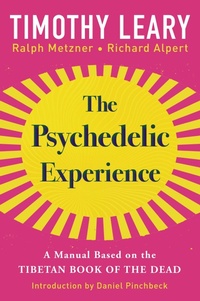
The Psychedelic Experience
Published on 9. April 2024
144 pages
978-0-8065-4459-5 (ISBN)
Description

Years after the Summer of Love, the promise of the psychoactive 1960s-that deeper self-awareness and greater harmony can be achieved through reality-bending substances and practices-is close to becoming a mainstream phenomenon. The signs are everywhere, from a renewed interest in the therapeutic effects of LSD to the popularity of ayahuasca trips and the annual spectacle of Burning Man.
The Psychedelic Experience, created by the prophetic shaman-professors Timothy Leary, Ralph Metzner, and Richard Alpert (Ram Dass), is a foundational text that serves as a model and a guide for all subsequent mind-expanding inquiries. Based on a unique interpretation of The Tibetan Book of the Dead, The Psychedelic Experience remains a vital testament to broadening spiritual consciousness through a combination of Tibetan meditation techniques and psychotropic substances.
For a new generation seeking the trip of a lifetime, The Psychedelic Experience is the essential guidebook to getting there.
The Psychedelic Experience, created by the prophetic shaman-professors Timothy Leary, Ralph Metzner, and Richard Alpert (Ram Dass), is a foundational text that serves as a model and a guide for all subsequent mind-expanding inquiries. Based on a unique interpretation of The Tibetan Book of the Dead, The Psychedelic Experience remains a vital testament to broadening spiritual consciousness through a combination of Tibetan meditation techniques and psychotropic substances.
For a new generation seeking the trip of a lifetime, The Psychedelic Experience is the essential guidebook to getting there.
More details
Other editions
Additional editions
Timothy Leary
The Psychedelic Experience Manual
Book
02/2003
Citadel Press Inc.,U.S.
€34.84
Article not available
Persons
Timothy Leary; Richard Alpert; Ralph Metzner
Content
- Intro
- Title Page
- Copyright Page
- Dedication
- Table of Contents
- Introduction (2007)
- I. - GENERAL INTRODUCTION
- A Tribute to W. Y. Evans-Wentz
- A Tribute to Carl G. Jung
- A Tribute to Lama Anagarika Govinda
- II. - THE TIBETAN BOOK OF THE DEAD
- First Bardo: The Period of Ego-Loss or Non-Game Ecstasy
- Part I: The Primary Clear Light Seen at the Moment of Ego-Loss
- Part II: The Secondary Clear Light Seen Immediately After Ego-Loss
- Second Bardo: The Period of Hallucinations
- Introduction
- Explanation of the Second Bardo
- The Peaceful Visions
- The Wrathful Visions
- Conclusion of Second Bardo
- Third Bardo: The Period of Re-entry
- Introduction
- I. General Description of the Third Bardo
- II. Re-entry Visions
- III. The All-Determining Influence of Thought
- IV. Judgment Visions
- V. Sexual Visions
- VI. Methods for Preventing the Re-Entry
- VII. Methods of Choosing the Post-Session Personality
- General Conclusion
- III. - SOME TECHNICAL COMMENTS ABOUT PSYCHEDELIC SESSIONS
- Use of This Manual
- Planning a Session
- Drugs and Dosages
- Preparation
- The Setting
- The Psychedelic Guide
- Composition of the Group
- Follow-up
- IV. - INSTRUCTIONS FOR USE DURING A PSYCHEDELIC SESSION
- First Bardo Instructions
- Second Bardo Preliminary Instructions
- Instructions for Vision 1: The Source (Eyes closed, external stimuli ignored)
- Instructions for Physical Symptoms
- Instructions for Vision 2: The Internal Flow of Archetypal Processes (Eyes closed, external stimuli ignored
- intellectual aspects)
- Instructions for Vision 3: The Fire-Flow of Internal Unity (Eyes closed, external stimuli ignored, emotional aspects)
- Instructions for Vision 4: The Wave-Vibration Structure of External Forms (Eyes open, rapt involvement with external visual stimuli, intellectual aspects)
- Instructions for Vision 5: The Vibratory Waves of External Unity (Eyes open
- rapt involvement with external stimuli such as lights, or movements
- emotional aspects)
- Instructions for Vision 6: "The Retinal Circus"
- Instructions for Vision 7: "The Magic Theatre"
- Instructions for the Wrathful Visions
- Third Bardo: Preliminary Instructions
- Instructions for Re-entry Visions
- Instructions for the All-Determining Influence of Thought
- Instructions for Judgment Visions
- Instructions for Sexual Visions
- Four Methods of Preventing Re-entry
- First Method: Meditation on the Buddha
- Second Method: Meditation on Good Games
- Third Method: Meditation on Illusion
- Fourth Method: Meditation on the Void
- Instructions for Choosing the Post-Session Personality
- Notes
