

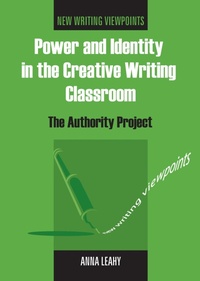
Power and Identity in the Creative Writing Classroom
The Authority Project
Published on 11. November 2005
240 pages
978-1-84769-626-7 (ISBN)
Description

Power and Identity In the Creative Writing Classroom remaps theories and practices for teaching creative writing at university and college level. This collection critiques well-established approaches for teaching creative writing in all genres and builds a comprehensive and adaptable pedagogy based on issues of authority, power, and identity. A long-needed reflection, this book shapes creative writing pedagogy for the 21st century.
Reviews / Votes
Power and Identity in the Creative Writing Classroom, edited by Anna Leahy, serves as a fine example of this expanding, improving conversation on the teaching of creative writing. This book is generative, ranging and substantial. It is a book I wish I had read before I taught my first creative writing workshop. This is an impressive collection. Among other issues, The Authority Project addresses power dynamics in the classroom, assumptions about the roles of students and teachers in creative writing, gendering in creative writing, and how best to teach students in this complicated classroom space. To its credit, the collection provides no prescriptions. Authority, as all teachers know, is a central dynamic in the classroom, and this collection should be of use to creative writing teachers and others who want to learn more about it. * Eric Burger, Pedagogy 7:1 *More details
Series
Language
English
Place of publication
Bristol
United Kingdom
Publishing group
Channel View Publications Ltd
Target group
Professional and scholarly
ISBN-13
978-1-84769-626-7 (9781847696267)
Copyright in bibliographic data and cover images is held by Nielsen Book Services Limited or by the publishers or by their respective licensors: all rights reserved.
Schweitzer Classification
Other editions
Additional editions
E-Book
11/2005
Multilingual Matters
€14.49
Available for download
Book
11/2005
Multilingual Matters
€37.40
Shipment within 10-20 days
Person
Anna Leahy is Associate Professor of English, Associate Director of the MFA in Creative Writing, and Director of Undergraduate Research and Creative Activity at Chapman University, USA. She has published widely on creative writing pedagogy, as well as creative non-fiction and poetry. She is the editor of TAB: The Journal of Poetry & Poetics.
Content
Foreword - Anna Leahy
Part 1: Understanding the Larger Influences
1. Personal Therapeutic Writing vs. Literary Writing - Nancy Kuhl
2. Who Cares-and How: The Value and Cost of Nurturing - Anna Leahy
3. Inspiration, Creativity, and Crisis: The Romantic Myth of the Writer Meets the Contemporary Classroom - Brent Royster
4. Reinventing Writing Classrooms: The Combination of Creating and Composing - Evie Yoder Miller
5. The Double Bind and Stumbling Blocks: A Case Study as an Argument for Authority-Conscious Pedagogy - Carl Vandermeulen
Part 2: The Teacher's Place, Voice, and Style
6. Teaching and Evaluation: Why Bother? - Mary Cantrell
7. Who's the Teacher?: From Student to Mentor - Audrey Petty
8. The Pregnant Muse: Assumptions, Authority, and Accessibility - Rachel Hall
9. Dismantling Authority: Teaching What We Do Not Know - Katharine Haake
Part 3: Course Design
10. Contracts, Radical Revision, Portfolios, and the Risks of Writing - Wendy Bishop
11. An 'A' for Effort: How Grading Policies Shape Courses - Suzanne Greenberg
12. Gender and Authorship: How Assumptions Shape Perceptions and Pedagogies - Susan Hubbard
13. Writing the Community: Service Learning in Creative Writing - Argie Manolis
Part 4: In the Classroom
14. Where Do You Want Me To Sit?: Defining Authority through Metaphor - Cathy Day
15. Duck, Duck, Turkey: Using Encouragement To Structure Workshop Assignments - Mary Swander
16. How To Avoid Workshop Dilemmas: The Use of Myth to Teach Writerly Concepts - Amy Sage Webb
17. Writing in the Shadows: Topics, Models, and Audiences that Focus on Language - Sandy Feinstein
Afterword
The Reason It Is: the Rhyme It Isn't - Graeme Harper and Stephanie Vanderslice
Part 1: Understanding the Larger Influences
1. Personal Therapeutic Writing vs. Literary Writing - Nancy Kuhl
2. Who Cares-and How: The Value and Cost of Nurturing - Anna Leahy
3. Inspiration, Creativity, and Crisis: The Romantic Myth of the Writer Meets the Contemporary Classroom - Brent Royster
4. Reinventing Writing Classrooms: The Combination of Creating and Composing - Evie Yoder Miller
5. The Double Bind and Stumbling Blocks: A Case Study as an Argument for Authority-Conscious Pedagogy - Carl Vandermeulen
Part 2: The Teacher's Place, Voice, and Style
6. Teaching and Evaluation: Why Bother? - Mary Cantrell
7. Who's the Teacher?: From Student to Mentor - Audrey Petty
8. The Pregnant Muse: Assumptions, Authority, and Accessibility - Rachel Hall
9. Dismantling Authority: Teaching What We Do Not Know - Katharine Haake
Part 3: Course Design
10. Contracts, Radical Revision, Portfolios, and the Risks of Writing - Wendy Bishop
11. An 'A' for Effort: How Grading Policies Shape Courses - Suzanne Greenberg
12. Gender and Authorship: How Assumptions Shape Perceptions and Pedagogies - Susan Hubbard
13. Writing the Community: Service Learning in Creative Writing - Argie Manolis
Part 4: In the Classroom
14. Where Do You Want Me To Sit?: Defining Authority through Metaphor - Cathy Day
15. Duck, Duck, Turkey: Using Encouragement To Structure Workshop Assignments - Mary Swander
16. How To Avoid Workshop Dilemmas: The Use of Myth to Teach Writerly Concepts - Amy Sage Webb
17. Writing in the Shadows: Topics, Models, and Audiences that Focus on Language - Sandy Feinstein
Afterword
The Reason It Is: the Rhyme It Isn't - Graeme Harper and Stephanie Vanderslice
