

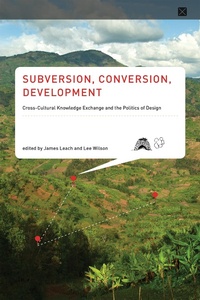
Subversion, Conversion, Development
Description

This book explores alternative cultural encounters with and around information technologies. These encounters are alternative because they counter dominant, Western-oriented notions of media consumption; they include media practices as forms of cultural resistance and subversion, "DIY cultures,” and other nonmainstream models of technology production. The contributors—leading thinkers in science and technology studies, anthropology, and software design—pay special attention to the specific inflections that different cultures and communities give to the value of knowledge. The richly detailed accounts presented here challenge the dominant view of knowledge as a neutral good—information available for representation and encoding but separated from all social relations.
The chapters examine specific cases in which the forms of knowledge and cross-cultural encounters are shaping technology use and development. They consider design, use, and reuse of technological tools, including databases, GPS devices, books, and computers, in locations that range from Australia and New Guinea to Germany and the United States.
Contributors Poline Bala, Alan Blackwell, Wade Chambers, Michael Christie, Hildegard Diemberger, Stephen Hugh-Jones, James Leach, Jerome Lewis, Dawn Nafus, Gregers Petersen, Marilyn Strathern, David Turnbull, Helen Verran, Laura Watts, Lee Wilson
More details
Other editions
Additional editions

Persons
Lee Wilson is a Postdoctoral Research Fellow at the School of Political Science and International Studies at the University of Queensland.
James Leach is Professor of Anthropology and ARC Future Fellow at the School of Social and Cultural Studies at the University of Western Australia and Directeur de Recherche at the Centre National de la Recherche Scientifique/CREDO, France.
Lee Wilson is a Postdoctoral Research Fellow at the School of Political Science and International Studies at the University of Queensland.
Laura Watts is a poet, writer, ethnographer of futures, and Interdisciplinary Senior Lecturer in Energy and Society in the School of Geosciences at the University of Edinburgh. As a science and technology studies scholar she has explored the effect of ?edge? landscapes on how the future is imagined and made. She is coauthor of Ebban an' Flowan, the world's first poetic primer for marine renewable energy, and in 2017 she won the International Cultural Innovation Prize with the Reconstrained Design Group for a community-built energy storage device designed from scrap.
Alan Blackwell is Reader in Interdisciplinary Design in the Computer Laboratory at the University of Cambridge and a Fellow of Darwin College, Cambridge.
James Leach is Professor of Anthropology and ARC Future Fellow at the School of Social and Cultural Studies at the University of Western Australia and Directeur de Recherche at the Centre National de la Recherche Scientifique/CREDO, France.
Lee Wilson is a Postdoctoral Research Fellow at the School of Political Science and International Studies at the University of Queensland.
