

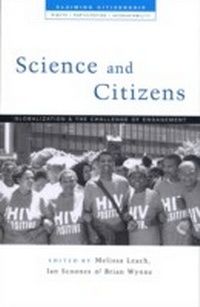
Science and Citizens
Globalization and the Challenge of Engagement
1st Edition
Published on 29. February 2008
304 pages
978-1-84813-169-9 (ISBN)
Description

Rapid advances and new technologies in the life sciences - such as biotechnologies in health, agricultural and environmental arenas - pose a range of pressing challenges to questions of citizenship. This volume brings together for the first time authors from diverse experiences and analytical traditions, encouraging a conversation between science and technology and development studies around issues of science, citizenship and globalisation. It reflects on the nature of expertise; the framing of knowledge; processes of public engagement; and issues of rights, justice and democracy. A wide variety of pressing issues is explored, such as medical genetics, agricultural biotechnology, occupational health and HIV/AIDS. Drawing upon rich case studies from Asia, Africa, Latin America and Europe, Science and Citizens asks:
? Do new perspectives on science, expertise and citizenship emerge from comparing cases across different issues and settings?
? What difference does globalisation make?
? What does this tell us about approaches to risk, regulation and public participation?
? How might the notion of 'cognitive justice' help to further debate and practice?
? Do new perspectives on science, expertise and citizenship emerge from comparing cases across different issues and settings?
? What difference does globalisation make?
? What does this tell us about approaches to risk, regulation and public participation?
? How might the notion of 'cognitive justice' help to further debate and practice?
Reviews / Votes
The overall admirable aim of the book, consisting of provocative and well-written essays, is to bring together modern work in science studies and disciplines devoted to investigating global and national development. * Christopher Lawrence, UCL * Makes a major contribution to debates about the relationship between science and society. * Bulletin of the Food Ethics Council * [Highlighting] the politics in science and how science has in the past been used by the establishment to consolidate its power...the book is an example of what a genuine ideological and intellectual commitment to the philosophy of participation can produce. * Development and Change * This volume is a unique blend of two, hitherto separate, streams of work - science and technology studies and development studies. * Steve Rayner, University of Oxford * The global scope of the case-studies, and of its theoretical and normative perspectives is particularly novel and a uniquely valuable contribution to some of the world's most pressing issues. * Ulrich Beck, University of Munich *More details
Series
Edition
1. Auflage
Language
English
Place of publication
London
United Kingdom
Publishing group
Bloomsbury Publishing PLC
Target group
College/higher education
Professional and scholarly
ISBN-13
978-1-84813-169-9 (9781848131699)
Copyright in bibliographic data and cover images is held by Nielsen Book Services Limited or by the publishers or by their respective licensors: all rights reserved.
Schweitzer Classification
Other editions
Additional editions
Melissa Leach | Ian Scoones | Brian Wynne
Science and Citizens
Globalization and the Challenge of Engagement
Book
01/2005
Zed Books Ltd
€119.04
Article exhausted; check different version
Melissa Leach | Ian Scoones | Brian Wynne
Science and Citizens
Globalization and the Challenge of Engagement
Book
01/2005
Zed Books Ltd
€51.90
Shipment within 3-4 weeks
Persons
Professor Melissa Leach is a social anthropologist and Professorial Fellow of the Institute of Development Studies at the University of Sussex.
Ian Scoones is a Professorial Fellow with the Environment Group, of which he has been team leader in the past. He came to IDS in 1995 from the International Institute of Environment and Development in London.
Professor Brian Wynne is Professor of Science Studies at the Institute for Environment, Philosophy and Public Policy, Furness College, Lancaster University
Ian Scoones is a Professorial Fellow with the Environment Group, of which he has been team leader in the past. He came to IDS in 1995 from the International Institute of Environment and Development in London.
Professor Brian Wynne is Professor of Science Studies at the Institute for Environment, Philosophy and Public Policy, Furness College, Lancaster University
Content
Foreword - John Gaventa
Part I: Science and Citizenship
1. Introduction: Science, citizenship and globalization - Melissa Leach, Ian Scoones and Brian Wynne
2. Science and citizenship in a global context - Melissa Leach and Ian Scoones
Part II: Beyond risk: defining the terrain
Commentary - Melissa Leach, Ian Scoones and Brian Wynne
3. The post-normal science of safety - Jerry Ravetz
4. Are scientists irrational? Risk assessment in practical reason - Frank Fischer
5. Risk as globalizing 'democratic' discourse? Framing subjects and citizens - Brian Wynne
6. Knowledge, justice and democracy -Shiv Visvanathan
Part III: Citizens engaging with science
Commentary - Melissa Leach, Ian Scoones, Brian Wynne
7. Myriad stories: Constructing expertise and citizenship in discussions of the new genetics - Richard Tutton, Anne Kerr and Sarah Cunningham-Burley
8. AIDS, science and citizenship after apartheid - Steven Robins
9. Demystifying occupational and environmental health: Experiences from India- Murlidhar V.
10. Absentee expertise: Science advice for biotechnology regulation in developing countries - Kees Jansen and Esther Roquas
11. Interrogating China's biotechnology revolution: Contesting dominant science policy cultures in the risk society - James Keeley
12. Environmental perception and political mobilization in Rio de Janeiro and Sao Paulo: A comparative analysis - Angela Alonso and Valeriano Costa
13. 'Let Them Eat Cake': GM Foods and the Democratic Imagination - Sheila Jasanoff
14. Plant biotechnology and the rights of the poor: A technographic approach - Paul Richards
Part IV: Participation and the politics of engagement
Commentary - Melissa Leach, Ian Scoones, Brian Wynne
15. Opening up or closing down? Analysis, participation and power in the social appraisal of technology - Andy Stirling
16. Geographic information systems for participation - John Forrester and Steve Cinderby
17. Democratizing science in the UK: The case of radioactive waste management - Jason Chilvers
18. Genetic engineering in Aotearoa New Zealand: A case of opening up or closing down debate? - Audley Genus and Tee Rogers-Hayden
19. Exploring food and farming futures in Zimbabwe: A citizens' jury and scenario workshop experiment - Elijah Rusik
Part I: Science and Citizenship
1. Introduction: Science, citizenship and globalization - Melissa Leach, Ian Scoones and Brian Wynne
2. Science and citizenship in a global context - Melissa Leach and Ian Scoones
Part II: Beyond risk: defining the terrain
Commentary - Melissa Leach, Ian Scoones and Brian Wynne
3. The post-normal science of safety - Jerry Ravetz
4. Are scientists irrational? Risk assessment in practical reason - Frank Fischer
5. Risk as globalizing 'democratic' discourse? Framing subjects and citizens - Brian Wynne
6. Knowledge, justice and democracy -Shiv Visvanathan
Part III: Citizens engaging with science
Commentary - Melissa Leach, Ian Scoones, Brian Wynne
7. Myriad stories: Constructing expertise and citizenship in discussions of the new genetics - Richard Tutton, Anne Kerr and Sarah Cunningham-Burley
8. AIDS, science and citizenship after apartheid - Steven Robins
9. Demystifying occupational and environmental health: Experiences from India- Murlidhar V.
10. Absentee expertise: Science advice for biotechnology regulation in developing countries - Kees Jansen and Esther Roquas
11. Interrogating China's biotechnology revolution: Contesting dominant science policy cultures in the risk society - James Keeley
12. Environmental perception and political mobilization in Rio de Janeiro and Sao Paulo: A comparative analysis - Angela Alonso and Valeriano Costa
13. 'Let Them Eat Cake': GM Foods and the Democratic Imagination - Sheila Jasanoff
14. Plant biotechnology and the rights of the poor: A technographic approach - Paul Richards
Part IV: Participation and the politics of engagement
Commentary - Melissa Leach, Ian Scoones, Brian Wynne
15. Opening up or closing down? Analysis, participation and power in the social appraisal of technology - Andy Stirling
16. Geographic information systems for participation - John Forrester and Steve Cinderby
17. Democratizing science in the UK: The case of radioactive waste management - Jason Chilvers
18. Genetic engineering in Aotearoa New Zealand: A case of opening up or closing down debate? - Audley Genus and Tee Rogers-Hayden
19. Exploring food and farming futures in Zimbabwe: A citizens' jury and scenario workshop experiment - Elijah Rusik
