

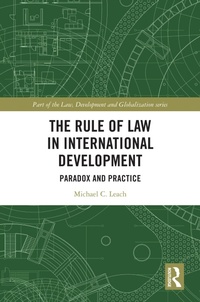
The Rule of Law in International Development
Paradox and Practice
1st Edition
Published on 17. March 2026
260 pages
978-1-040-63740-1 (ISBN)
Description

This book examines how the concept of the Rule of Law has been used in the field of international development over the past three decades.
In the early 1990s, the field of international development turned to law as a tool for socio-political transformation and economic reform. Within time, the legal-philosophical notion of the 'Rule of Law' emerged as the primary conceptual frame for that work. Although the Rule of Law is typically promoted as a transcendent, and universal value, development workers often express frustration with how hard it is to make sense of it in any specific or practical way. This makes it a paradox for any who work with it: while it is ubiquitous throughout international development policy and project work, it is also maddeningly elusive for those tasked with promoting it in practice. This book treats this paradox as an invitation to ask empirical questions about how development actors make use of the Rule of Law and what it means for them. Rather than trying to resolve this paradox with a new definition or conceptualization, the book instead argues that the Rule of Law became a powerful concept in development work because of, not despite, its lack of precise meaning. Informed by interviews with Rule of Law professionals, it challenges prevailing assumptions that value-laden concepts like the Rule of Law do the work of 'framing' international development practices. Instead, it demonstrates that the relationship between concept and practice is better understood inversely: it is international development itself that 'frames' how the Rule of Law has been rendered meaningful (and meaningless) in practice and that its many apparent paradoxes are a product of this.
The Rule of Law in International Development will appeal to scholars, practitioners, and policymakers across the fields of international development, international law, and socio-legal studies.
In the early 1990s, the field of international development turned to law as a tool for socio-political transformation and economic reform. Within time, the legal-philosophical notion of the 'Rule of Law' emerged as the primary conceptual frame for that work. Although the Rule of Law is typically promoted as a transcendent, and universal value, development workers often express frustration with how hard it is to make sense of it in any specific or practical way. This makes it a paradox for any who work with it: while it is ubiquitous throughout international development policy and project work, it is also maddeningly elusive for those tasked with promoting it in practice. This book treats this paradox as an invitation to ask empirical questions about how development actors make use of the Rule of Law and what it means for them. Rather than trying to resolve this paradox with a new definition or conceptualization, the book instead argues that the Rule of Law became a powerful concept in development work because of, not despite, its lack of precise meaning. Informed by interviews with Rule of Law professionals, it challenges prevailing assumptions that value-laden concepts like the Rule of Law do the work of 'framing' international development practices. Instead, it demonstrates that the relationship between concept and practice is better understood inversely: it is international development itself that 'frames' how the Rule of Law has been rendered meaningful (and meaningless) in practice and that its many apparent paradoxes are a product of this.
The Rule of Law in International Development will appeal to scholars, practitioners, and policymakers across the fields of international development, international law, and socio-legal studies.
More details
Series
Edition
1. Auflage
Language
English
Place of publication
London
United Kingdom
Publishing group
Taylor & Francis Ltd
Target group
College/higher education
Product notice
Reflowable
File size
0,54 MB
ISBN-13
978-1-040-63740-1 (9781040637401)
Copyright in bibliographic data and cover images is held by Nielsen Book Services Limited or by the publishers or by their respective licensors: all rights reserved.
Schweitzer Classification
Other editions
Additional editions
Book
approx. 03/2026
1st Edition
Routledge
€213.80
Not yet published
Person
Dr. Michael C. Leach is an Assistant Professor in the Department of Public Law and Governance at Tilburg Law School. He received his PhD (cum laude) from Tilburg Law School in September 2021 for his doctoral thesis entitled: 'A Kaleidoscope of Meaning Fragments: Understanding the Rule of Law's Paradoxes in International Development' Before his PhD he completed an M. St. in Socio-Legal Research at Oxford University, an LL.M. in Comparative Law at McGill Law School, an LL.B. in Common Law at the University of Ottawa, an M.A. in Russian and East European Studies at the University of Toronto, and a B.A. in History & Political Science, also at the University of Toronto. Between 2008 and 2011, he worked on a number of international development projects in Afghanistan in Kabul, Mazar-e-Sharif, and Jalalabad, experiences that later became the inspiration for this book. He currently lives and works in Tilburg, where he writes on a range of topics that include the Rule of Law in international development, systems and complexity theory, and climate change and law in the Anthropocene.
Content
1. Introduction
2. Theoretical, Methodological, and Interpretive Framework
3. The 'Transmogrified Duplication' of the Rule of Law in Development
4. The Construction and Fragmentation of RoL's Meaning and Meaningfulness as Development Policy
5. RoL's Conceptual Contingency in Project Design and Reporting
6. The Promotion of RoL as Meaningful Dynamic Practice
7. Conclusion
2. Theoretical, Methodological, and Interpretive Framework
3. The 'Transmogrified Duplication' of the Rule of Law in Development
4. The Construction and Fragmentation of RoL's Meaning and Meaningfulness as Development Policy
5. RoL's Conceptual Contingency in Project Design and Reporting
6. The Promotion of RoL as Meaningful Dynamic Practice
7. Conclusion
