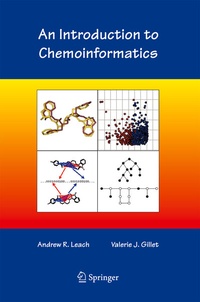
An Introduction to Chemoinformatics
Description

Chemoinformatics draws upon techniques from many disciplines including computer science, mathematics, computational chemistry and data visualisation to tackle these problems.
This, the first text written specifically for this field, aims to provide an introduction to the major techniques of chemoinformatics. The first part of the book deals with the representation of 2D and 3D molecular structures, the calculation of molecular descriptors and the construction of mathematical models. The second part describes other important topics including molecular similarity and diversity, the analysis of large data sets, virtual screening, and library design. Simple illustrative examples are used throughout to illustrate key concepts, supplemented with case studies from the literature.
The book is aimed at graduate students, final-year undergraduates, and professional scientists. No prior knowledge is assumed other than a familiarity with chemistry and some basic mathematical concepts.
Reviews / Votes
This is a rather remarkable little book. Just as its title promises, it provides an introduction to a very wide variety of chemoinformatic and CADD topics. Allthough the book is written for beginning graduate students and advanced undergraduates, it could certainly provide a very helpful overview for professionals with no prior knowledge of the subject matter.
Robert S. Pearlman, University of Texas at Austin.
J.Am. Chem. Soc., Vol 126, No. 4, 2004.
More details
Other editions
Additional editions