

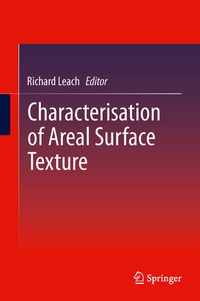
Characterisation of Areal Surface Texture
Description

The function of a component part can be profoundly affected by its surface topography. There are many examples in nature of surfaces that have a well-controlled topography to affect their function. Examples include the hydrophobic effect of the lotus leaf, the reduction of fluid drag due to the riblet structure of shark skin, the directional adhesion of the gecko foot and the angular sensitivity of the multi-faceted fly eye. Surface structuring is also being used extensively in modern manufacturing. In this way many properties can be altered, for example optical, tribological, biological and fluidic. Previously, single line (profile) measurements were adequate to control manufacture of surfaces, but as the need to control the functionality of surfaces increases, there is a growing need for three-dimensional (areal) measurement and characterisation techniques. For this reason there has been considerable research, development and standardisation of areal techniques. This book will present the areal framework that is being adopted by the international community. Whereas previous books have concentrated on the measurement aspects, this book concentrates on the characterisation techniques, i.e. how to interpret the measurement data to give the appropriate (functional) information for a given task. The first part of the book presents the characterisation methods and the second part case studies that highlight the use of areal methods in a broad range of subject areas - from automobile manufacture to archaeology.
Contents
Introduction to Surface Topography
The Areal Field Parameters
The Areal Feature Parameters
Areal Filtering Methods
Areal Form Removal
Areal Fractal Methods
Choosing the Appropriate Parameter
Characterisation of Individual Areal Features
Multi-Scale Signature of Surface Topography
Correlation of Areal Surface Texture Parameters to Solar Cell Efficiency
Characterisation ofCylinder Liner Honing Textures for Production Control
Characterisation of the Mechanical Bond Strength for Copper on Glass Plating Applications
Inspection of Laser Structured Cams and Conrods
Road Surfaces
More details
Other editions
Additional editions
Person
Professor Richard Leach is a Principal Research Scientist at the National Physical Laboratory in the UK and a visiting professor at Loughborough University. He obtained a BSc in Applied Physics with Microelectronics and Computing from Kinston University in 1989, an MSc in Industrial Measurement Systems from Brunel University in 1994 and PhD in Surface Metrology from University of Warwick in 2000. He has been with NPL since 1990 and has current research interests in surface topography measurement, micro-coordinate metrology, high dynamic range sensing and computed tomography. Richard is on the Council of European Society of Precision Engineering and Nanotechnology, the IoN Advisory Board, the EPSRC Peer Review College, the International Committee on Measurements and Instrumentation and several international standards committees. He is the European Editor-in-Chief for Precision Engineering and Editor-in-Chief of Surface Topography: Metrology & Properties. He has over 180 publications including three textbooks. Richard is a Fellow of the Institute of Physics, a Fellow of the Institute of Nanotechnology and a Sustained Member of the American Society of Precision Engineers.
