

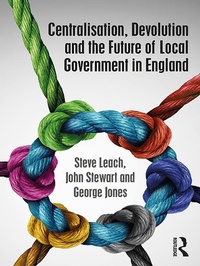
Centralisation, Devolution and the Future of Local Government in England
Published on 28. July 2017
192 pages
978-1-315-40793-7 (ISBN)
Description

English local government is in a state of decline after 40 years of incremental but cumulative centralisation by central government.
This book is the first to directly address this trend's impact upon the institution of local government, a crucial element in the democratic viability of a unitary state. The process of centralisation, and its corrosive effect on the status and responsibilities of local government, have been widely recognised and deplored among politicians and senior officers within local government, and by academics with an interest in this field. However, there has been no study exploring in detail its impact, and, equally important, suggesting ways in which the growing imbalance between the powers of central and local government should be rectified. This book fills this gap.
This text will be of key interest to scholars, students and practitioners of local government, and more generally to those interested in what has been happening to British politics and governance.
This book is the first to directly address this trend's impact upon the institution of local government, a crucial element in the democratic viability of a unitary state. The process of centralisation, and its corrosive effect on the status and responsibilities of local government, have been widely recognised and deplored among politicians and senior officers within local government, and by academics with an interest in this field. However, there has been no study exploring in detail its impact, and, equally important, suggesting ways in which the growing imbalance between the powers of central and local government should be rectified. This book fills this gap.
This text will be of key interest to scholars, students and practitioners of local government, and more generally to those interested in what has been happening to British politics and governance.
Reviews / Votes
''Timely' is an overused word, but not in relation to this excellent book. The case for a more devolved and decentralised country is even stronger after the EU referendum vote. Power should not be hoarded in Westminster and Whitehall, but available at the sub-national level. Here is the reasoned case for a such a change.' - Tony Travers, London School of Economics, UK.'The three leading scholars of English local government challenge us to recognise the substantial shift in authority from local communities to Westminster and Whitehall over recent decades. This book offers a rigorous critique of that centralisation and an alternative localist vision for the future governance of the UK. It is an essential read for anyone interested in giving communities new opportunities to shape their futures.' - Chris Skelcher, University of Birmingham, UK.
'The book is written by three towering figures in local government academia and provides a wide-ranging analysis of what currently ails local government. The book is a timely reminder for why we have local government and it provides a solid exploration of its purpose and contribution to the fabric of governance. The book unpicks the 'myth of localism' and provides comprehensive analysis of the changes necessary for local government to take its rightful place as a partner in government. A book for scholars, students, practitioners and policy-makers. It is with great sadness that Professor George Jones passed away before the publication of this book. But his contribution to it and academia is of great international renown. He will be missed.' - Colin Copus, De Montfort University, UK.
'It is an important book. It should be read by contemporary councillors, council officials, civil servants, parliamentarians and ministers, and by commentators. And it should be a rallying call for those of us who share its authors' passion for local government. It is also a great tribute to George Jones.' - John Tizard, Huffington Post UK.
More details
Series
Language
English
Place of publication
London
United Kingdom
Publishing group
Taylor & Francis Ltd
Target group
College/higher education
File size
1,70 MB
ISBN-13
978-1-315-40793-7 (9781315407937)
Copyright in bibliographic data and cover images is held by Nielsen Book Services Limited or by the publishers or by their respective licensors: all rights reserved.
Schweitzer Classification
Other editions
Additional editions
Steve Leach | John Stewart | George Jones
Centralisation, Devolution and the Future of Local Government in England
Book
08/2017
1st Edition
Routledge
€231.10
Shipment within 10-20 days
Steve Leach | John Stewart | George Jones
Centralisation, Devolution and the Future of Local Government in England
Book
08/2017
1st Edition
Routledge
€68.70
Shipment within 10-20 days
Persons
Steve Leach worked at the Institute of Local Government Studies (INLOGOV) from 1977 to 1996, by which time he held the position of Reader. He was then appointed Professor of Local Government at De Montfort University, UK, a position he held until his retirement in 2009, and still holds on an Emeritus basis.
John Stewart joined the Institute of Local Government Studies (INLOGOV) at the University of Birmingham, UK, in 1966, and became Professor of Local Government in the early 1970s, a position he held until he retired in the late 1990s, and now holds on an Emeritus basis. He was a member of the Layfield committee on Local Government Finance (1974-1976), and has contributed to many other government inquiries.
George Jones joined the London School of Economics (LSE) in 1966 and was appointed Professor of Government in 1976, a position he held until his retirement in 2007 and which he later held on an Emeritus basis. He, too, was a member of the Layfield Committee and gave evidence to a range of other government inquiries.
John Stewart joined the Institute of Local Government Studies (INLOGOV) at the University of Birmingham, UK, in 1966, and became Professor of Local Government in the early 1970s, a position he held until he retired in the late 1990s, and now holds on an Emeritus basis. He was a member of the Layfield committee on Local Government Finance (1974-1976), and has contributed to many other government inquiries.
George Jones joined the London School of Economics (LSE) in 1966 and was appointed Professor of Government in 1976, a position he held until his retirement in 2007 and which he later held on an Emeritus basis. He, too, was a member of the Layfield Committee and gave evidence to a range of other government inquiries.
Content
Introduction: The Plight of Local Government and Central-Local Relations
Part I: The Current Situation
1. The Justification for Local Government
2. How the Past can inform the Present; Five Stages in the Development of Local Government
3. The Myth of Localism
4. Central-Local Relations: An Interpretation
Part II: Moving Forward
5. The Need for Constitutional Change
6. Rethinking Local Government Finance
7. Politics, Parties and local Democracy
8. Central-Local Relations and Local Government Reorganisation
9. The Devolution Agenda
10. Reflections and Conclusions
Part I: The Current Situation
1. The Justification for Local Government
2. How the Past can inform the Present; Five Stages in the Development of Local Government
3. The Myth of Localism
4. Central-Local Relations: An Interpretation
Part II: Moving Forward
5. The Need for Constitutional Change
6. Rethinking Local Government Finance
7. Politics, Parties and local Democracy
8. Central-Local Relations and Local Government Reorganisation
9. The Devolution Agenda
10. Reflections and Conclusions
