

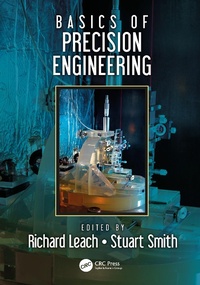
Basics of Precision Engineering
Published on 9. April 2018
675 pages
978-0-429-88743-7 (ISBN)
Description

Advances in engineering precision have tracked with technological progress for hundreds of years. Over the last few decades, precision engineering has been the specific focus of research on an international scale. The outcome of this effort has been the establishment of a broad range of engineering principles and techniques that form the foundation of precision design.
Today's precision manufacturing machines and measuring instruments represent highly specialised processes that combine deterministic engineering with metrology. Spanning a broad range of technology applications, precision engineering principles frequently bring together scientific ideas drawn from mechanics, materials, optics, electronics, control, thermo-mechanics, dynamics, and software engineering. This book provides a collection of these principles in a single source. Each topic is presented at a level suitable for both undergraduate students and precision engineers in the field. Also included is a wealth of references and example problems to consolidate ideas, and help guide the interested reader to more advanced literature on specific implementations.
Today's precision manufacturing machines and measuring instruments represent highly specialised processes that combine deterministic engineering with metrology. Spanning a broad range of technology applications, precision engineering principles frequently bring together scientific ideas drawn from mechanics, materials, optics, electronics, control, thermo-mechanics, dynamics, and software engineering. This book provides a collection of these principles in a single source. Each topic is presented at a level suitable for both undergraduate students and precision engineers in the field. Also included is a wealth of references and example problems to consolidate ideas, and help guide the interested reader to more advanced literature on specific implementations.
Reviews / Votes
"This is a highly informative and significant book for all those studying or practicing precision engineering."- Bernard Hon, University of Liverpool, UK
"The book, Basics of Precision Engineering, delivers a useful perspective on precision engineering. It is an excellent learning resource to UG and PG students and Precision Engineers in the field. The book covers both scientific fundamental and engineering application for the development of precision machine. The tone of the book reflects a learned appreciation for rapid development precision engineering. The authors are proven scientists specializing in precision manufacturing and metrology. The construction of the book meshes well with its organization and lends itself successfully to the study of different scientific aspects of precision engineering from kinetic design, dynamics, metrology, system modeling to control systems. The book is well-referenced, making skillful use of first-person sources."
- Xichun Luo, University of Strathclyde, UK
More details
Language
English
Place of publication
London
United Kingdom
Publishing group
Taylor & Francis Ltd
Target group
College/higher education
Product notice
Reflowable
Illustrations
48 s/w Tabellen, 200 s/w Abbildungen
48 Tables, black and white; 200 Illustrations, black and white
File size
11,39 MB
ISBN-13
978-0-429-88743-7 (9780429887437)
Copyright in bibliographic data and cover images is held by Nielsen Book Services Limited or by the publishers or by their respective licensors: all rights reserved.
Schweitzer Classification
Other editions
Additional editions
Richard Leach | Stuart T. Smith
Basics of Precision Engineering
Book
03/2021
1st Edition
CRC Press
€73.10
Shipment within 15-20 days
Richard Leach | Stuart T. Smith
Basics of Precision Engineering
Book
03/2018
1st Edition
CRC Press
€230.80
Shipment within 15-20 days
Persons
Richard Leach is a professor in Metrology at the University of Nottingham and heads the Manufacturing Metrology Team. Prior to this position, he was at the National Physical Laboratory from 1990 to 2014. His primary love is instrument building, from concept to final installation, and his current interests are the dimensional measurement of precision and additive manufactured structures. His research themes include the measurement of surface topography, development of methods for measuring 3D structures, development of methods for controlling large surfaces to high resolution in industrial applications and x-ray computed tomography. He is a leader of several professional societies and a visiting professor at Loughborough University and the Harbin Institute of Technology.
Stuart T. Smith has been working in engineering for four decades starting in 1977 with a factory maintenance apprenticeship with Miles Redfern Limited. He is now a Professor of Mechanical Engineering and leads the Instrument Development Group at the University of North Carolina at Charlotte. Throughout the years, his main focus has been the development of instrumentation and sensor technologies primarily aimed towards the challenges of atomic scale discrimination, manipulation and manufacture with applications in the fields of optical, biological and mechanical processes.
Stuart T. Smith has been working in engineering for four decades starting in 1977 with a factory maintenance apprenticeship with Miles Redfern Limited. He is now a Professor of Mechanical Engineering and leads the Instrument Development Group at the University of North Carolina at Charlotte. Throughout the years, his main focus has been the development of instrumentation and sensor technologies primarily aimed towards the challenges of atomic scale discrimination, manipulation and manufacture with applications in the fields of optical, biological and mechanical processes.
Content
Introduction to Precision. Metrology. Background Principles. Introduction to Dynamics: Implications on the Design of Precision Machines. Dimensional Metrology. Kinematic Design. Precision Machine Principles and Elements. System Modelling. Measurement Uncertainty. Alignment and Assembly Principles. Force Loops. Materials Selection in Precision Mechanics. Environmental Isolation. Control Systems for Precision Motion. Appendix. Index.
