

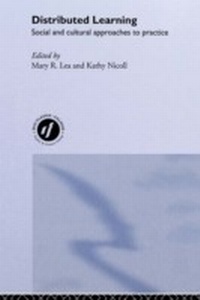
Distributed Learning
Social and Cultural Approaches to Practice
1st Edition
Published on 8. October 2013
224 pages
978-1-136-45269-7 (ISBN)
Description

At a time of increasing globalisation, the concept of open and distance learning is being constantly redefined. New technologies have opened up new ways of understanding and participating in Learning. Distributed Learning offers a collection of perspectives from a social and cultural practice-based viewpoint, with contributions from leading international authors in the field. Key issues in this comprehensive text are:
*the challenges of ICT to traditional teaching and learning practices
*the value and relevance of 'activity theory' and 'communities of practice' in educational institutions and the workplace
*perspectives on the relationship between globalisation and distributed learning, and the breakdown of distinctions between global and local contexts
*issues of identity and community in designing courses for the virtual student
*language and literacies in distributed learning contexts
This book provides useful introductory reading, building a sound theoretical framework for practitioners interested in how distributed learning is shaping post-compulsory education.
*the challenges of ICT to traditional teaching and learning practices
*the value and relevance of 'activity theory' and 'communities of practice' in educational institutions and the workplace
*perspectives on the relationship between globalisation and distributed learning, and the breakdown of distinctions between global and local contexts
*issues of identity and community in designing courses for the virtual student
*language and literacies in distributed learning contexts
This book provides useful introductory reading, building a sound theoretical framework for practitioners interested in how distributed learning is shaping post-compulsory education.
Reviews / Votes
'This is a high quality, leading edge volume which seeks not only to explore social and cultural aspects of distributed learning but also to 'push the enevlope' of established methods of enquiry into open and distance educational theory.' - Carolyn Richardson, British Journal of Educational Technology'This is a rich resource for teachers in a range of settings. Those of us working as teacher educators will find it extremely useful as a way of engaging our practitioner-students with the problematic issue of the relationship between learning and technology and challenging assumptions about the utility of ICT as a teaching tool ... The contributions offer an empowering indication of how we can better understand, and thus take a more active role in shaping, "distibuted learning" for the future.' - Janice Malcolm, Teaching in Higher Education
More details
Language
English
Place of publication
London
United Kingdom
Publishing group
Taylor & Francis Ltd
Target group
Professional and scholarly
File size
16,10 MB
ISBN-13
978-1-136-45269-7 (9781136452697)
Copyright in bibliographic data and cover images is held by Nielsen Book Services Limited or by the publishers or by their respective licensors: all rights reserved.
Schweitzer Classification
Other editions
Additional editions
Book
11/2001
Routledge
€49.75
Shipment within 15-20 days
Book
11/2001
Routledge
€88.19
Shipment within 15-20 days
Persons
Lea, Mary R.; Nicoll, Kathy
Content
1. Information, Knowledge and Learning: Some Issues Facing Epistemology and Education in a Digital Age 2. Informed Opportunism: teaching for Learning in Uncertain Contexts of Distributed Education 3. Legitimate Peripheral Participation in Communities of Practice 4. Looking Beyond the Interface: Activity Theory and Distributed Learning 5. Workplaces, Communities and Pedagogy: An Activity Theory View 6. Distribution and Interconnectedness: the Globalisation of Education 7. The English Language and 'Global' Teaching 8. From Independent Learning to Collaborative Learning: New Communities of Practice in Open, Distance and Distributed Learning 9. Learning as Cultural Practice 10. The University Campus as a 'Resourceful Constraint': Process and Practice in the Construction of the Virtual University 11. Identity, Community and Distributed Learning 12. Flexible Literacies: Distributed Learning and Changing Educational Spaces
