

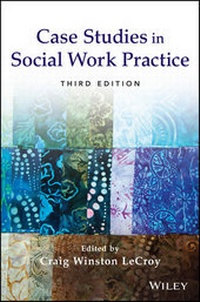
Case Studies in Social Work Practice
Description

More details
Other editions
Additional editions
Person
Craig Winston LeCroy, PhD, is Professor in the School of Social Work at Arizona State University. Dr. LeCroy has directed several projects for children and adolescents, including a National Institue of Mental Health Training Grant for emotionally disturbed children and adolescents. He has published widely in the areas of children's mental health, social skills training, risk and needs assessment with juvenile offenders, and adolescent treatment and program evaluation.
Content
Educational Policy and Accreditation Standards (EPAS) and Case Studies Crosswalk xi
Case Study Topic Areas Matrix xv
Preface xix
Acknowledgments xxiii
About the Editor xxv
Contributors xxvii
Part I Case Studies in Generalist Practice 1
Case Study 1-1 Using the Ecological Model in Generalist Practice: Life Transitions in Late Adulthood 5
Shirley Patterson, Jan Jess, and Craig Winston LeCroy
Case Study 1-2 Finding Resources: Case Management With Childhood Chronic Illness 13
Kathy L. Lortie
Case Study 1-3 A Strengths-Focused Approach to Community Development 21
Jeannine K. Chapelle
Part II Case Studies in Integrating Theory and Practice 31
Case Study 2-1 Social Work Practice From an Ecological Perspective 35
Barbra Teater
Case Study 2-2 Social Learning Theory in the Treatment of Phobic Disorders 45
Bruce A. Thyer
Case Study 2-3 Relational Theory With a Young Adult Experiencing Interpersonal Problems 55
Joseph Walsh
Case Study 2-4 Using a Family Systems Approach With the Adoptive Family of a Child With Special Needs 65
Martha Morrison Dore
Part III Case Studies in Child and Family Welfare 75
Case Study 3-1 Clinical Social Work in an Interdisciplinary Team: An Adolescent Inpatient Psychiatry Case 79
Catherine Sammons
Case Study 3-2 Family Drug Court 87
Chris Swenson-Smith and Yesenia Campos
Case Study 3-3 Child Welfare Supervision Case Study 97
Cynthia A. Lietz
Case Study 3-4 Challenging the Tradition: In Some Families, Violence Is a Way of Life 107
Steven Krugman
Part IV Case Studies in Family Therapy 113
Case Study 4-1 Homebuilders: Helping Families Stay Together 115
Nancy Wells Gladow, Peter J. Pecora, and Charlotte Booth
Case Study 4-2 Humanizing the Impossible Case: Engaging the Power of a Family-Larger Systems Intervention 129
Jay Lappin and John VanDeusen
Case Study 4-3 Completing Brad's Dreams 137
David Eddy
Part V Case Studies in Treating Adult Problems 141
Case Study 5-1 Nightshift 143
Carl Oekerman
Case Study 5-2 Individual Treatment of Depression Using Cognitive Therapy 151
Brent B. Geary
Case Study 5-3 Jasmika, the Docs, and Me: A Short Story With a Happy Ending About Partnership, Collaboration, Social Work, and Psychiatric Medication 159
Kia J. Bentley
Case Study 5-4 Beyond Just Words: Multisensory Interventions Can Heighten Therapy's Impact 171
Danie Beaulieu
Case Study 5-5 Treatment of Depression and Coping With Chronic Pain Through Mindfulness-Oriented
Recovery Enhancement 181
Amber Kelly and Eric Garland
Part VI Case Studies in Preventing Problems and Developing Resourcefulness 189
Case Study 6-1 A Group-Based Approach to Stress Management 191
Randy Magen
Case Study 6-2 Mediation and Facilitation: Alternatives to the Adversarial Process of Conflict Resolution in
Child Welfare Cases 205
Susan K. Parnell
Case 6-3 Project Home Base: How Berto Came Indoors After 20 Years of Sidewalk Sleeping 217
Catherine Sammons
Case Study 6-4 Treating Geriatric Depression in the Context of Caregiving 225
Kristen Gustavson
Case Study 6-5 The Go Grrrls Program: Universal Prevention for Early Adolescent Girls 235
Craig Winston LeCroy
Part VII Case Studies in Group Work 249
Case Study 7-1 A Mutual Aid Support Group for Persons With AIDS in Early Substance Abuse Recovery 253
Lawrence Shulman
Case Study 7-2 A Group for Relatives and Friends of the Institutionalized Aged 267
Toby Berman-Rossi and Alex Gitterman
Case Study 7-3 A Social Skills Group for Children 281
Craig Winston LeCroy
Case Study 7-4 Group Work With Men Who Batter 291
Richard M. Tolman and Larry Bennett
Part VIII Case Studies in Diversity 301
Case Study 8-1 The Case of Ruth and Janice 305
Deana F. Morrow and Frances E. Tack
Case Study 8-2 Counseling an Interracial Couple 313
Man-Keung Ho
Case Study 8-3 Working With the Urban Poor 319
Myrtle Parnell and Jo VanderKloot
Case Study 8-4 Highlighting the Role of Cross-Cultural Competence in Ethically Sound Practice 329
Kathleen Cox, Nancy Sullivan, Jennifer Reiman, and Cher Vang
Part IX Case Studies in Using Practice Evaluation 337
Case Study 9-1 Evaluating the Treatment of a Sexually Assaulted Child 341
Betty J. Blythe
Case Study 9-2 Doing Family Therapy With an Acting-Out Adolescent: Using Rapid Assessment Tools in Clinical Practice 349
Kevin Corcoran and Kristin Beers
Case Study 9-3 Practice Evaluation Methods: Practical Variations on a Theme 357
Paula S. Nurius and Sara Green
Case Study 9-4 Becoming Evidence-Based: A Social Work Agency's Effort to Move Research Into Practice 369
Jennifer L. Bellamy
Key Words 381
Index 385
Case Study 1-1
Using the Ecological Model in Generalist Practice: Life Transitions in Late Adulthood
SHIRLEY PATTERSON, JAN JESS, AND CRAIG WINSTON LECROY
This case uses the ecological perspective as a guide to generalist practice. This perspective offers a framework for how the social worker organizes her work and helps the client cope with a serious life transition.
Questions
1. Why is the ecological perspective considered a good framework for generalist practice? 2. What were the essential skills and abilities the social worker used in this approach? 3. How were ecological concepts used to help the social worker? 4. How was the concept of person and environmental fit used in this case?I met Mrs. Lilly Goodman at the medical center in Kansas City on the long-term care unit where I work. She is a 77-year-old woman who is thin, small in stature, with straggly gray hair, who peers at you above her glasses, which keep slipping down her nose. When I met her for the first time, I was struck by her sad demeanor. However, as I got to know her, I came to love her wry sense of humor that is often masked to those who do not know her well.
Mrs. Lilly Goodman has been a hard-working laborer all of her life. She grew up in poverty—living in apartments and moving frequently as her father sought new work opportunities. She was not encouraged to go to school and, in fact, quit school after completing a fifth-grade education. Despite this, she is a well-spoken woman who is articulate, well-read, and has seized new learning opportunities all of her life.
Mrs. Lilly Goodman began work as a “cleaning lady” at 12 years old and has been doing it ever since, until she became too frail to continue. She recounts the very day she could not work anymore: “It was about half past noon when I bent over to put fresh sheets on the bed. As I tried to straighten up, my back experienced sharp shooting pains and I knew that I could not work any longer.” As she tells me about her life, I can sense the confident, proud woman that she is. As she talks, you quickly get to know that one of her greatest achievements and joys is her home. She bought and paid for her own home, and she is very proud of having accomplished this goal. Also, her home is a central source of comfort: “I have lived in my home now for 30 years. I have one of the neighborhood'S best gardens. My neighbors stop by to see me on a regular basis.”
I try to think back to what life must have been like for her prior to landing in the hospital. I can see her getting up early in the morning to tend to her flowers, sitting and reading in an old overstuffed chair, and having a few old friends over for afternoon tea. Everything is different now. Her independence has come to an end, and she has not had much time to prepare for it. After suffering two strokes, one right after the other, and developing crippling and painful arthritis, I know that her life must have changed dramatically.
She, however, has not accepted these changes. Mrs. Goodman has consistently told the hospital staff that she plans to return home to live as soon as she gets out of the hospital. Because staff were unsure about the possibility of her returning to home, I was brought in as the long-term care social worker. Mrs. Lilly Goodman did not directly ask for help, but she willingly accepted my offer for help, proffered help—I was reaching out to her.
An ecological perspective was used in thinking about and guiding my approach to practice (Gitterman, 2009; Gitterman & Germain, 2008). From an ecological perspective, Mrs. Lilly Goodman is best understood as someone who is in a life transition. She is at a place in her life where she is facing a major transition—from an independent person who took care of herself to a person who is dependent and needs some assistance. There are three aspects of her life transition that help in thinking about how to offer her help:
Her developmental stage Her change in status and roles The crises she facesMrs. Lilly Goodman is in the final stages of growth. The developmental stage that confronts her has a biological base, and the associated tasks of this stage of development arise out of biological pressures and the social and physical environment. In other words, her residency in long-term care is not of her own choosing; rather, it is a result of illness, limited resources, and lack of family support.
Mrs. Lilly Goodman is also being thrust into some very new statuses, none of which she is particularly happy about. These include being:
A resident of a nursing home A displaced homeowner A dependent person An older adult with fairly limiting health problems, which are difficult for her to acceptIn addition to new statuses, Mrs. Lilly Goodman has new roles that she must adapt to, including being:
A lucid, ambulatory resident among many residents who are neither A protected mother (and mother-in-law) in a sheltered environment A welfare recipient, who receives Medicaid to supplement her social security that pays for her care in the long-term care unitThese roles are a striking contrast to the Mrs. Lilly Goodman of only a few months ago—someone who lived independently, tended her garden, cared for her home, and shared tea in the afternoon with friends.
As the team of workers at the hospital staffed this case, they recognized that Mrs. Lilly Goodman faces several life stressors. They are considered critical life stressors because they are situations that exceed the personal and environmental resources she has for managing them. The critical life stressors she faces include:
Loss of health Denial of the limitations her strokes have caused The threat of losing her home Her daughter'S poor health, which prevents her from providing her mother with supportClient strengths are an important part of the ecological model (Gitterman & Germain, 2008). As I thought about Mrs. Lilly Goodman, I needed to be aware that there is an innate strength in her—toward health, continued growth, and the development of new potentials. Although many of the people on the team exclusively discussed her limitations and what she could not do, I was always quick to point out her strengths—what she could do. As a social worker focused on helping Mrs. Lilly Goodman obtain self-determination, I empathized with her desire for discharge in order to live in her own house. Out of respect for her, I wanted to honor her wishes. Also, I knew that health could not be easily separated from obtaining satisfaction and meaning in life.
USING THE ECOLOGICAL MODEL TO GUIDE PRACTICE: A TEAM APPROACH
As the team members began to get to know Mrs. Lilly Goodman, they could see a determined woman who really did deserve an opportunity to try to return home. The team agreed that this was a reasonable goal that everyone could help her achieve. We set about a specific set of actions to make this happen.
Being in the long-term care unit had taken an emotional toll on Mrs. Goodman. Over time she had become increasingly despondent. The first goal was to rejuvenate her passion to seek a more meaningful life. To do this, we agreed to provide her with our support to supplement the limited support she received from her daughter in her wish to return home. We spent time talking with Mrs. Goodman about her home—getting her to tell us what it was like and to describe what her priorities would be when she returned. One team member who is an amateur artist sat down with Mrs. Goodman and drew a picture of her house—the outside and inside. You could observe an instant impact from this intervention. This helped shift her focus away from being a “patient” and helped her focus on what she wanted to achieve.
The team knew that to release Mrs. Lilly Goodman back to her home, they would have to be confident that she could function independently. This called for an assessment of the feasibility of discharge. To conduct this assessment, different team members took on separate tasks.
The occupational therapist conducted a cooking evaluation with Mrs. Goodman. This was done in the hospital occupational therapy kitchen. The assessment did not focus on her skills of cooking but on her stamina in cooking for herself. Mrs. Goodman rather enjoyed this challenge. Trying these tasks gave her an opportunity to show others what she could do. Each team member was instructed to help emphasize the positive competencies that she was able to demonstrate. Indeed, Mrs. Goodman did have the necessary stamina for cooking.
The nurse set out to help Mrs. Goodman plan daily activities while she was still on the long-term care unit. This was done to help her develop the stamina to live alone and care for herself. Mrs. Goodman was encouraged to take on increasing amounts of daily living activities. Also, to improve her physical stamina, the nurse worked with her to increase the amount of walking she could do.
As the social worker on the unit, I helped Mrs. Goodman assess what resources and support she would need when she returned home. I talked with her about the kinds of resources other older persons I had helped found useful, such as homemakers, visiting nurses, meals-on-wheels, transportation, telephone reassurance, neighborly support, and...
