

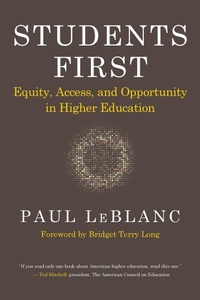
Students First
Description

Paul LeBlanc has reimagined higher education, with a focus on the most fundamental of functions: student learning. In Students First, he advocates for an entire higher education ecosystem in which students have the flexibility to gain, assess, and certify their knowledge on their own terms and timelines.
In a perceptive analysis, LeBlanc provides a clear-eyed view of how and why higher education is failing to reach and serve a great many potential students. He then deftly explores how reform can address systemic inequities, improve college affordability, and broaden accessibility. Through case studies, he highlights alternative delivery models such as online, distance, and just-in-time learning, and he envisions a learning environment that values competencies rather than credit hours. LeBlanc describes how these innovations and others will allow colleges and universities to help close the skills gap and respond to a rapidly evolving, technology-driven job market.
Although a college education remains one of the great drivers of socioeconomic mobility, today's higher education industry has built financial, logistical, and practical barriers that keep out the very students who are most in need of opportunity. Students First makes a persuasive case that realigning US educational priorities will enable larger populations of graduates to enjoy a return on investment in the form of good pay, meaningful work, and a stable future. As the book emphasizes, such change is imperative, for in better serving its students, higher education will better serve society.
More details
Other editions
Additional editions
Person
Dr. Paul J. LeBlanc is President of Southern New Hampshire University (SNHU). Under the eighteen years of Paul's direction, SNHU has grown from 2,800 students to more than 170,000 and is the largest nonprofit provider of online higher education in the country, and the first to have a full competency-based degree program untethered to the credit hour or classes approved by a regional accreditor and the US Department of Education. In 2012 the university was number twelve on Fast Company magazine's "World's Fifty Most Innovative Companies" list and was the only university included. Forbes Magazine has listed Paul as one of its fifteen "Classroom Revolutionaries" and one of the "most influential people in higher education" for 2016, and Washington Monthly named him one of America's ten most innovative university presidents. In 2018, Paul won the prestigious IAA Institute Hesburgh Award for Leadership Excellence in Higher Education, joining some of the most respected university and college presidents in American higher education. He has served on the Board of the American Council on Education, the Association of Governing Boards President's Council, the Academy of Sciences Board on Workforce and Higher Education, as well as many others. He is a sought-after speaker, often appears in the media, and is a contributing writer to Forbes Magazine.
