

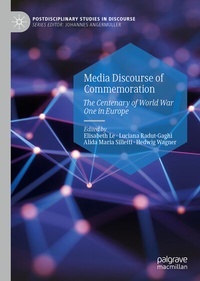
Media Discourse of Commemoration
Description

Reviews / Votes
The central question raised here could not be more relevant, given the present tensions within the European Union. The readers will be fascinated to see how the construction of WWI memory in a sample of countries speaks both to an Europeanisation and a nationalisation trend, thus mirroring the complex cultural dynamics at work at the EU scale.-Gérard Bouchard , Université du Québec à Chicoutimi, Canada.
A powerful and diverse range of interdisciplinary scholarship that offers an up-to-date appreciation of how 21st century media events and representations produce a culture of First World War memory across Europe. Each chapter explores the memorialising, inscribing, performing and shaping of how we are meant to remember this war through contemporary media. It shows clearly how media discourses turn past stories into influence and action - ensuring that audiences as well as those in power align themselves (through images and text) to the key narratives. This book is a must read for students and researchers of media and communication studies, memory studies, history and war studies. -Joanne Garde-Hansen , Professor of Culture, Media and Communication, University of Warwick, UKMore details
Other editions
Additional editions
Persons
Elisabeth Le is Professor of Applied Linguistics in the Department of Modern Languages and Cultural Studies at the University of Alberta, Canada.
Luciana Radut-Gaghi is Habilitated Associated Professor at the CY Cergy Paris Université, France. She has directed the Lemel (l'Europe dans les médias en ligne) research network since 2014.
Alida Maria Silletti is Associate professor of French Language and Translation in the Department of Political Science at the University of Bari Aldo Moro, Italy.
Hedwig Wagner holds a professorship in European Media Studies at the Europa-Universitaet Flensburg, Germany and is on the board of the Interdisciplinary Centre for European Studies (ICES).