

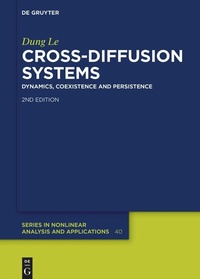
Cross-Diffusion Systems
Dynamics, Coexistence and Persistence
2nd Edition
Published on 22. September 2025
X, 282 pages
978-3-11-161567-7 (ISBN)
Description

The introduction of cross diffusivity opens many questions in the theory of reactiondiffusion systems. This book will be the first to investigate such problems presenting new findings for researchers interested in studying parabolic and elliptic systems where classical methods are not applicable. In addition, The Gagliardo-Nirenberg inequality involving BMO norms is improved and new techniques are covered that will be of interest. This book also provides many open problems suitable for interested Ph.D students.
More details
Series
Edition
2nd, revised and expanded edition
Language
English
Place of publication
Berlin/Boston
Germany
Target group
Professional and scholarly
US School Grade: College Graduate Student
Edition type
Revised edition
File size
9,81 MB
ISBN-13
978-3-11-161567-7 (9783111615677)
Schweitzer Classification
Other editions
Additional editions
E-Book
09/2025
2nd Edition
De Gruyter
€179.95
Available for download
Book
09/2025
2nd Edition
De Gruyter
€179.95
Shipment within 5-7 days
Person
Content
- Intro
- Contents
- 1 Introduction
- 2 Preliminaries
- 2.1 Functional spaces
- 2.1.1 Lebesgue spaces
- 2.1.2 Morrey and Campanato spaces
- 2.1.3 BMO space
- 2.1.4 Sobolev spaces
- 2.1.5 Compactness
- 2.2 Technical lemmas and various inequalities
- 2.3 Fixed point theorems
- 2.4 Weighted Gagliardo-Nirenberg inequality involving BMO norms - a simple case and its improvements
- 2.4.1 Notations
- 2.4.2 The strong Gagliardo-Nirenberg inequality and its proof
- 2.4.3 Proof of Theorem 2.4.1
- 2.4.4 A new (weak) Gagliardo-Nirenberg inequality
- 2.4.5 Parabolic version
- 3 Existence results for cross-diffusion systems
- 3.1 Models in biology and ecology
- 3.2 Cross-diffusion models
- 3.3 A more general evolution cross-diffusion model
- 3.4 The concepts of strong, weak and strong weak solutions
- 3.5 The existence of strong weak solutions
- 3.5.1 The ellipticity and spectral gap conditions
- 3.5.2 The map L and its fixed point
- 3.5.3 Main results
- 3.6 Uniqueness
- 3.7 Estimates for the spatial derivatives
- 3.8 The proof of the main result
- 3.8.1 A compactness lemma
- 3.8.2 The space X and L:XX is compact
- 3.8.3 Proof of the main theorem
- 3.9 The corollaries
- 4 Scalar techniques and diagonalization
- 4.1 On scalar equations
- 4.1.1 Global boundedness and a local estimate
- 4.1.2 A local property of functions in M(O,T)
- 4.1.3 Hölder continuity
- 4.2 Applications to systems
- 4.2.1 Diagonal systems
- 4.2.2 Full systems
- 4.2.2.1 Full SKT systems on planar domains
- 4.2.2.2 Triangular systems on N-dimensional domains
- 4.3 Diagonalization and local uniform boundedness
- 4.3.1 On the inverse of H(w1,w2)
- 4.4 On conditions (iii) and (iv) of Theorem 4.3.3
- 4.4.1 An application of the strong GNBMO inequality
- 4.4.2 An application of the weak GNBMO inequality (parabolic version)
- 4.5 Integrability of temporal derivatives
- 4.6 Dynamics and attractors
- 5 Existence of solutions to general elliptic systems
- 5.1 The map L and the space X
- 5.2 Estimates for derivatives
- 5.3 Proof of the main theorem and its corollaries
- 5.3.1 An application of the weak GNBMO inequality
- 6 Existence of solutions to elliptic systems of two equations
- 6.1 On scalar quasilinear elliptic equations
- 6.1.1 Global boundedness and a local estimate
- 6.1.2 Hölder continuity
- 6.2 Applications to systems
- 6.2.1 Diagonal systems
- 6.2.2 Full systems
- 6.2.3 Triangular systems
- 6.3 The case m=2
- 6.3.1 The BMOsmall condition and an example for SKT systems
- 6.4 Eigenvalue problems in ordered Banach space-Indices
- 6.4.1 OBSs and positive linear operators
- 6.4.2 Topological indices on retracts of a Banach space
- 6.5 Trivial, semitrivial and nontrivial solutions
- 6.5.1 Abstract theory and index theory in ordered Banach spaces
- 6.5.2 A concrete example in cross-diffusion systems
- 6.5.3 The index and eigenvalue problems
- 6.5.4 Pattern formation
- 7 Persistence in the dynamics of evolution processes
- 7.1 Persistence
- 7.2 The dynamics of evolutionary solutions
- 7.2.1 Some technicalities and the general case
- 7.2.2 Different boundary conditions when t&1
- 7.2.3 General dimension N
- 7.3 On the number t=rL?-1M and the condition t&1
- 7.3.1 An application of the anti-maximum principle to the assumption t&1 in (7.2)
- 7.3.2 A minmax formula for t in (7.11)
- 7.4 The effect of cross-diffusion when t&1
- 8 Coexistence of a class of cross-diffusion systems of m equations via index theories
- 8.1 Abstract results, trivial, semitrivial and nontrivial solutions and the models
- 8.1.1 The abstract theory and index theory in ordered Banach spaces
- 8.1.2 A concrete example in cross-diffusion systems
- 8.2 The index and eigenvalue problems
- 8.2.1 The condition (e)
- 8.3 Verifications of (e)
- 8.3.1 Cooperative case
- 8.4 The effect of the coefficient geometry on the first eigenvalue and the verification of (8.35)
- 8.4.1 The scalar case
- 8.4.2 The system case
- 9 Global and local Gagliardo-Nirenberg inequalities with a BMO term and fractional Laplacians
- 9.1 Introduction
- 9.2 Preliminaries
- 9.2.1 Ws,p spaces and frational Laplacians
- 9.2.2 Notations and tools from harmonic analysis
- 9.3 The strong global Gagliardo-Nirenberg inequality with a BMO norm and fractional derivatives
- 9.4 A new local weak Gagliardo-Nirenberg inequality
- 9.4.1 The proof
- 9.4.2 A variances of the weak inequality in Theorem 9.4.1
- 9.4.3 Some elementary facts on (-?)ß2uBMO and further improvements of Theorem 9.4.1
- 9.4.4 On the term |(-?)su2 u|2
- 9.4.5 On the BMO norm of (-?)su2 u
- 9.5 Some new global inequalities involving BMO norms and fractional Laplacians
- 9.5.1 H=(-?)s2u and [Theorem 1.1]SR
- 9.5.2 H=u (in BMO?Ws,2(RN)) and an exponential inequality
- 9.5.3 Improvements of the Moser-Trudinger inequality
- Bibliography
- Index
