

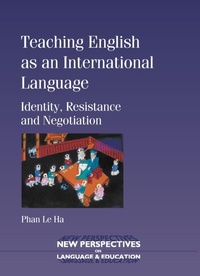
Teaching English as an International Language
Identity, Resistance and Negotiation
Published on 28. March 2008
180 pages
978-1-84769-983-1 (ISBN)
Description

Building on both Western and Asian theoretical resources, the book examines how EIL teachers see themselves as professional and individual in relation to their work practices. It reveals the tensions, compromises, negotiations and resistance in their enactment of different roles and selves, especially when they are exposed to values often associated with the English-speaking West. The ways they perceive their identity formation problematise and challenge the seemingly dominant views of identity as always changing, hybrid and fragmented. Their experiences highlight the importance of the sense of belonging and being, connectedness, continuity and a coherent growth in identity formation. Their attachment to a particular locality and their commitment to perform the moral guide role as EIL teachers serve as the most powerful platform for all their other identities to be constructed, negotiated and reconstituted.
Reviews / Votes
This is an interesting and insightful book that uses both Western and Vietnamese theoretical resources to underscore the importance of understanding the shifting professional identities of a group of Vietnamese ESL teachers, as they struggle to come to terms with competing pressures, both national and transnational. It shows that these teachers stand at the vanguard of a new era in which English represents the possibilities of greater intercultural understanding but also a hegemonic globalism that poses the risks of marginalizing other languages and cultural traditions. * Professor Fazal Rizvi, University of Illinois at Urbana-Champaign * Phan Le Ha has fulfilled such a daunting task, especially in terms of epistemology. Her critical discussion of and engagement with both Western and non-Western philosophies and knowledge is one of the most powerful elements of the book that offers meaningful space to any of us, teachers of the English language, to relate, reflect and grow. * Associate Professor Jayakaran Mukundan, Universiti Putra Malaysia * Interestingly, the book has capably grappled with the existing notions of epistemology in the previous literature while making sense of the author's own experiences in the classroom. Her discussion on epistemology as a driving force in developing modes of resistance both in her local setting and the wider context of the profession will surely be a lasting contribution to the complex processes that underlie the development of knowledge in the field for years to come. Most importantly, the application of auto-ethnography, which appears to be an underdeveloped method for research in English language teaching, makes this a welcome addition to the growing literature on the application of indigenous methods of investigation in the field. Since the expansion of hazy concepts such as epistemology and identity are adequately addressed in this book using the author's own documented experiences, the use of auto-ethnography has the potential to draw similar/conflicting experiences among professionals across different cultures and settings. -- Paolo Nino M. Valdez, De La Salle University Manila in Journal of Language, Identity & Education 10:5, 364-367 (2011)More details
Series
Language
English
Place of publication
Bristol
United Kingdom
Publishing group
Channel View Publications Ltd
Target group
Professional and scholarly
Product notice
Reflowable
ISBN-13
978-1-84769-983-1 (9781847699831)
Copyright in bibliographic data and cover images is held by Nielsen Book Services Limited or by the publishers or by their respective licensors: all rights reserved.
Schweitzer Classification
Other editions
Additional editions
Book
03/2008
Multilingual Matters
€42.00
Shipment within 10-20 days
Person
Phan Le Ha has recently been appointed Associate Professor of Education in the College of Education, The University of Hawaii at Manoa, USA, after nearly a decade lecturing in the Faculty of Education, Monash University, Australia. Her research interests include International Education, English as an International Language, Identity Studies, and Academic Writing.
Content
Acknowledgements
Chapter 1 - Introduction
Chapter 2 - Language, Culture and Identity
Chapter 3 - The Politics of English as an International Language and English Language Teaching
Chapter 4 - Identity Formation: Negotiations of Apparently Contradictory Roles and Selves
Chapter 5 - Identity Formation: The Teacher and the Politics of ELT
Chapter 6 - An EIL Teacher's Identity Formation
Chapter 7 - Teacher Identity and The Teaching of English as an International Language
References
Chapter 1 - Introduction
Chapter 2 - Language, Culture and Identity
Chapter 3 - The Politics of English as an International Language and English Language Teaching
Chapter 4 - Identity Formation: Negotiations of Apparently Contradictory Roles and Selves
Chapter 5 - Identity Formation: The Teacher and the Politics of ELT
Chapter 6 - An EIL Teacher's Identity Formation
Chapter 7 - Teacher Identity and The Teaching of English as an International Language
References
