

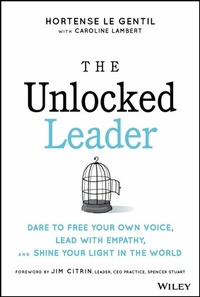
The Unlocked Leader
Description

In The Unlocked Leader veteran executive leadership coach Hortense le Gentil combines real life stories, rigorous research, and practical tools to explain how superhero leaders can become effective human leaders. You'll discover:
· How to identify the mental obstacles that stand between you and leadership authenticity, and sap your energy and impact - your mindtraps.
· How to confront your fears and escape those traps by operating a mindshift.
· Practical strategies to better connect with yourself and others - a mindbuild.
The journey from superhero leader to human leader not only transforms the lives of leaders themselves - both at work and beyond. It also makes a profound and lasting difference in the lives of people around them and the organizations they lead. This is how human leaders make an impact and shine their light in the world: by changing the way they connect with themselves and other people, they start a chain reaction that reverberates throughout their organizations and beyond them, because we are all part of interconnected networks of human relationships.
An indispensable leadership manual for people who wish to lead not just with their heads, but with their heart and soul as well, The Unlocked Leader belongs on the bookshelves of leaders and aspiring leaders at all levels looking for a fresh new perspective on effective, powerful leadership in service of something bigger than themselves.
More details
Other editions
Additional editions
Person
HORTENSE LE GENTIL is an executive leadership coach whose work is informed by 30 years of experience working across industries. Hortense is part of the Marshall Goldsmith 100 Coaches, which brings together the world's leading executive coaches, consultants, speakers, authors, iconic leaders, entrepreneurs, and nonprofit leaders.
Content
Acknowledgments
INTRODUCTION: The Fear of Being Human9
A New Business Environment and New Expectations
The Sum of All Fears
How to Become a Human Leader
PART 1: MINDTRAP - Identify Your Lock
Chapter 1. When the keys to past success get in your way: how mindsets become mindtraps
The Birth of a Mindtrap
Cul de Sac
How well do you know yourself?
Chapter 2. Uncover your inner obstacles: which mindtrap is holding you back?
The long shadow of trauma
What is a Trauma?
Inherited trauma
How do you define your identity?
Are You Wearing the Right "Suit"?
The Consequence of Mindtraps
Chapter 3. Find the source of your mindtrap: whose voice is it?
The Voice of Authority
When behavior speaks louder than words
The Power of the Collective
Which voice do you listen to?
PART 2: MINDSHIFT - Free Your Voice
Chapter 4. How we can change our mindset: the stories we tell ourselves
Finding Order in Chaos
The Master Filter
The Meaning Making Machine
The Space and Time Traveler
The Human Connection
The gap between who we are and how we are perceived
The "Gandhi neurons"
Chapter 5. See yourself differently: a view from outside the frame
Hitting the Wall
The Gift of External Perspective
Your immediate environment
The power of words
The Professional Guide
Open your Ears, Eyes and Mind85
Chapter 6. Challenge your beliefs: is it true, relevant, or helpful today?89
Truth Be Told
Claire
Andrew
Hortense
Is it relevant?
David
Buddha
Mateo
Is it still helpful?
Andrew
Claire
Chapter 7. Challenge your fears: three strategies to "do it anyway"
See the Gift in Crises
Find Your Boosters
Take One Step at a Time
Chapter 8. Let it go: three ways to make peace with the past
Let Go
Walter
Andrew
Rewrite Your Story
Time travel
PART 3: MINDBUILD - Lead With Empathy
Chapter 9. Define your identity as a human leader
Understand what drives you
From Personal to Collective Purpose
Write Your Eulogy
Imagine your future self
Back to the future
Identify your role models
The Other Benefits of Flexing Your Imagination
Chapter 10. Empower your inner leader: four practices to better connect with yourself
Staying on the Right Path
Self-care for the soul
Draw from a bank of positive memories
Practice Gratitude
Learn to protect yourself and recharge
Chapter 11. Become a new leader: four practices to better connect with others
Learn to listen more and speak last
Cultivate Your Empathy
Practice and roleplay conversations
Learn to set and maintain new boundaries
CONCLUSION: The New Leader
Index
Introduction: The Fear of Being Human
Imagine an elegant office somewhere in the Upper East Side of New York City. One after the other, top business executives discreetly slip into the comfortable waiting room a few minutes before the door opens. They fear crossing paths with someone they might know. When that happens, both people awkwardly look the other way. This is the office of a renowned psychotherapist, and most of the business leaders who turn up there would rather keep their visits secret. Never mind that over one in five CEOs now seek therapy.1 Even Richard Nixon's psychotherapist pointed out that leaders who seek help in times of stress are courageous and serve interests broader than their own.2 Unfortunately, for many business leaders, openly asking for help and exploring their emotions is still too often perceived as a weakness.
For decades, the traditional view was that to be successful, business leaders had to be infallible, unflappable, in control, and fearless. These leaders appeared to be born leaders, naturally endowed with supreme intelligence, coming up with brilliant ideas and directives from the mountaintop that lower echelons were then expected to execute. They are what I call superhero leaders.
As an executive coach, I have worked with many such superhero leaders. These smart, goal-oriented, and successful executives are masters at leading with their heads. Yet there is something many of them are now realizing they should probably know but don't: how to lead with their hearts and souls, too. Hiding behind their superhero leader façade, they're not sure how they can connect differently with people at work. They don't know how to be vulnerable, authentic, and empathetic in a way that unleashes the best in others. In short, they don't know how to be human leaders.
This is a problem of global proportions-for these leaders themselves, but also for people around them, their companies, and by extension, for the world at large. Why? Because the multiple global challenges and crises we're facing have highlighted that superhero leaders are no longer what companies need.
This traditional approach to leadership is not what is most effective today because the world has changed, and so have employees' expectations.
A New Business Environment and New Expectations
The world, and therefore the business environment, has become increasingly more volatile, complex, and unpredictable. In 2019, for example, few people would have predicted that a new coronavirus was about to sweep through the world with devastating consequences. We're facing an unprecedented combination of complex socioeconomic, geopolitical, and climate challenges. To survive, companies must be increasingly fast and agile-and expect the unexpected. In the 1920s, a company listed in the S&P 500 could expect to live for 67 years on average; and today? Only 15 years. By some estimates, three-quarters of today's S&P 500 companies will be replaced by new firms within 10 years.3 More than ever, companies must be environments of collaboration, flexibility, and innovation to survive and thrive. In today's business world, no one is infallible, and no single person, no matter how smart and experienced, has all the answers.
In addition to navigating a fast-changing and unpredictable environment, business leaders must also address new expectations and needs-starting with employees and, increasingly, shareholders. To give the best of themselves, employees want to feel respected, listened to, and inspired. They want to be seen, understood, and valued for who they are as individuals. Employees ponder over not only when, where, and how they want to work but also why they work.
Perhaps you think that these are soft, nice-to-have considerations rather than real business imperatives. But failing to pay attention carries a cost that may feel invisible but directly affects employees' loyalty and engagement, and therefore the company's bottom line. Employees rank respect from their leaders as the consideration that affects their engagement and commitment the most-ahead of recognition or appreciation, an inspiring vision, and opportunities for learning, growth, and development. Yet in March 2022, three in four employees felt that their company didn't care about their well-being.4 Companies around the world suffer from an epidemic of disengagement.
In addition to being respected, seen, and valued, employees also seek leaders who feel human, not distant and perfect beings with whom they can't connect. There is clear evidence that members of a group consider as their leaders the individuals who put the collective interest before their own, work hard to make other people's good ideas happen, and are strongly perceived as "one of us" rather than someone striving to stand out from their peers. In other words, team members who are more concerned with getting things done than having their own way are the ones who emerge as genuine leaders. Why? Because they have more influence on the group than people who think of themselves as leaders and display the dominant behavior traditionally associated with it.5
In a context of changing expectations from employees and shareholders, as well as the demands of today's business environment, the traditional model of the seemingly unflappable, infallible, and fearless superhero leader doesn't feel like a great match. "We don't need another hero," Tina Turner was already singing in 1985. We need leaders who want to be a lot more like coach Ted Lasso of the Apple TV original series-the unassuming Midwestern football coach who transforms a struggling and fractious British Premier League club by bringing hope, joy, kindness, and an indomitable team spirit.
The most effective leadership today-at all levels, from the C-suite to small teams at the bottom of the corporate pyramid-isn't about technical expertise and having all the answers. In addition to articulating a compelling vision, it's about the ability to connect with people, understand their needs, and unleash their potential. As Mary Barra, the CEO of General Motors, put it, "At the end of the day, all businesses are about people first-because the only way we can build genuinely successful businesses is to build lasting relationships inside and outside the company," she told fresh graduates of the Stanford Graduate School of Business. "We do that by holding ourselves accountable, by doing what we say we are going to do, and by inspiring others to strive for something bigger than themselves."6 Rita McGrath, a business professor at Columbia University, sees the evolution of business management in three eras: the first two were the eras of execution and expertise; today, she says, management has entered a new era of empathy.
Empathy is not often a word that comes to mind when thinking about business strategy and performance. It isn't often the first thing that comes to mind when thinking about successful business leaders, either. But a growing number of companies and business leaders are indeed realizing that the ability to put ourselves in someone else's shoes-whether a colleague, a customer, a supplier, a competitor, or a shareholder-and see the world the way they do has become a business imperative. Take Microsoft. In 2014, the company was losing ground. The tech giant, whose culture back then was known as brash and aggressive, had missed several fundamental technology shifts toward cloud and mobile computing. Then came a reboot. Over the following years, the company's fortunes turned, pushing the stock price up. Central to Microsoft's success has been a cultural revolution led by Microsoft's new CEO, Satya Nadella. What was that cultural revolution? Embracing empathy.
Empathy increasingly appears in job listings from mainstream employers such as strategy consulting firms, banks, or tech firms.7 Understanding customers' needs, including the needs they might not articulate, is central to innovation and customer service. Microsoft's model-coach-care approach to management-model the behavior you'd like your reports to embrace, coach them, and care about them and what matters to them as individuals-relies on human connections, too. And the most effective teams are those made up of people of different backgrounds, experience, and perspectives who are able to understand, respect, and trust each other. Empathy is therefore critical at all echelons, starting at the top.
In short, to be most effective in today's environment, leaders must be human leaders.
Yet despite countless success stories and hard evidence advocating for leadership based on empathy, many leaders still cling to the good old superhero leadership approach.
So why do human leaders seem to remain the exception rather than the norm?
Because, as the saying goes, the longest journey we'll ever travel is the 18 inches between our head and our heart. Shifting from superhero leader to a more human approach is hard for several reasons. First, we are creatures of habit, relying on what we know. And many leaders have built their success on being goal focused. Over time, the specific brain network that focuses on setting and achieving goals has grown very robust. The tricky part is, when this specific network in our brain gets activated, the people-focused network-which helps you understand and...
