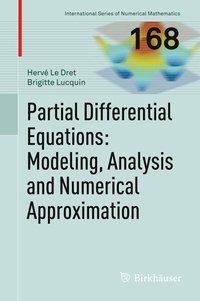
Partial Differential Equations: Modeling, Analysis and Numerical Approximation
Description

This book is devoted to the study of partial differential equation problems both from the theoretical and numerical points of view. After presenting modeling aspects, it develops the theoretical analysis of partial differential equation problems for the three main classes of partial differential equations: elliptic, parabolic and hyperbolic. Several numerical approximation methods adapted to each of these examples are analyzed: finite difference, finite element and finite volumes methods, and they are illustrated using numerical simulation results. Although parts of the book are accessible to Bachelor students in mathematics or engineering, it is primarily aimed at Masters students in applied mathematics or computational engineering. The emphasis is on mathematical detail and rigor for the analysis of both continuous and discrete problems.
Reviews / Votes
"This textbook covers a broad array of aspects of partial differential equations (PDEs), ranging from a study of their analytical properties to the approximate numerical simulations of their solutions. The level of the book is mainly targeted towards Master's students in applied mathematics or related fields of engineering. . The topics on modeling and approximating partial differential equations are well chosen and are presented in a logical and balanced order." (Michael M. Tung, Mathematical Reviews, June, 2017)
"This work explores the field of partial differential equations in an advanced manner. . authors provide remarks that help clarify and expand on information that was proved. This is a useful feature for the student trying to make connections with the material. . the authors not only provide a brief summary of the material just covered, but also allude to how this material will be seen in the following chapters. Summing Up: Recommended. Upper-division undergraduates and above; researchers and faculty." (S. L. Sullivan, Choice, Vol. 54 (9), May, 2017)
"This book presents both a theoretical and a numerical approach to partial differential equations. . The book appeals to graduate students as well as to researchers in any field of pure and applied mathematics who want to be introduced to numerical approximation method for PDEs through a rigorous approach." (Marius Ghergu, zbMATH 1339.35005, 2016)
More details
Other editions
Additional editions