

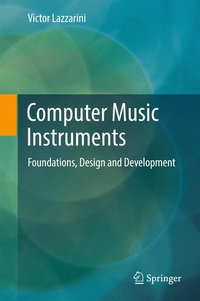
Computer Music Instruments
Description

This book is divided into three elements. Part I provides a broad introduction to the foundations of computer music instruments, covering some key points in digital signal processing, with rigorous but approachable mathematics, and programming examples, as well as an overview of development environments for computer instruments. In Part II, the author presents synthesis and processing, with chapters on source-filter models, summation formulae, feedback and adaptive systems, granular methods, and frequency-domain techniques. In Part III he explains application development approaches, in particular communication protocols and user interfaces, and computer music platforms.
All elements are fully illustrated with programming examples using Csound, Python, and Faust. The book is suitable for advanced undergraduate and postgraduate students in music and signal processing, and for practitioners and researchers.
Reviews / Votes
"If you are looking for a useful reference book on computer music for instrument development, Lazzarini's book will surely serve the purpose. . I enjoyed reading this book, which has an abundance of programs in Python, Csound, and Faust. The target readership includes postgraduates, advanced undergraduates, and researchers in signal processing, including music signals." (Soubhik Chakraborty, Computing Reviews, March, 2018)
More details
Other editions
Additional editions
Person
Content
Audio and Music Signals.- Digital Signal Processing Fundamentals.- Music Programming Environments.- Source-Filter Methods.- Closed-Form Summation Formulae.- Feedback Techniques.- Delay-Based Approaches.- Adaptive Methods.- Granular Processing.- Frequency-Domain Techniques.- Music Programming Environments.- Source-Filter Methods.- Closed-Form Summation Formulae.- Feedback Techniques.- Delay-Based Approaches.- Adaptive Methods.- Granular Processing.- Frequency-Domain Techniques.- Digital Waveguides.- Wave Digital Filters.- Finite Difference Methods.- Mass-Spring Models.- Scanned Synthesis.- Computer Music Platforms.- User Experience and Interaction.- Application Programming Interfaces.
