

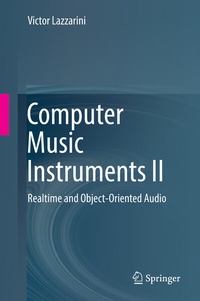
Computer Music Instruments II
Description

This book is divided into two parts. The chapters in Part I offer a comprehensive introduction to the C language and to fundamental programming concepts, followed by an explanation of realtime audio programming, including audio synthesis and processing. The chapters in Part II demonstrate how the object-oriented programming paradigm is useful in the modelling of computer music instruments, each chapter shows a set of instrument components that are paired with key C++ programming concepts. Ultimately the author discusses the development of a fully-fledged object-oriented library.
Together with its companion volume, Computer Music Instruments: Foundations, Design and Development , this book provides a comprehensive treatment of computational instruments for sound and music. It is suitable for advanced undergraduate and postgraduate students in music and signal processing, and for practitioners and researchers. Some understanding of acoustics and electronic music would be helpful to understand some applications, but it's not strictly necessary to have prior knowledge of audio DSP or programming, while C / C++ programmers with no experience of audio may be able to start reading the chapters that deal with sound and music computing.
More details
Other editions
Additional editions
Person
Victor Lazzarini is the Dean of the Dept. of Arts, Celtic Studies and Philosophy of the National University of Ireland, Maynooth, Ireland.
Content
Part I, Towards Realtime Audio in C.- Introduction to the Programming Environment.- Data Types and Operators.- Standard Input and Output.- Control of Flow.- Arrays and Pointers.- Functions.- Structures.- Memory Management.- File Input and Output.- Soundfiles.- Realtime Audio.- Realtime MIDI.- Part II, Object-Oriented Audio in C++.- Oscillators.- Interpolation.- Envelopes.- Filters.- AuLib.- Delay Line Processing.- Frequency-Doman Processing.- Plugins.- Appendix. A, AuLib Reference.- References.- Index.
