

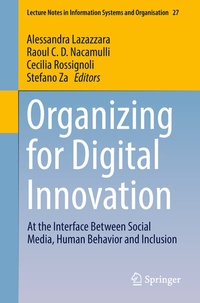
Organizing for Digital Innovation
Description

More details
Other editions
Additional editions
Persons
Alessandra Lazazzara is an assistant professor of Organization and Human Resource Management at the University of Milan (Italy). She holds a PhD in Organizational Development from the University of Milan - Bicocca (Italy) and has been a Visiting Scholar at the Netherlands Interdisciplinary Demographic Institute. Her research interests focus on diversity and inclusion, job crafting, internal branding and e-HRM, and she is involved in several national and international research projects with a wide range of companies and institutions. Alessandra teaches at both the undergraduate and graduate levels in the areas of Organization Studies, Training and Development, and Organizational Behavior. She has authored several publications in national and international journals, co-edited a book of the LNISO Springer series and is an editorial board member with the International Journal of Human Resource Management. Alessandra serves as vice-president of ItAIS, the Italian Chapter of the Association for Information Systems and is a board member of ASSIOA, the Association of Italian Organization Studies Academics.
Raoul C. D. Nacamulli is a full professor of Organizational Theory and Management at the University of Milan - Bicocca (Italy). Professor Nacamulli is the director of the Bicocca Training and Development Centre and faculty member of MIP, the Business School of Politecnico di Milano, the largest technical university in Italy. His more influential works have presented and refined an interdisciplinary framework of organizational theories. In this regard, particular importance has been assigned to the organizational economics approach of markets and hierarchies applied to the management sciences. He is currently analyzing the organizational challenges of meta-organizations with a special focus on Employers' Associations. Other current research topics are workplace innovation, job crafting and the new processes of organizational development.
Cecilia Rossignoli is a full professor of Organization Science at the University of Verona (Italy). Previously she served as an Assistant Professor at the Catholic University of Milan (Italy). Professor Rossignoli is a member of faculty at the Graduate School of Economics and Management (GSEM), University of Padua (Italy), and University of Verona (Italy). Her research and teaching interests are chiefly in Information Systems and Organization Studies. She has published, among others, in Information Systems and E-Business Management, Electronic Markets, Journal of Intellectual Capital, Journal of Business Research and at the International Conference on Information Systems (ICIS) and at the European Conference on Information Systems (ECIS). She is currently President of ItAIS, the Italian Chapter of the Association for Information Systems.
Stefano Za is an Adjunct Professor and Research Fellow at LUISS Guido Carli University (Italy) and Visiting Professor at EM Strasbourg Business School (France). He was Assistant Professor of Organizational Studies and Information Systems at E-Campus University until April 2017. He has been Secretary of the Italian chapter of the AIS and program committee member of the ITAIS conferences since 2008. Stefano has been a member of program committees and reviewer for national and international conferences in the domains of Information Systems and Organization Studies, such as ICIS and AMCIS. His current research interests include analyzing the link between digital platforms and individual and group behavior, in order to devise new governance models. He has published in international conferences, journals, and book series, such as ICIS, ECIS, Information & Management, the British Journal of Educational Technology, International Journal of Innovation and Learning, LNBIP and LNISO Springer series.
Content
- Intro
- Preface
- Contents
- 1 The Innovation Agency: An Overview
- 1 Part I: Digital Innovation and Its Effect on Individuals
- 2 Part II: Digital Innovation for Inclusion and Sustainability
- 3 Part III: Innovative Solutions in Digital Learning
- 4 Part IV: Organizing for Digital Innovation
- References
- Digital Innovation and its Effect on Individuals
- 2 ICT Use and Job Satisfaction. The Moderating Role of Task Characteristics
- Abstract
- 1 Introduction
- 2 Theoretical Background
- 2.1 Work Design and Employees' Job Satisfaction
- 2.2 ICT Use, Work Design and Employees' Job Satisfaction
- 3 Empirical Analysis
- 3.1 Method
- 3.2 Analysis and Results
- 4 Conclusions, Limitations and Further Research
- References
- 3 Accountants Are from Mars, ICT Practitioners Are from Venus. Predicting Technology Acceptance Between Two Groups
- Abstract
- 1 Introduction
- 2 Theoretical Background and Model Development
- 2.1 Technology Acceptance Model
- 2.2 Technology Acceptance Model and Cultural Differences
- 3 Research Methodology
- 3.1 The Questionnaire
- 3.2 Sample
- 3.3 Proposed Model
- 4 Research Results
- 5 Discussion and Conclusions
- References
- 4 What Kind of Benefits Different Stakeholders Can Expect and Obtain from HRIS Implementations: An Italian Case Study
- Abstract
- 1 Introduction
- 2 Theoretical Framework
- 3 Methodology
- 3.1 Research Design and Setting
- 3.2 Data Collection
- 3.3 Data Analysis
- 4 Findings
- 4.1 RHO Perspective
- 4.1.1 Expected
- 4.1.2 Realized
- 4.2 HR Professionals Perspective
- 4.2.1 Expected
- 4.2.2 Realized
- 4.3 Administrative IS Team
- 4.3.1 Expected and Realized
- 4.4 Managers and Employees
- 4.4.1 Expected
- 4.4.2 Realized
- 5 Discussion
- 6 Limitations
- 7 Conclusion
- References
- 5 The Dark Side of E-justice Implementation. An Empirical Investigation of the Relation Between Cultural Orientation and Information System Success
- Abstract
- 1 Introduction
- 2 Literature Review and Hypotheses Development
- 2.1 The Role of ICT Within Judicial System
- 2.2 The Individual Cultural Orientation
- 3 Method
- 3.1 Data Collection and Sample Analysis
- 3.2 Variable Description and Statistics
- 3.2.1 Dependent Variable
- 3.2.2 Independent Variables: Individual Cultural Orientation
- 3.2.3 Control Variables
- 4 Regression Analysis
- 4.1 Empirical Model
- 4.2 Empirical Results
- 5 Conclusions and Limitations
- Acknowledgements
- References
- 6 Acceptance of Personalised Services and Privacy Disclosure Decisions: Results from a Representative Survey of Internet Users in Spain
- Abstract
- 1 Introduction
- 2 The Model
- 3 Methodology-Measures, Survey and Data Analysis
- 3.1 Measures
- 3.2 Participants and Procedure
- 3.3 Data Analysis
- 4 Results and Discussion
- 5 Conclusions
- References
- Digital Innovation for Inclusion and Sustainability
- 7 The Role of Communication in Stereotypes, Prejudices and Professional Identity: The Case of Nurses
- Abstract
- 1 Introduction
- 2 Social Categorization, Stereotypes and Prejudices
- 3 Media Power and Social Perception: The Influence of the Internet
- 4 The Description of the Nursing World Through the Major Traditional Media
- 5 Text Analysis: The Image of Nurses from the New Media
- 6 Concluding Remarks
- Acknowledgements
- References
- 8 Analysis of Gender Diversity in the Italian Community of Information Systems
- Abstract
- 1 Introduction
- 2 Related Work
- 3 Methodological Framework for Analysis of Gender Diversity
- 4 Method and Tools
- 5 Context Dimension
- 5.1 Semantics Assessment
- 5.2 Community Assessment
- 6 Attitude and Success Dimensions
- 6.1 Susceptibility and Empowerment Assessment
- 6.2 Creativity Assessment
- 7 Conclusions
- References
- 9 Fundraising Across Digital Divide: Evidences from Charity Crowdfunding
- Abstract
- 1 Introduction
- 2 Related Works
- 3 The Effect of Contextual Factors on Online Donations
- 4 Mary's Meals: A Donation-Based Crowdfunding Platform
- 4.1 Mary's Meals Crowdfunding in Italy
- 5 Results
- 6 Discussion and Conclusion
- Acknowledgements
- References
- 10 Cities, Smartness and Participation Towards Sustainability
- Abstract
- 1 Introduction
- 2 Towards Sustainable Cities
- 3 How Technology Is Leading Cities to Proceed Towards Sustainability
- 3.1 Building Smartness Within Cities
- 3.2 New Technologies Leading from Smartness to Participation
- 3.3 Sustaining Participation to Drive Citizens to Develop Urban Policies
- 4 Rediscovering Cities Proceeding Towards Sustainability
- References
- 11 The Paradigm Shift of Living Labs in Service Co-creation for Smart Cities: SynchroniCity Validation
- Abstract
- 1 Definition of Central Concepts
- 1.1 Co-creation for the Smart Cities
- 1.2 Participatory Design Versus Co-creation
- 1.3 Philosophy of Open Innovation in Smart Cities
- 2 Social Transformation of Citizens in Adopting Co-creation Platforms
- 2.1 The Role of Living Labs in the Innovation Process for Smart Cities
- 3 The SyncroniCity Project
- 4 Co-creation Methods and Tools in Smart Cities
- 5 Results from the Questionnaire and Interviews
- 6 Conclusions and Next Steps
- Acknowledgements
- References
- 12 How to Design Citizen-Science Activities: A Framework for Implementing Public Engagement Strategies in a Research Project
- Abstract
- 1 Introduction
- 2 Literature Review
- 3 The Case: HeritageBot
- 4 Developing Public Engagement Initiatives
- 4.1 The Social Micro-Blogging Initiative
- 4.2 The HeritageBot Seminar Survey
- 5 Developing and Validating the Ad Hoc 3D Simulator
- 6 Preliminary Results
- 7 Conclusions
- References
- Innovative Solutions in Digital Learning
- 13 (E)Learning and What Else? Looking Back to Move Forwards
- Abstract
- 1 Introduction
- 1.1 Content Analysis: Overview of the Method
- 1.2 Shedding Light on Multiple Ways of Learning
- 1.3 The Use of Learning Terms Over Time
- 1.4 A Proposed Framework for a Comprehensive Learning Model
- 2 Conclusions
- References
- 14 One Game Does not Fit All. Gamification and Learning: Overview and Future Directions
- Abstract
- 1 Introduction
- 2 Gamification in Learning
- 3 Theoretical Framework
- 4 Studies on Effectiveness
- 5 Discussion
- 6 Research Proposition
- References
- 15 Being Absorbed in Technological Learning Environments: Distraction, Boredom and the Effects of a Creative Climate on Learning and Training Transfer
- Abstract
- 1 Introduction
- 2 Concepts and Propositions
- 2.1 Distraction, Boredom and Absorption
- 2.2 Absorption, Learning and Training Transfer
- 2.3 Creative Climate
- 3 Contribution
- References
- 16 Discovering Blended Learning Adoption: An Italian Case Study in Higher Education
- Abstract
- 1 Introduction
- 2 Understanding Blended Learning
- 3 The Conceptual Framework
- 4 Method
- 5 The Case Study of the University of Pavia: Findings and Discussion
- 5.1 Phase 1 (2008-2014): The Exploration Stage
- 5.2 Phase 2 (2015-Today): The Adoption/Early Implementation Stage
- 5.3 The Faculty Satisfaction
- 6 Conclusions and Next Steps
- References
- 17 Virtuality in E-Internships: A Descriptive Account
- Abstract
- 1 Introduction
- 1.1 Open Research Questions
- 2 Methods
- 2.1 Procedure and Participants
- 2.2 Measures
- 3 Results
- 3.1 General Descriptives
- 3.2 Research Questions
- 4 Discussion
- 4.1 Implications
- 4.2 Limitations
- 4.3 Future Research
- Acknowledgements
- References
- Organizing for Digital Innovation
- 18 Designing e-Business for SMEs: Drawing on Pragmatism
- Abstract
- 1 Introduction
- 2 Exploring Small Firm Business and e-Business Practices
- 3 Searching Knowledge on e-Business Design for SMEs
- 4 Proposing an Interaction-Based Model for Designing Ebusiness
- 5 Concluding Remarks
- References
- 19 Different Strategies for Different Channels: Influencing Behaviors in Product Return Policies for Consumer Goods
- Abstract
- 1 Introduction
- 2 Theory and Hypotheses
- 2.1 The Notion of Reverse Logistics
- 2.2 Value of Product Returns for Customers
- 2.3 Cost of Product Returns for Retailers
- 2.4 Difference in Product Returns Facts Between Offline and Online Retailers
- 2.5 Main Factors in Product Returns Policies
- 2.6 Research Questions
- 3 Method
- 3.1 General Framework
- 3.2 Sample Selection
- 4 Results
- 5 Discussion and Lessons Learned
- References
- 20 A Cross-National Analysis of E-HRM Configurations: Integrating the Information Technology and HRM Perspectives
- Abstract
- 1 Introduction
- 2 Theoretical Framework
- 2.1 E-HRM Typologies
- 2.2 Information Technology and HRM Perspectives
- 3 Method
- 3.1 Sample and Procedures
- 3.2 The Study Variables
- 3.3 Analysis
- 4 Results
- 5 Discussion and Conclusion
- References
- 21 Company Reporting on Social Media: A Content Analysis of the Albanian Companies
- Abstract
- 1 Introduction
- 2 Literature Review and Research Questions
- 2.1 Literature Review
- 2.2 Research Questions
- 3 Methodology
- 4 Results
- 4.1 Facebook
- 4.2 Twitter
- 4.3 LinkedIn
- 4.4 Statistical Analysis
- 5 Conclusions
- References
- 22 The Usage of Social Networking Technology. The Case Study City of Naples Facebook Account
- Abstract
- 1 Introduction
- 2 The Social Networking Technologies: Theoretical Background
- 3 Research Method
- 3.1 The Research Context
- 4 Data Analysis
- 4.1 How the Municipalities Use a Social Media?
- 4.2 What Type of Contents They Disclosure Using These Tools?
- 4.3 Which Type of Impact the Social Media Have on Citizens?
- 4.4 The Survey
- 5 Findings, Conclusion, Limits and Practical Implication
- References
- Author Index
