

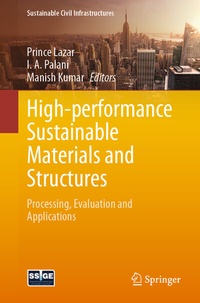
High-performance Sustainable Materials and Structures
Description

This book underscores the idea of harnessing the sustainable designs and materials in nature and integrating them into the field of engineering to design innovative materials and structures with multifunctional properties targeting defense, automotive, aerospace, electronics, nuclear, healthcare, energy, sports, packaging, etc. to offer improved safety, reliability, performance, durability, sustainability, and functionality. The concept of sustainability involves the understanding of how nature has evolved solutions to various challenges over millions of years and applying these principles to design innovative materials and structures with multifunctional properties. This book provides a thorough examination of the methods and techniques used in developing sustainable materials and structures, highlighting their potential for multifunctional applications. The book delves into the expansion of our understanding in this field, which is accompanied by novel synthesis and processing methods. These methods and techniques incorporate sustainable strategies, to create innovative materials and systems to offer a wide range of properties and functions, making them highly attractive for various applications in different fields of advanced technology. In addition, these materials and structures can be tailored to have specific properties and functions, such as self-healing capabilities, high strength-to-weight ratios, and enhanced energy absorption which are the prime requirements for the researchers looking for lightweight materials and structures.
More details
Other editions
Additional editions
Persons
Dr. Prince Jeya Lal Lazar is a distinguished academic and researcher with a specialization in Lightweight Materials & Structures. He holds a Bachelor's Degree in Mechanical Engineering and a Master's Degree in Engineering Design, both of which laid the foundation for his deep expertise in the field. He earned his Ph.D. from Anna University, Chennai, where he made significant contributions to the understanding of impact, blast, and crash loading on lightweight structures. Further enhancing his global research perspective, Dr. Prince completed a Post-doctoral tenure at Arizona State University in the United States. With over a decade of experience, Dr. Prince has established himself as a leading expert in developing innovative solutions for lightweight materials that enhance performance and sustainability across various industries. His research output includes numerous high-impact articles and book chapters that have gained wide recognition in the academic community. In addition to his research, Dr. Prince is actively involved in training and mentoring the next generation of engineers. He has successfully conducted various sponsored projects and training programs, supported by esteemed organizations such as SERB-DST, BRNS-DAE, TNSCST-DOTE, and the Centre for Faculty Development at Anna University. His commitment to advancing the field extends to his role as a reviewer for prestigious journals like Engineering Structures and Key Engineering Materials. He also serves as a Guest Editor for Elsevier Materials Today Proceedings and Sustainable Civil Infrastructures of Springer. His contributions to academic excellence are further recognized through his role as a Ph.D. Supervisor at Anna University, Chennai.
Dr. I. A. Palani is a prominent academic and researcher, currently serving as a Professor in the Department of Mechanical Engineering at the Indian Institute of Technology (IIT) Indore, India. He earned his Doctorate from the Indian Institute of Technology Madras and subsequently worked as a post-doctoral research scientist at the Graduate School of Information Science and Electrical Engineering, Kyushu University, Japan. At IIT Indore, Dr. Palani has been instrumental in establishing the Mechatronics and Instrumentation Lab. His expertise spans several advanced areas, including laser-assisted surface processing, micro-machining, smart materials, and shape memory alloys. He is a prolific author, with over 100 international journal publications, and has filed six Indian patents. Dr. Palani has successfully executed projects worth ?6 crores, funded by various prestigious agencies such as the DST, SERB, DAAD, JSPS, DRDO, and MHRD. His strong industry collaborations include technical consulting roles with companies like Volvo Eicher, John Deere, and WABCO. In addition to his industry work, he has established significant research collaborations with leading international institutions, including the University of IFW Dresden, Germany; Kyushu University, Japan; Jeju University, South Korea; St. Petersburg State University, Russia; and Purdue University, USA. A life member of the Indian Laser Association and the Institute of Smart Materials and Structures, Dr. Palani has received numerous accolades, including the 2015 Alumni Award for research and innovation. He has also been honored with the Kyushu University Friendship Scholarship and the AICTE National Doctoral Fellowship. His leadership roles at IIT Indore include being the founding Head of the Metallurgy Engineering and Material Science department, Head of the Mechanical Engineering Discipline, and currently, the Dean of Research and Development.
Dr. Manish Kumar is an esteemed academic and researcher, currently serving as an Associate Professor in the Department of Civil Engineering at the Indian Institute of Technology (IIT) in Bombay, India. He earned his MS and Ph.D. degrees in Structural and Earthquake Engineering from the State University of New York (SUNY) at Buffalo, USA. Following his doctoral studies, he furthered his research as a Postdoctoral Fellow in the Department of Civil Engineering at SUNY Buffalo. Dr. Kumar is also a Licensed Professional Civil Engineer in the state of California. Dr. Kumar's research is centered on the development of Blast and Impact Resistant Structures. He has been instrumental in establishing a state-of-the-art blast and impact laboratory at IIT Bombay, enabling cutting-edge experiments at the lab scale. His prolific research output includes 15 high-impact journal articles, 3 book chapters, and 15 conference proceedings. His multidisciplinary work encompasses the development of analytical models, numerical analysis, and experimental investigations in blast engineering. Dr. Kumar is an active member of several prestigious professional organizations, including the American Society of Civil Engineers (ASCE), American Society of Mechanical Engineers (ASME), American Concrete Institute (ACI), and American Institute of Steel Construction (AISC). He also contributes to national standards as a member of the CED 39 committee of the Bureau of Indian Standards (BIS) on Base-Isolated Buildings. Currently, he is guiding 7 Ph.D. research scholars in exploring advanced topics in impact and blast engineering.
Content
- Intro
- Preface
- Contents
- About the Editors
- Processing Techniques for Sustainable Materials
- Investigation of Fluid Flow Behavior in a Gas Atomization Process for Metal Powder Production
- 1 Introduction
- 2 Experimental Method and Procedure
- 3 Numerical Simulation Procedure
- 3.1 Sample Pre-processing
- 3.2 Numerical Formulation
- 3.3 Post-processing
- 4 Results
- 4.1 Powder Particle Distribution
- 4.2 Effect of Melt Delivery Tube Diameter
- 4.3 Clogging of Nozzle
- 4.4 Pressure Distribution Contours
- 4.5 Prediction of Pressure Zones
- 4.6 Fluid Flow Pattern
- 4.7 General Discussion
- 5 Conclusion
- References
- A Comparative Study of Gypsum-Based Composites with Waste Recycling for Electrical Properties in Futuristic Applications
- 1 Introduction
- 2 Methodology
- 2.1 Composite Synthesis
- 2.2 Di-electric Testing
- 3 Results & Discussion
- 3.1 High-Resolution Scanning Electron Microscope (HR-SEM)
- 3.2 Experimental Analysis of Dielectric Constant
- 3.3 Statistical Analysis of Dielectric Constant
- 4 Conclusion
- References
- Sustainable Manufacturing Processes
- Optimization of Cutting Parameters of Laser Drilling on Ti6Al4V Alloy Using ANN
- 1 Introduction
- 2 Materials and Method
- 3 Results and Discussion
- 4 Conclusions
- References
- Optimizing Delamination Free Drilling of GFRP Composites: An ANFIS Based Approach
- 1 Introduction
- 2 Literature Review
- 3 Experimental Setup
- 3.1 GFRP Laminate Manufacturing
- 3.2 Selection of Drilling Parameters
- 3.3 CNC Machining Center and Measurement Instruments
- 4 ANFIS-Based Mathematical Model
- 4.1 Development of the ANFIS Model in MATLAB
- 4.2 Analysis of Cutting Parameters and Tool Geometry
- 4.3 ANOVA Analysis for Thrust Force
- 4.4 Examination of Delamination Factors at Entry (Fdi) Through Analysis of Variance (ANOVA)
- 4.5 Analysis of Delamination at Exit (Fdo) Using ANOVA
- 4.6 Comparison of Predicted and Experimented Machining Values
- 5 Conclusion
- References
- Optimization of Process Parameters of Al6061/SiC /B4C / Talc Composite by Grey Relational Analysis
- 1 Introduction
- 2 Materials and Method
- 3 Results and Discussions
- 3.1 Microstructure
- 3.2 Wear Test
- 3.3 Grey Relational Analysis (GRA)
- 3.4 Worn Surface Effect and Analysis
- 3.5 Analysis of Variance
- 3.6 Conformation Experiment
- 4 Conclusion
- References
- Prediction of Improved Surface Quality by Optimized Influential Milling Processes Parameters with Different Cutters on Magnesium Alloy
- 1 Introduction
- 1.1 Novelty
- 2 Literature Survey
- 3 Methodology
- 4 Experimental Process
- 5 Results and Discussion
- 6 Confirmation Test
- 7 Conclusions
- References
- Abrasive Water Jet Drilling On AZ91D/ZrB2 Composite - The Preliminary Study
- 1 Introduction
- 2 Materials and Methods
- 3 Result and Discussion
- 3.1 Effect of Parameters Combination on the Diameter of the AWJ Drilled Hole
- 3.2 Effect of Parameters Combination on the Circularity
- 3.3 Effect of Parameters Combination on the Cylindricity
- 3.4 Effect of Parameter Combination on the Perpendicularity
- 4 Conclusions
- References
- Multi-Objective Optimization of Mechanical Attributes in Friction Stir Welding on Al 7075-T65 Using Anova
- 1 Introduction
- 2 FSW Process
- 3 Experimental Procedure
- 3.1 Setup for the Experiment
- 3.2 Design of Experiments
- 3.3 Mechanical Properties Evaluation
- 4 Results & Discussion
- 4.1 Weld Speed Effect
- 4.2 Rotational Speed
- 4.3 Taguchi GRA
- 4.4 Signal-To-Noise Ratio
- 4.5 Grey Relation Analysis
- 5 Result & Discussions
- 5.1 Examination of GRG's Means
- 5.2 Analysis of Variance for S/N Ratios
- 5.3 Confirmation Test
- 6 Conclusion
- References
- Optimization of Cutting Forces and Surface Roughness in Turning Haynes 25 Superalloy
- 1 Introduction
- 2 Experiment Setup and Details
- 2.1 Multifactor Optimization
- 3 Results and Discussion
- 3.1 Taguchi Analysis
- 3.2 Regression Analysis
- 4 Conclusion
- References
- A Machine Learning Based Prediction of Machining Characteristics of Super Alloy in EDM Using Green Synthesized Nano Copper Oxide Dispersed Bio Dielectric Fluid
- 1 Introduction
- 2 Materials and Methods
- 2.1 Synthesis of Nano Copper Oxide
- 2.2 Preparation of Methyl Ester
- 2.3 Preparation of Nano CuO Dispersed Bio Dielectric Fluid
- 2.4 Experimental Approach
- 2.5 Modeling by Artificial Neural Network
- 2.6 Support Vector Machine Modeling
- 2.7 Optimization by Genetic Algorithm
- 3 Results and Discussion
- 3.1 Characterization of Nano CuO
- 3.2 Predicted Results by ANN Model
- 3.3 Results from SVM Model
- 3.4 GA Optimization
- 3.5 Comparison of ANN and SVM
- 4 Conclusion
- References
- Predictive Modelling of Wear and Friction in Surface Textured TiAlN Coated Ti6Al4V Alloy Using Artificial Neural Networks
- 1 Introduction
- 2 Experimental Work
- 2.1 Material
- 2.2 Wear Test
- 2.3 Design of ANN
- 3 Result and Discussion
- 3.1 Confirmation Test
- 4 Conclusions
- References
- Properties and characterization of Sustainable Materials
- Effect of TiB2 on Dry Sliding Wear Behaviour of Aluminium-Based Metal Matrix Composites Fabricated via Powder Metallurgy
- 1 Introduction
- 2 Materials and Methods
- 2.1 Wear Test and Optimization Technique
- 3 Test Results and Explanations
- 3.1 Analysis of Microstructure of Fabricated Composites
- 3.2 Density and Porosity of Fabricated Composites
- 3.3 Hardness and Compressive Strength
- 3.4 ANOVA and Effects of Factors
- 3.5 Interaction Plots on Wear Rate
- 4 Conclusions
- References
- An Optimization Study on Wear Behaviour of AZ91/ZrB2 Composites Through Topsis Techniques
- 1 Introduction
- 2 Experimental Procedures
- 2.1 Dry Sliding Wear Behaviour
- 3 Obtained Results and Discussion
- 3.1 Micro Vickers Hardness of AZ91D/ZrB2
- 3.2 Wear and Friction Analysis
- 4 Conclusions
- References
- Mechanical Properties and Microstructure of Underwater Friction Stir Welded AA5083-Cu Dissimilar Plates
- 1 Introduction
- 2 Experimental Procedure
- 2.1 UFSW Experimental Setup
- 2.2 Tensile Properties
- 2.3 Microstructural Analysis
- 3 Result and Discussions
- 3.1 Tensile Properties
- 3.2 Post-Weld Hardness and Microstructure
- 4 Conclusion
- References
- Mechanical Characterization of Epoxy-Nanoclay-Kenaf Fiber Polymer Composites
- 1 Introduction
- 2 Materials and Methods
- 3 Results and Discussion
- 4 Conclusion
- References
- Thermal Studies on Palm Fibre and Rice Husk Ash Ash-Reinforced Epoxy Resin Composite
- 1 Introduction
- 2 Materials and Methods
- 3 Results and Discussion
- 4 Conclusion
- References
- Ultrasonic Testing: Comprehensive Approach to Forecast Mechanical Properties of Castings
- 1 Introduction
- 2 Ultrasonic Testing
- 3 Property Prediction by UT
- 3.1 Calibration
- 3.2 Ultrasonic Parameters
- 3.3 Ultrasonic Velocity Measurement
- 4 Correlation of Ultrasonic Parameters with Micro Structure and Mechanical Properties
- 5 Findings
- 6 Summary
- References
- A Short Review on Non-Destructive Testing (NDT) for Assessment of Damage in Fibre Reinforced Polymer Composites
- 1 Introduction
- 2 Impact on Composite Specimen
- 2.1 Elements Affecting Impact Properties
- 2.2 Damage Progression Under Impact Loading
- 3 Damage Detection Methods
- 4 Benefits and Drawbacks of NDT Methods
- 5 Conclusion
- References
- Critical Analysis of Current Tools and Techniques in Exploring Laser Welding for Joining Plates and Pipes with Similar/Dissimilar Metals from Various Sources
- 1 Introduction
- 1.1 Weldability of Metals
- 1.2 Types of Laser Welding
- 1.3 Process Parameters
- 2 Literature Review
- 2.1 Laser Welding of Similar Material
- 2.2 Other Review Papers
- 2.3 AI-ML Techniques Used
- 3 Mechanical Properties and Performance
- 3.1 Quality Assessment in Laser Welding
- 4 Characterization Techniques Used
- 5 Challenges and Limitations
- 6 Recent Advancements and Future Directions
- 7 Conclusions
- References
- An Experimental and Optimization of Bio-Based Polyurethane Foam for Low-Velocity Impact: Towards Futuristic Applications
- 1 Introduction
- 2 Experimental Procedure
- 2.1 Materials
- 2.2 Synthesis Procedure
- 2.3 Low-Velocity Impact Test Setup
- 3 Results and Discussion
- 3.1 Examination Using HR-SEM and FTIR Analysis
- 3.2 Experimental Analysis
- 3.3 Statistical Analysis
- 4 Conclusion
- 5 Data Availability Statement
- References
- Architected Structures
- Earthquake Behaviour of Stilt Buildings on Hill Slopes
- 1 Introduction
- 2 Building Configurations
- 3 Numerical Study
- 3.1 Elastic Behavior
- 3.2 Inelastic Behaviour Using Nonlinear Static Analysis
- 4 Conclusions
- References
- Earthquake Behaviour of Buildings with Transfer Structure
- 1 Introduction
- 2 Numerical Study
- 2.1 Building Characteristics
- 2.2 Elastic Behaviour
- 2.3 Inelastic Behaviour
- 3 Conclusions
- References
- Plan Geometric Effect on High-Rise Buildings Under Earthquake Shaking
- 1 Introduction
- 2 Numerical Study
- 2.1 Building Characteristics
- 2.2 Elastic Behaviour
- 2.3 Inelastic Behaviour Using Nonlinear Static Analysis
- 3 Conclusions
- References
- Structural Analysis and Optimization of Trussed Roof Steel Structures for Enhanced Safety-A Comparative Study
- 1 Introduction
- 2 Analytical Model Studied
- 3 Model Geometry
- 4 Material Properties
- 4.1 Member Sections of the Model
- 4.2 Element Type and Meshing
- 4.3 Loads and Boundary Conditions
- 5 Conclusions Based on Analytical Model Studied
- 6 Future Recommendations of This Study
- References
- Investigating the Lifting Characteristics of Bioinspired Wings Through Wind Tunnel Studies
- 1 Introduction
- 2 Materials and Methods
- 3 Experimental Setup and Procedure
- 4 Results and Discussion
- 5 Data Analysis
- 6 Conclusion
- References
- Evaluation Methods for Sustainable Structures
- Section Moment Capacity of Cold-Formed Steel Sigma Sections
- 1 Introduction
- 2 Numerical Study
- 2.1 FE Type and Meshing
- 2.2 Material Properties
- 2.3 Boundary and Loading Conditions
- 2.4 Validation of Experimental Results of Single Sigma Sections
- 2.5 Validation of Experimental Results of Built-Up Sigma Sections
- 3 Parametric Study
- 3.1 Specimen Dimensions for Both Single and Built-Up Sigma Sections
- 3.2 Specimen Modelling for Both Single and Built-Up Sigma Sections
- 4 Results and Discussion
- 4.1 Parametric Study Results of Single Sections
- 4.2 Parametric Study on Built-Up Sigma Sections
- 4.3 Comparison Between Single and Built-Up Beams
- 5 Conclusions
- References
- Optimization of Cold-Formed Steel Perforated Sections Subjected to Bending
- 1 Introduction
- 2 Numerical Study
- 2.1 Model Labelling
- 2.2 Loading and Boundary Conditions
- 2.3 Analysis and Results Validation
- 3 Parametric Study
- 3.1 Shape and Size of the Openings
- 3.2 Effect of Opening Shape on Moment Capacity
- 3.3 Effect of Shape Elongation of the Opening
- 3.4 Effect of Size of the Opening
- 3.5 Effect of Number, Spacing & Edge Distance of Openings
- 4 Optimized Sections
- 5 Conclusions
- References
- Applications of Sustainable Materials and Structures
- Fabrication of Supercapacitor Devices and Their Real-Time Applications
- 1 Introduction
- 1.1 Supercapacitor as Next-Generation Energy Storage Device
- 1.2 Global Supercapacitor and Ultracapacitor Manufacturers
- 2 Design, Fabrication, and Assembly of the Supercapacitor Device
- 3 Potential Applications of Supercapacitor Devices
- 3.1 Automobiles and Transport Applications
- 4 Summary and Outlook
- References
- Advances in Muffler Acoustics: From Conventional Material to Acoustic Metamaterial
- 1 Introduction
- 2 Conventional Muffler
- 3 Acoustic Metamaterial Mufflers
- 3.1 Membrane Type Acoustic Metamaterial Mufflers
- 3.2 The Acoustic Black Hole
- 3.3 Locally Resonant Phonic / Sonic Crystal
- 4 Discussion, Prospects, and Conclusion
- References
- Polyamide: Comprehensive Insights into Types, Chemical Foundations, Blending Techniques and Versatile Applications
- 1 Introduction
- 2 Chemistry of Polyamides
- 2.1 Polycondensation
- 2.2 Ring-Opening Polymerization
- 2.3 Nylon 6 and Nylon 66:
- 3 Types of Polyamides
- 4 Blending Processing Techniques
- 4.1 Melt Blending
- 4.2 Solution Blending
- 4.3 In-situ Polymerization
- 4.4 Compounding
- 4.5 Reactive Blending
- 5 Manufacturing Process of Polyamides
- 5.1 Monomer Production
- 5.2 Polymerization
- 5.3 Polymer Processing
- 5.4 Additives and Modifications
- 5.5 Quality Control and Testing
- 6 Applications of Polyamides
- 7 Recent Advances and Future Perspectives
- 7.1 Enhanced Mechanical Properties for Automotive Components
- 7.2 Barrier Films for Food Packaging
- 7.3 Biodegradable Polymers for Sustainable Products
- 7.4 Thermoplastic Elastomers (TPEs) in Medical Devices
- 7.5 Functional Coatings with Improved Adhesion
- 8 Conclusion
- References
- Experimental Investigation and CFD Analysis of the Effects of Various Geometrical Parameters and Inlet Pressure of a Vortex Tube
- 1 Introduction
- 2 Numerical Modeling and Governing Equations
- 3 Vortex Tube Modeling
- 3.1 Boundary Conditions
- 4 Result and Discussions:
- 4.1 Mesh Independence Study Analysis
- 4.2 Effect of Conical Valve Position
- 5 Experimental Setup
- 6 Validation
- 6.1 Comparison of CFD and Experimental Values.
- 7 Conclusion
- References
- Investigation of Aluminium-Alloy Wheel Using FEA and Energy Absorption Experiments
- 1 Introduction
- 2 Method
- 3 Results
- 4 Discussions
- 5 Conclusion
- References
- A Comprehensive Review on Friction Materials for Automotive Applications
- 1 Introduction
- 1.1 Friction Materials for Automotive Application
- 1.2 Influence of Matrix in Friction Material
- 1.3 Influence of Fillers in Friction Materials
- 2 Manufacturing Considerations
- 2.1 Metal Matrix for Friction Materials
- 2.2 Organic Matrix for Friction Materials
- 2.3 Ceramic Matrix for Friction Materials
- 3 Key Properties of Friction Materials
- 3.1 Coefficient of Friction
- 3.2 Wear Resistance
- 3.3 Thermal Stability
- 3.4 Mechanical Strength
- 4 Manufacturing Process
- 4.1 Mixing
- 4.2 Formation
- 4.3 Curing
- 4.4 Finishing
- 5 Performance Evaluation
- 5.1 Friction Tests
- 5.2 Wear Tests
- 5.3 Thermal Tests
- 5.4 Mechanical Tests
- 6 Conclusion
- References
- Case Studies: Multifunctional Sustainable Materials & Structures
- Computational Design of Fly Ash Geopolymer Mortar Using Experimental and Attribute Evaluation Approaches
- 1 Introduction
- 2 Methodology
- 2.1 Experimental Program
- 2.2 Analytical Methods for Attribute Evaluation
- 3 Results
- 3.1 Experimental Results
- 3.2 Attribute Evaluation
- 4 Discussion
- 5 Conclusion
- References
- A Novel Polycarbonate Urethane Aortic Valve with Computational Fluid-Structure Analysis
- 1 Introduction
- 2 Literature Survey
- 3 Materials, Methods and Proposed Work
- 3.1 3D Modelling of Aortic Valve
- 3.2 Designing 3D Valve Using Solid Works
- 3.3 Polycarbonate Urethane
- 3.4 Finite Element Analysis
- 3.5 CFD- Computational Fluid Dynamics
- 4 Results and Discussion
- 4.1 Comparative Analysis
- 5 Conclusion
- References
- Installation of Air Conditioning Pack into a Light Transport Aircraft: Design, Analysis and Optimization
- 1 Introduction
- 2 Methodology
- 2.1 FAR 23 Compliance Requirements
- 2.2 Design Factors Accounted
- 2.3 Arriving at Installatıon Scheme & Number of Components of the Installation, Material Selection and Component Sizing & Fastener Selection
- 2.4 Design Validation Using the SOM Approach
- 2.5 Design Validation Using FEA
- 3 Optimization
- 4 Results
- 4.1 Lug Analysis Using SOM Approach
- 4.2 Lug Analysis Using FEA
- 4.3 Mass Reduction
- 4.4 Optimized Model FEA Results
- 5 Conclusions
- References
- Design and Dynamic Analysis of Artificial Heart Model by Using FEA
- 1 Introduction
- 1.1 Heart
- 1.2 Artificial Heart
- 2 Literature Review
- 2.1 Early Stages of Development
- 2.2 An Artificial Heart Implants-Early Designs
- 3 Methodology
- 4 Modelling and Analysis
- 4.1 Design of Total Artificial Heart Model
- 4.2 Parameters to Construct the Geometry to Develop Heart Model
- 4.3 Geometry Construction and Development of Total Heart Model
- 4.4 Working Principle
- 4.5 Pumping Volume
- 5 FEA (Finite Element Analysis)-Dynamic Analysis
- 5.1 Steps Followed
- 5.2 Setting Up the FE Model-Applying Boundary Conditions and Loads
- 5.3 Solving the Boundary Value Problem
- 6 Results
- 6.1 Dynamic Analysis Results
- 6.2 Theoretical Calculations for CFD Flow Comparison
- 7 Conclusions
- References
- Numerical Study of Impact Force on Thin Aluminium Plate Against Hail Ice Impact
- 1 Introduction
- 2 Material and Method
- 2.1 Simulation Model
- 2.2 Ice Material Model
- 3 Numerical Modelling
- 4 Results and Discussion
- 4.1 Numerical Simulation
- 4.2 Deformation and Failure Mechanism
- 5 Conclusion
- References
- Design and Analysis of Material Handling Equipment of Cladding
- 1 Introduction
- 2 Design of Bin
- 3 Research Methodology
- 3.1 Autodesk Netfabb 2024
- 3.2 Static Structural Analysis Using ANSYS R22
- 4 Results
- 5 Conclusions
- References
- Dimensionally Reduced Modelling of Hyperelastic Coated Fabric Using Variational Asymptotic Method
- 1 Introduction
- 2 3D Kinematics and Potential Energy
- 3 Dimensional Reduction Using VAM
- 4 Plate Analysis: 2D Non-Linear FEA
- 5 Numerical Analysis: Test Case
- 6 Conclusion
- References
- Author Index
