

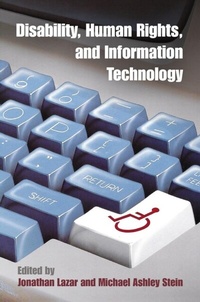
Disability, Human Rights, and Information Technology
1st Edition
Published on 12. May 2017
360 pages
978-0-8122-9409-5 (ISBN)
Description

Disability, Human Rights, and Information Technology addresses the global issue of equal access to information and communications technology (ICT) by persons with disabilities. The right to access the same digital content at the same time and at the same cost as people without disabilities is implicit in several human rights instruments and is featured prominently in Articles 9 and 21 of the Convention on the Rights of Persons with Disabilities. The right to access ICT, moreover, invokes complementary civil and human rights issues: freedom of expression; freedom to information; political participation; civic engagement; inclusive education; the right to access the highest level of scientific and technological information; and participation in social and cultural opportunities.
Despite the ready availability and minimal cost of technology to enable people with disabilities to access ICT on an equal footing as consumers without disabilities, prevailing practice around the globe continues to result in their exclusion. Questions and complexities may also arise where technologies advance ahead of existing laws and policies, where legal norms are established but not yet implemented, or where legal rights are defined but clear technical implementations are not yet established.
At the intersection of human-computer interaction, disability rights, civil rights, human rights, international development, and public policy, the volume's contributors examine crucial yet underexplored areas, including technology access for people with cognitive impairments, public financing of information technology, accessibility and e-learning, and human rights and social inclusion.
Contributors: John Bertot, Peter Blanck, Judy Brewer, Joyram Chakraborty, Tim Elder, Jim Fruchterman, G. Anthony Giannoumis, Paul Jaeger, Sanjay Jain, Deborah Kaplan, Raja Kushalnagar, Jonathan Lazar, Fredric I. Lederer, Janet E. Lord, Ravi Malhotra, Jorge Manhique, Mirriam Nthenge, Joyojeet Pal, Megan A. Rusciano, David Sloan, Michael Ashley Stein, Brian Wentz, Marco Winckler, Mary J. Ziegler.
Despite the ready availability and minimal cost of technology to enable people with disabilities to access ICT on an equal footing as consumers without disabilities, prevailing practice around the globe continues to result in their exclusion. Questions and complexities may also arise where technologies advance ahead of existing laws and policies, where legal norms are established but not yet implemented, or where legal rights are defined but clear technical implementations are not yet established.
At the intersection of human-computer interaction, disability rights, civil rights, human rights, international development, and public policy, the volume's contributors examine crucial yet underexplored areas, including technology access for people with cognitive impairments, public financing of information technology, accessibility and e-learning, and human rights and social inclusion.
Contributors: John Bertot, Peter Blanck, Judy Brewer, Joyram Chakraborty, Tim Elder, Jim Fruchterman, G. Anthony Giannoumis, Paul Jaeger, Sanjay Jain, Deborah Kaplan, Raja Kushalnagar, Jonathan Lazar, Fredric I. Lederer, Janet E. Lord, Ravi Malhotra, Jorge Manhique, Mirriam Nthenge, Joyojeet Pal, Megan A. Rusciano, David Sloan, Michael Ashley Stein, Brian Wentz, Marco Winckler, Mary J. Ziegler.
Reviews / Votes
"This is an exciting and much-needed project. The right to accessibility has received relatively little academic attention and this book performs a field-defining role." (Anna Lawson, University of Leeds) "As information technology continues to transform human endeavor, it poses new challenges to law and regulation in many sectors. Disability is such a sector. There is no other book that provides so many insights into the rapidly evolving international scene." (Clayton H. Lewis, University of Colorado, Boulder)More details
Series
Language
English
Place of publication
Pennsylvania
United States
Target group
College/higher education
File size
1,36 MB
ISBN-13
978-0-8122-9409-5 (9780812294095)
Copyright in bibliographic data and cover images is held by Nielsen Book Services Limited or by the publishers or by their respective licensors: all rights reserved.
Schweitzer Classification
Other editions
Additional editions
Jonathan Lazar | Michael Ashley Stein
Disability, Human Rights, and Information Technology
Book
06/2017
University of Pennsylvania Press
€79.00
Shipment within 10-20 days
Persons
Jonathan Lazar is Professor of Information Studies and Associate Director of the Trace Research and Development Center at the University of Maryland. He is author of numerous books, including Ensuring Digital Accessibility Through Process and Policy and Research Methods in Human-Computer Interaction. Michael Ashley Stein is Cofounder and Executive Director of the Harvard Law School Project on Disability, Visiting Professor at Harvard Law School, and Extraordinary Professor at University of Pretoria Faculty of Law, Centre for Human Rights.
Content
- Cover
- Contents
- Foreword
- Introduction
- PART I. PARTICIPATION AND INCLUSION
- 1. Standards Bodies, Access to Information Technology, and Human Rights
- 2. Accessible ICTs and the Opening of Political Space for Persons with Disabilities
- 3. Web Accessibility for People with Cognitive Disabilities: A Legal Right?
- 4. The Intersection of Human Rights, Social Justice, the Internet, and Accessibility in Libraries: Access, Education, and Inclusion
- PART II. GOVERNMENT AND GOVERNANCE
- 5. Public Financing of Information Technology and Human Rights for People with Disabilities
- 6. Using Provincial Laws to Drive a National Agenda: Connecting Human Rights and Disability Rights Laws
- 7. Access to Justice
- 8. Open Government and Digital Accessibility
- PART III. SPECIFIC APPLICATIONS AND TECHNOLOGIES
- 9. E-Books and Human Rights
- 10. Accessibility and Online Learning
- 11. Who Owns Captioning?
- 12. Information Privacy and Security as a Human Right for People with Disabilities
- 13. How Does Inaccessible Gaming Lead to Social Exclusion?
- PART IV. INTERNATIONAL DEVELOPMENT
- 14. The Pivot Model of Policy Entrepreneurship: An Application of European Ideas in the Global South
- 15. The Accessibility Infrastructure and the Global South
- 16. ICT Access, Disability Human Rights, and Social Inclusion in India
- Notes
- Contributors
- Index
- A
- B
- C
- D
- E
- F
- G
- H
- I
- J
- K
- L
- M
- N
- O
- P
- Q
- R
- S
- T
- U
- V
- W
- X
- Y
