

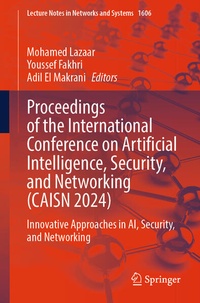
Proceedings of the International Conference on Artificial Intelligence, Security, and Networking (CAISN 2024)
Description

This book presents a selection of 42 original and peer-reviewed research papers from the International Conference on Artificial Intelligence, Security and Networking (CAISN 2024) held at the Faculty of Sciences, Ibn Tofail University, Kenitra, Morocco.
Covering cutting-edge topics in AI, cybersecurity, communication networks, cloud computing, embedded systems, and their applications in smart cities and industrial automation, this book highlights recent advances and emerging trends in intelligent systems and secure technologies.
CAISN 2024 brought together a diverse group of researchers and professionals from academia and industry to share innovations and challenges shaping the future of intelligent and secure systems.
This book serves as a valuable reference for students, researchers, engineers, and practitioners seeking insights into the rapidly evolving fields of artificial intelligence, networking, and security.
More details
Other editions
Additional editions
Persons
Mohamed Lazaar is a full professor at the National School of Computer Science and Systems Analysis (ENSIAS), Mohammed V University in Rabat, Morocco. His scientific interests encompass decision support systems, artificial intelligence, and digital transformation. He has supervised a number of Ph.D.s and Master's theses and has published widely in international conferences and journals in AI and data analytics. He has also served in organizational responsibilities for national and international research meetings.
Youssef Fakhri is a full professor in computer science at the Faculty of Sciences, University Ibn Tofail, Kenitra, Morocco. His research also focuses on machine learning, security, and intelligent systems. He has published and co-published numerous scientific papers within these areas. He is an active member in academic peer reviewing and technical committees of international conferences.
Adil El Makrani is a full professor of computer science at Ibn Tofail University, Faculty of Sciences, Kenitra, Morocco. His research addresses artificial intelligence, smart cities, and secure digital communication. Prof. El Makrani has directed numerous engineering and master's students and commonly acts as a reviewer for international journals as well as Springer conferences. As a general chair of CAISN 2024, he contributed in the scientific program organization leading the review process in order to maintain the quality of the submitted papers.
Content
1.Comparing LSTM, CNN, and BERT Models in Oil Price Forecasting.- 2.Advanced Intrusion Detection Systems: A Comparative Study of Deep Learning and Ensemble Learning Models for IIoT Networks.- 3.Enhancing Large Language Models with Retrieval Augmented Generation for a Trusted Help Desk Solution.- 4.A New Contextual Model to Overcome the Recommender Systems Issues: An Exploratory Study.- 5.Comparative Study between YOLOv5 and YOLOv8 in Object Detection and Re-Identification using the DukeMTMC-reID Dataset.- 41.MAGENTA+: Detection of Arabic Machine-Generated Text across Domains.- 42.Deep Learning-Based Classification of Brain Tumor MRI Images: A Comparative Study.
