

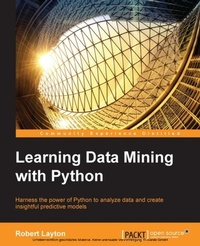
Learning Data Mining with Python
Harness the power of Python to analyze data and create insightful predictive models
Published on 7. October 2025
344 pages
978-1-78439-120-1 (ISBN)
Description

Key Features
Book DescriptionIf you are a programmer who wants to get started with data mining, then this book is for you.What you will learn
Apply data mining concepts to realworld problems
Predict the outcome of sports matches based on past results
Determine the author of a document based on their writing style
Use APIs to download datasets from social media and other online services
Find and extract good features from difficult datasets
Create models that solve realworld problems
Design and develop data mining applications using a variety of datasets
Set up reproducible experiments and generate robust results
Recommend movies, online celebrities, and news articles based on personal preferences
Compute on big data, including realtime data from the Internet
Who this book is forIf you are a programmer who wants to get started with data mining, then this book is for you.
Book DescriptionIf you are a programmer who wants to get started with data mining, then this book is for you.What you will learn
Apply data mining concepts to realworld problems
Predict the outcome of sports matches based on past results
Determine the author of a document based on their writing style
Use APIs to download datasets from social media and other online services
Find and extract good features from difficult datasets
Create models that solve realworld problems
Design and develop data mining applications using a variety of datasets
Set up reproducible experiments and generate robust results
Recommend movies, online celebrities, and news articles based on personal preferences
Compute on big data, including realtime data from the Internet
Who this book is forIf you are a programmer who wants to get started with data mining, then this book is for you.
All prices
More details
Edition
Digital original
Language
English
Place of publication
Birmingham
United Kingdom
Target group
Professional and scholarly
US School Grade: College Graduate Student
Edition type
Digital original
File size
4,01 MB
ISBN-13
978-1-78439-120-1 (9781784391201)
Copyright in bibliographic data and cover images is held by Nielsen Book Services Limited or by the publishers or by their respective licensors: all rights reserved.
Schweitzer Classification
Other editions
Additional editions
Robert Layton
Learning Data Mining with Python
Book
07/2015
Packt Publishing
€56.50
Shipment within 3-4 weeks
Person
Layton Robert :
Robert Layton is a data scientist investigating data-driven applications to businesses across a number of sectors. He received a PhD investigating cybercrime analytics from the Internet Commerce Security Laboratory at Federation University Australia, before moving into industry, starting his own data analytics company dataPipeline. Next, he created Eureaktive, which works with tech-based startups on developing their proof-of-concepts and early-stage prototypes. Robert also runs the LearningTensorFlow website, which is one of the world's premier tutorial websites for Google's TensorFlow library. Robert is an active member of the Python community, having used Python for more than 8 years. He has presented at PyConAU for the last four years and works with Python Charmers to provide Python-based training for businesses and professionals from a wide range of organisations. Robert can be best reached via Twitter @robertlayton
Robert Layton is a data scientist investigating data-driven applications to businesses across a number of sectors. He received a PhD investigating cybercrime analytics from the Internet Commerce Security Laboratory at Federation University Australia, before moving into industry, starting his own data analytics company dataPipeline. Next, he created Eureaktive, which works with tech-based startups on developing their proof-of-concepts and early-stage prototypes. Robert also runs the LearningTensorFlow website, which is one of the world's premier tutorial websites for Google's TensorFlow library. Robert is an active member of the Python community, having used Python for more than 8 years. He has presented at PyConAU for the last four years and works with Python Charmers to provide Python-based training for businesses and professionals from a wide range of organisations. Robert can be best reached via Twitter @robertlayton
Content
Table of Contents
Getting Started with data mining
Classifying using scikit-learn estimators
Predicting Sports Winners with Decision Trees
Recommending Movies using Affinity Analysis
Extracting Features with Transformers
Detecting Social media spam using Naive Bayes
Discovering accounts to follow using graph mining
Beating CAPTCHAs with Neural Networks
Authorship attribution
Clustering news articles
Detecting objects in images using Deep Neural Networks
Getting fit with big data
Appendix : Next steps
Getting Started with data mining
Classifying using scikit-learn estimators
Predicting Sports Winners with Decision Trees
Recommending Movies using Affinity Analysis
Extracting Features with Transformers
Detecting Social media spam using Naive Bayes
Discovering accounts to follow using graph mining
Beating CAPTCHAs with Neural Networks
Authorship attribution
Clustering news articles
Detecting objects in images using Deep Neural Networks
Getting fit with big data
Appendix : Next steps

