

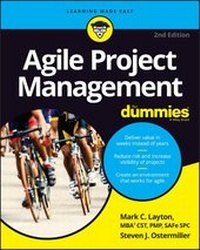
Agile Project Management For Dummies
2nd Edition
Published on 21. August 2017
432 pages
978-1-119-40574-0 (ISBN)
Description

Flex your project management muscle
Agile project management is a fast and flexible approach to managing all projects, not just software development. By learning the principles and techniques in this book, you'll be able to create a product roadmap, schedule projects, and prepare for product launches with the ease of Agile software developers. You'll discover how to manage scope, time, and cost, as well as team dynamics, quality, and risk of every project.
As mobile and web technologies continue to evolve rapidly, there is added pressure to develop and implement software projects in weeks instead of months--and Agile Project Management For Dummies can help you do just that. Providing a simple, step-by-step guide to Agile project management approaches, tools, and techniques, it shows product and project managers how to complete and implement projects more quickly than ever.
* Complete projects in weeks instead of months
* Reduce risk and leverage core benefits for projects
* Turn Agile theory into practice for all industries
* Effectively create an Agile environment
Get ready to grasp and apply Agile principles for faster, more accurate development.
More details
Other editions
Additional editions
Mark C. Layton | Steven J. Ostermiller
Agile Project Management For Dummies
Book
10/2017
2nd Edition
Wiley
€28.90
Article exhausted; check for reprint
Persons
Mark C. Layton, aka "Mr. Agile¯(TM)," is a veteran of more than 25 years in the project and program management field. He is a Certified Scrum Trainer, a PMP, and an MBA. He holds multiple scrum scaling certifications and is the founder of Platinum Edge, LLC. Steven J. Ostermiller is a coach, mentor, and trainer empowering leaders and teams to become more agile. He holds CSP and PMP designations.
Content
1 - Title Page [Seite 3]
2 - Copyright Page [Seite 4]
3 - Table of Contents [Seite 7]
4 - Introduction [Seite 15]
4.1 - About This Book [Seite 15]
4.2 - Foolish Assumptions [Seite 15]
4.3 - Icons Used in This Book [Seite 16]
4.4 - Beyond the Book [Seite 16]
4.5 - Where to Go from Here [Seite 17]
5 - Part 1 Understanding Agile [Seite 19]
5.1 - Chapter 1 Modernizing Project Management [Seite 21]
5.1.1 - Project Management Needed a Makeover [Seite 21]
5.1.1.1 - The origins of modern project management [Seite 22]
5.1.1.2 - The problem with the status quo [Seite 24]
5.1.2 - Introducing Agile Project Management [Seite 25]
5.1.2.1 - How agile projects work [Seite 27]
5.1.2.2 - Why agile projects work better [Seite 28]
5.2 - Chapter 2 Applying the Agile Manifesto and Principles [Seite 31]
5.2.1 - Understanding the Agile Manifesto [Seite 31]
5.2.2 - Outlining the Four Values of the Agile Manifesto [Seite 34]
5.2.2.1 - Value 1: Individuals and interactions over processes and tools [Seite 34]
5.2.2.2 - Value 2: Working software over comprehensive documentation [Seite 36]
5.2.2.3 - Value 3: Customer collaboration over contract negotiation [Seite 38]
5.2.2.4 - Value 4: Responding to change over following a plan [Seite 39]
5.2.3 - Defining the 12 Agile Principles [Seite 40]
5.2.3.1 - Agile principles of customer satisfaction [Seite 41]
5.2.3.2 - Agile principles of quality [Seite 44]
5.2.3.3 - Agile principles of teamwork [Seite 45]
5.2.3.4 - Agile principles of project management [Seite 47]
5.2.4 - Adding the Platinum Principles [Seite 51]
5.2.4.1 - Resisting formality [Seite 51]
5.2.4.2 - Thinking and acting as a team [Seite 52]
5.2.4.3 - Visualizing rather than writing [Seite 52]
5.2.5 - Changes as a Result of Agile Values [Seite 55]
5.2.6 - The Agile Litmus Test [Seite 55]
5.3 - Chapter 3 Why Being Agile Works Better [Seite 57]
5.3.1 - Evaluating Agile Benefits [Seite 57]
5.3.2 - How Agile Approaches Beat Historical Approaches [Seite 62]
5.3.2.1 - Greater flexibility and stability [Seite 63]
5.3.2.2 - Reduced nonproductive tasks [Seite 65]
5.3.2.3 - Higher quality, delivered faster [Seite 67]
5.3.2.4 - Improved team performance [Seite 68]
5.3.2.5 - Tighter project control [Seite 70]
5.3.2.6 - Faster and less costly failure [Seite 71]
5.3.3 - Why People Like Being Agile [Seite 71]
5.3.3.1 - Executives [Seite 72]
5.3.3.2 - Product development and customers [Seite 73]
5.3.3.3 - Management [Seite 74]
5.3.3.4 - Development teams [Seite 75]
6 - Part 2 Being Agile [Seite 77]
6.1 - Chapter 4 Agile Approaches [Seite 79]
6.1.1 - Diving under the Umbrella of Agile Approaches [Seite 79]
6.1.2 - Reviewing the Big Three: Lean, Scrum, and Extreme Programming [Seite 83]
6.1.2.1 - An overview of lean [Seite 83]
6.1.2.2 - An overview of scrum [Seite 87]
6.1.2.3 - An overview of extreme programming [Seite 90]
6.1.3 - Putting It All Together [Seite 94]
6.2 - Chapter 5 Agile Environments in Action [Seite 95]
6.2.1 - Creating the Physical Environment [Seite 96]
6.2.1.1 - Collocating the team [Seite 96]
6.2.1.2 - Setting up a dedicated area [Seite 97]
6.2.1.3 - Removing distractions [Seite 98]
6.2.1.4 - Going mobile [Seite 99]
6.2.2 - Low-Tech Communicating [Seite 100]
6.2.3 - High-Tech Communicating [Seite 102]
6.2.4 - Choosing Tools [Seite 104]
6.2.4.1 - The purpose of the tool [Seite 104]
6.2.4.2 - Organizational and compatibility constraints [Seite 104]
6.3 - Chapter 6 Agile Behaviors in Action [Seite 107]
6.3.1 - Establishing Agile Roles [Seite 107]
6.3.1.1 - Product owner [Seite 108]
6.3.1.2 - Development team member [Seite 111]
6.3.1.3 - Scrum master [Seite 112]
6.3.1.4 - Stakeholders [Seite 114]
6.3.1.5 - Agile mentor [Seite 116]
6.3.2 - Establishing New Values [Seite 116]
6.3.2.1 - Commitment [Seite 117]
6.3.2.2 - Courage [Seite 117]
6.3.2.3 - Focus [Seite 118]
6.3.2.4 - Openness [Seite 119]
6.3.2.5 - Respect [Seite 120]
6.3.3 - Changing Team Philosophy [Seite 121]
6.3.3.1 - Dedicated team [Seite 121]
6.3.3.2 - Cross-functionality [Seite 122]
6.3.3.3 - Self-organization [Seite 124]
6.3.3.4 - Self-management [Seite 125]
6.3.3.5 - Size-limited teams [Seite 126]
6.3.3.6 - Ownership [Seite 127]
7 - Part 3 Agile Planning and Execution [Seite 129]
7.1 - Chapter 7 Defining the Product Vision and Product Roadmap [Seite 131]
7.1.1 - Agile Planning [Seite 132]
7.1.1.1 - Progressive elaboration [Seite 134]
7.1.1.2 - Inspect and adapt [Seite 134]
7.1.2 - Defining the Product Vision [Seite 135]
7.1.2.1 - Step 1: Developing the product objective [Seite 136]
7.1.2.2 - Step 2: Creating a draft vision statement [Seite 137]
7.1.2.3 - Step 3: Validating and revising the vision statement [Seite 139]
7.1.2.4 - Step 4: Finalizing the vision statement [Seite 140]
7.1.3 - Creating a Product Roadmap [Seite 140]
7.1.3.1 - Step 1: Identifying stakeholders [Seite 141]
7.1.3.2 - Step 2: Establishing product requirements [Seite 142]
7.1.3.3 - Step 3: Arranging product features [Seite 144]
7.1.3.4 - Step 4: Estimating efforts and ordering requirements [Seite 145]
7.1.3.5 - Step 5: Determining high-level time frames [Seite 149]
7.1.3.6 - Saving your work [Seite 149]
7.1.4 - Completing the Product Backlog [Seite 149]
7.2 - Chapter 8 Planning Releases and Sprints [Seite 153]
7.2.1 - Refining Requirements and Estimates [Seite 153]
7.2.1.1 - What is a user story? [Seite 154]
7.2.1.2 - Steps to create a user story [Seite 156]
7.2.1.3 - Breaking down requirements [Seite 160]
7.2.1.4 - Estimation poker [Seite 162]
7.2.1.5 - Affinity estimating [Seite 164]
7.2.2 - Release Planning [Seite 166]
7.2.3 - Sprint Planning [Seite 169]
7.2.3.1 - The sprint backlog [Seite 170]
7.2.3.2 - The sprint planning meeting [Seite 171]
7.3 - Chapter 9 Working throughout the Day [Seite 177]
7.3.1 - Planning Your Day: The Daily Scrum [Seite 177]
7.3.2 - Tracking Progress [Seite 180]
7.3.2.1 - The sprint backlog [Seite 180]
7.3.2.2 - The task board [Seite 184]
7.3.3 - Agile Roles in the Sprint [Seite 186]
7.3.4 - Creating Shippable Functionality [Seite 188]
7.3.4.1 - Elaborating [Seite 188]
7.3.4.2 - Developing [Seite 189]
7.3.4.3 - Verifying [Seite 190]
7.3.4.4 - Identifying roadblocks [Seite 192]
7.3.5 - The End of the Day [Seite 193]
7.4 - Chapter 10 Showcasing Work, Inspecting, and Adapting [Seite 195]
7.4.1 - The Sprint Review [Seite 195]
7.4.1.1 - Preparing to demonstrate [Seite 196]
7.4.1.2 - The sprint review meeting [Seite 197]
7.4.1.3 - Collecting feedback in the sprint review meeting [Seite 200]
7.4.2 - The Sprint Retrospective [Seite 201]
7.4.2.1 - Planning for sprint retrospectives [Seite 203]
7.4.2.2 - The sprint retrospective meeting [Seite 203]
7.4.2.3 - Inspecting and adapting [Seite 205]
7.5 - Chapter 11 Preparing for Release [Seite 207]
7.5.1 - Preparing the Product for Deployment: The Release Sprint [Seite 207]
7.5.2 - Preparing for Operational Support [Seite 211]
7.5.3 - Preparing the Organization for Product Deployment [Seite 213]
7.5.4 - Preparing the Marketplace for Product Deployment [Seite 214]
8 - Part 4 Agile Management [Seite 217]
8.1 - Chapter 12 Managing Scope and Procurement [Seite 219]
8.1.1 - What's Different about Agile Scope Management? [Seite 220]
8.1.2 - Managing Agile Scope [Seite 222]
8.1.2.1 - Understanding scope throughout the project [Seite 222]
8.1.2.2 - Introducing scope changes [Seite 225]
8.1.2.3 - Managing scope changes [Seite 225]
8.1.2.4 - Using agile artifacts for scope management [Seite 227]
8.1.3 - What's Different about Agile Procurement? [Seite 228]
8.1.4 - Managing Agile Procurement [Seite 230]
8.1.4.1 - Determining need and selecting a vendor [Seite 230]
8.1.4.2 - Understanding cost approaches and contracts for services [Seite 232]
8.1.4.3 - Organizational considerations for procurement [Seite 235]
8.1.4.4 - Working with a vendor [Seite 237]
8.1.4.5 - Closing a contract [Seite 238]
8.2 - Chapter 13 Managing Time and Cost [Seite 239]
8.2.1 - What's Different about Agile Time Management? [Seite 239]
8.2.2 - Managing Agile Schedules [Seite 241]
8.2.2.1 - Introducing velocity [Seite 242]
8.2.2.2 - Monitoring and adjusting velocity [Seite 243]
8.2.2.3 - Managing scope changes from a time perspective [Seite 248]
8.2.2.4 - Managing time by using multiple teams [Seite 249]
8.2.2.5 - Using agile artifacts for time management [Seite 250]
8.2.3 - What's Different about Agile Cost Management? [Seite 251]
8.2.4 - Managing Agile Budgets [Seite 252]
8.2.4.1 - Creating an initial budget [Seite 253]
8.2.4.2 - Creating a self-funding project [Seite 254]
8.2.4.3 - Using velocity to determine long-range costs [Seite 256]
8.2.4.4 - Using agile artifacts for cost management [Seite 258]
8.3 - Chapter 14 Managing Team Dynamics and Communication [Seite 259]
8.3.1 - What's Different about Agile Team Dynamics? [Seite 259]
8.3.2 - Managing Agile Team Dynamics [Seite 261]
8.3.2.1 - Becoming self-managing and self-organizing [Seite 262]
8.3.2.2 - Supporting the team: The servant-leader [Seite 266]
8.3.2.3 - Working with a dedicated team [Seite 268]
8.3.2.4 - Working with a cross-functional team [Seite 269]
8.3.2.5 - Reinforcing openness [Seite 271]
8.3.2.6 - Limiting development team size [Seite 272]
8.3.2.7 - Managing projects with dislocated teams [Seite 273]
8.3.3 - What's Different about Agile Communication? [Seite 276]
8.3.4 - Managing Agile Communication [Seite 277]
8.3.4.1 - Understanding agile communication methods [Seite 277]
8.3.4.2 - Status and progress reporting [Seite 280]
8.4 - Chapter 15 Managing Quality and Risk [Seite 283]
8.4.1 - What's Different about Agile Quality? [Seite 283]
8.4.2 - Managing Agile Quality [Seite 286]
8.4.2.1 - Quality and the sprint [Seite 287]
8.4.2.2 - Proactive quality [Seite 289]
8.4.2.3 - Quality through regular inspecting and adapting [Seite 294]
8.4.2.4 - Automated testing [Seite 295]
8.4.3 - What's Different about Agile Risk Management? [Seite 297]
8.4.4 - Managing Agile Risk [Seite 300]
8.4.4.1 - Reducing risk inherently [Seite 300]
8.4.4.2 - Identifying, prioritizing, and responding to risks early [Seite 305]
9 - Part 5 Ensuring Agile Success [Seite 309]
9.1 - Chapter 16 Building a Foundation [Seite 311]
9.1.1 - Organizational and Individual Commitment [Seite 311]
9.1.1.1 - Organizational commitment [Seite 312]
9.1.1.2 - Individual commitment [Seite 313]
9.1.1.3 - Getting commitment [Seite 313]
9.1.1.4 - Can you make the transition? [Seite 314]
9.1.1.5 - Timing the transition [Seite 316]
9.1.2 - Choosing the Right Pilot Team Members [Seite 316]
9.1.2.1 - The agile champion [Seite 316]
9.1.2.2 - The agile transition team [Seite 317]
9.1.2.3 - The product owner [Seite 318]
9.1.2.4 - The development team [Seite 319]
9.1.2.5 - The scrum master [Seite 319]
9.1.2.6 - The project stakeholders [Seite 320]
9.1.2.7 - The agile mentor [Seite 321]
9.1.3 - Creating an Environment That Enables Agility [Seite 321]
9.1.4 - Support Agility Initially and Over Time [Seite 324]
9.2 - Chapter 17 Scaling across Agile Teams [Seite 325]
9.2.1 - Multi-Team Agile Projects [Seite 326]
9.2.2 - Making Work Digestible through Vertical Slicing [Seite 328]
9.2.2.1 - Scrum of scrums [Seite 329]
9.2.3 - Aligning through Roles with Scrum at Scale [Seite 332]
9.2.3.1 - Scaling the scrum master [Seite 333]
9.2.3.2 - Scaling the product owner [Seite 334]
9.2.3.3 - Synchronizing in one hour a day [Seite 336]
9.2.4 - Multi-Team Coordination with LeSS [Seite 337]
9.2.4.1 - LeSS, the smaller framework [Seite 337]
9.2.4.2 - LeSS Huge framework [Seite 338]
9.2.4.3 - Sprint review bazaar [Seite 339]
9.2.4.4 - Observers at the daily scrum [Seite 340]
9.2.4.5 - Component communities and mentors [Seite 340]
9.2.4.6 - Multi-team meetings [Seite 341]
9.2.4.7 - Travelers [Seite 341]
9.2.5 - Reducing Dependencies with Nexus [Seite 341]
9.2.5.1 - Nexus role - Nexus integration team [Seite 342]
9.2.5.2 - Nexus artifacts [Seite 344]
9.2.5.3 - Nexus events [Seite 344]
9.2.6 - Joint Program Planning with SAFe [Seite 346]
9.2.6.1 - Understanding the four SAFe levels [Seite 347]
9.2.6.2 - Joint program increment planning [Seite 350]
9.2.6.3 - Clarity for managers [Seite 351]
9.2.7 - Modular Structures with Enterprise Scrum [Seite 351]
9.2.7.1 - ES scrum elements generalizations [Seite 351]
9.2.7.2 - ES key activities [Seite 352]
9.3 - Chapter 18 Being a Change Agent [Seite 357]
9.3.1 - Becoming Agile Requires Change [Seite 357]
9.3.2 - Why Change Doesn't Happen on Its Own [Seite 358]
9.3.3 - Strategic Approaches to Implementing and Managing Change [Seite 359]
9.3.3.1 - Lewin [Seite 359]
9.3.3.2 - ADKAR's five steps to change [Seite 360]
9.3.3.3 - Kotter's eight steps for leading change [Seite 362]
9.3.4 - Platinum Edge's Change Roadmap [Seite 363]
9.3.4.1 - Step 1: Conduct an implementation strategy with success metrics [Seite 363]
9.3.4.2 - Step 2: Build awareness and excitement [Seite 366]
9.3.4.3 - Step 3: Form a transformation team and identify a pilot project [Seite 367]
9.3.4.4 - Step 4: Build an environment for success [Seite 369]
9.3.4.5 - Step 5: Train sufficiently and recruit as needed [Seite 369]
9.3.4.6 - Step 6: Kick off the pilot with active coaching [Seite 370]
9.3.4.7 - Step 7: Execute the Roadmap to Value [Seite 371]
9.3.4.8 - Step 8: Gather feedback and improve [Seite 371]
9.3.4.9 - Step 9: Mature and solidify improvements [Seite 372]
9.3.4.10 - Step 10: Progressively expand within the organization [Seite 373]
9.3.5 - Avoiding Pitfalls [Seite 374]
9.3.6 - Signs Your Changes Are Slipping [Seite 377]
10 - Part 5 The Part of Tens [Seite 381]
10.1 - Chapter 19 Ten Key Benefits of Agile Project Management [Seite 383]
10.1.1 - Better Product Quality [Seite 383]
10.1.2 - Higher Customer Satisfaction [Seite 384]
10.1.3 - Reduced Risk [Seite 385]
10.1.4 - Increased Collaboration and Ownership [Seite 385]
10.1.5 - More Relevant Metrics [Seite 386]
10.1.6 - Improved Performance Visibility [Seite 387]
10.1.7 - Increased Project Control [Seite 388]
10.1.8 - Improved Project Predictability [Seite 388]
10.1.9 - Customized Team Structures [Seite 389]
10.1.10 - Higher Team Morale [Seite 390]
10.2 - Chapter 20 Ten Key Factors for Project Success [Seite 391]
10.2.1 - Dedicated Team Members [Seite 391]
10.2.2 - Collocation [Seite 392]
10.2.3 - Automated Testing [Seite 392]
10.2.4 - Enforced Definition of Done [Seite 392]
10.2.5 - Clear Product Vision and Roadmap [Seite 393]
10.2.6 - Product Owner Empowerment [Seite 394]
10.2.7 - Developer Versatility [Seite 394]
10.2.8 - Scrum Master Clout [Seite 394]
10.2.9 - Management Support for Learning [Seite 395]
10.2.10 - Transition Support [Seite 395]
10.3 - Chapter 21 Ten Metrics for Agile Organizations [Seite 397]
10.3.1 - Return on Investment [Seite 397]
10.3.1.1 - New requests in ROI budgets [Seite 400]
10.3.1.2 - Capital redeployment [Seite 400]
10.3.2 - Satisfaction Surveys [Seite 401]
10.3.3 - Defects in Production [Seite 402]
10.3.4 - Sprint Goal Success Rates [Seite 403]
10.3.5 - Time to Market [Seite 403]
10.3.6 - Lead and Cycle Times [Seite 404]
10.3.7 - Cost of Change [Seite 405]
10.3.8 - Team Member Turnover [Seite 405]
10.3.9 - Skill Versatility [Seite 406]
10.3.10 - Manager-to-Creator Ratio [Seite 406]
10.4 - Chapter 22 Ten Valuable Resources for Agile Professionals [Seite 409]
10.4.1 - Agile Project Management For Dummies Online Cheat Sheet [Seite 409]
10.4.2 - Scrum For Dummies [Seite 410]
10.4.3 - The Scrum Alliance [Seite 410]
10.4.4 - The Agile Alliance [Seite 410]
10.4.5 - The Project Management Institute Agile Community [Seite 411]
10.4.6 - International Consortium for Agile (ICAgile) [Seite 411]
10.4.7 - InfoQ [Seite 411]
10.4.8 - Lean Enterprise Institute [Seite 412]
10.4.9 - Extreme Programming [Seite 412]
10.4.10 - Platinum Edge [Seite 412]
11 - Index [Seite 415]
12 - EULA [Seite 435]
2 - Copyright Page [Seite 4]
3 - Table of Contents [Seite 7]
4 - Introduction [Seite 15]
4.1 - About This Book [Seite 15]
4.2 - Foolish Assumptions [Seite 15]
4.3 - Icons Used in This Book [Seite 16]
4.4 - Beyond the Book [Seite 16]
4.5 - Where to Go from Here [Seite 17]
5 - Part 1 Understanding Agile [Seite 19]
5.1 - Chapter 1 Modernizing Project Management [Seite 21]
5.1.1 - Project Management Needed a Makeover [Seite 21]
5.1.1.1 - The origins of modern project management [Seite 22]
5.1.1.2 - The problem with the status quo [Seite 24]
5.1.2 - Introducing Agile Project Management [Seite 25]
5.1.2.1 - How agile projects work [Seite 27]
5.1.2.2 - Why agile projects work better [Seite 28]
5.2 - Chapter 2 Applying the Agile Manifesto and Principles [Seite 31]
5.2.1 - Understanding the Agile Manifesto [Seite 31]
5.2.2 - Outlining the Four Values of the Agile Manifesto [Seite 34]
5.2.2.1 - Value 1: Individuals and interactions over processes and tools [Seite 34]
5.2.2.2 - Value 2: Working software over comprehensive documentation [Seite 36]
5.2.2.3 - Value 3: Customer collaboration over contract negotiation [Seite 38]
5.2.2.4 - Value 4: Responding to change over following a plan [Seite 39]
5.2.3 - Defining the 12 Agile Principles [Seite 40]
5.2.3.1 - Agile principles of customer satisfaction [Seite 41]
5.2.3.2 - Agile principles of quality [Seite 44]
5.2.3.3 - Agile principles of teamwork [Seite 45]
5.2.3.4 - Agile principles of project management [Seite 47]
5.2.4 - Adding the Platinum Principles [Seite 51]
5.2.4.1 - Resisting formality [Seite 51]
5.2.4.2 - Thinking and acting as a team [Seite 52]
5.2.4.3 - Visualizing rather than writing [Seite 52]
5.2.5 - Changes as a Result of Agile Values [Seite 55]
5.2.6 - The Agile Litmus Test [Seite 55]
5.3 - Chapter 3 Why Being Agile Works Better [Seite 57]
5.3.1 - Evaluating Agile Benefits [Seite 57]
5.3.2 - How Agile Approaches Beat Historical Approaches [Seite 62]
5.3.2.1 - Greater flexibility and stability [Seite 63]
5.3.2.2 - Reduced nonproductive tasks [Seite 65]
5.3.2.3 - Higher quality, delivered faster [Seite 67]
5.3.2.4 - Improved team performance [Seite 68]
5.3.2.5 - Tighter project control [Seite 70]
5.3.2.6 - Faster and less costly failure [Seite 71]
5.3.3 - Why People Like Being Agile [Seite 71]
5.3.3.1 - Executives [Seite 72]
5.3.3.2 - Product development and customers [Seite 73]
5.3.3.3 - Management [Seite 74]
5.3.3.4 - Development teams [Seite 75]
6 - Part 2 Being Agile [Seite 77]
6.1 - Chapter 4 Agile Approaches [Seite 79]
6.1.1 - Diving under the Umbrella of Agile Approaches [Seite 79]
6.1.2 - Reviewing the Big Three: Lean, Scrum, and Extreme Programming [Seite 83]
6.1.2.1 - An overview of lean [Seite 83]
6.1.2.2 - An overview of scrum [Seite 87]
6.1.2.3 - An overview of extreme programming [Seite 90]
6.1.3 - Putting It All Together [Seite 94]
6.2 - Chapter 5 Agile Environments in Action [Seite 95]
6.2.1 - Creating the Physical Environment [Seite 96]
6.2.1.1 - Collocating the team [Seite 96]
6.2.1.2 - Setting up a dedicated area [Seite 97]
6.2.1.3 - Removing distractions [Seite 98]
6.2.1.4 - Going mobile [Seite 99]
6.2.2 - Low-Tech Communicating [Seite 100]
6.2.3 - High-Tech Communicating [Seite 102]
6.2.4 - Choosing Tools [Seite 104]
6.2.4.1 - The purpose of the tool [Seite 104]
6.2.4.2 - Organizational and compatibility constraints [Seite 104]
6.3 - Chapter 6 Agile Behaviors in Action [Seite 107]
6.3.1 - Establishing Agile Roles [Seite 107]
6.3.1.1 - Product owner [Seite 108]
6.3.1.2 - Development team member [Seite 111]
6.3.1.3 - Scrum master [Seite 112]
6.3.1.4 - Stakeholders [Seite 114]
6.3.1.5 - Agile mentor [Seite 116]
6.3.2 - Establishing New Values [Seite 116]
6.3.2.1 - Commitment [Seite 117]
6.3.2.2 - Courage [Seite 117]
6.3.2.3 - Focus [Seite 118]
6.3.2.4 - Openness [Seite 119]
6.3.2.5 - Respect [Seite 120]
6.3.3 - Changing Team Philosophy [Seite 121]
6.3.3.1 - Dedicated team [Seite 121]
6.3.3.2 - Cross-functionality [Seite 122]
6.3.3.3 - Self-organization [Seite 124]
6.3.3.4 - Self-management [Seite 125]
6.3.3.5 - Size-limited teams [Seite 126]
6.3.3.6 - Ownership [Seite 127]
7 - Part 3 Agile Planning and Execution [Seite 129]
7.1 - Chapter 7 Defining the Product Vision and Product Roadmap [Seite 131]
7.1.1 - Agile Planning [Seite 132]
7.1.1.1 - Progressive elaboration [Seite 134]
7.1.1.2 - Inspect and adapt [Seite 134]
7.1.2 - Defining the Product Vision [Seite 135]
7.1.2.1 - Step 1: Developing the product objective [Seite 136]
7.1.2.2 - Step 2: Creating a draft vision statement [Seite 137]
7.1.2.3 - Step 3: Validating and revising the vision statement [Seite 139]
7.1.2.4 - Step 4: Finalizing the vision statement [Seite 140]
7.1.3 - Creating a Product Roadmap [Seite 140]
7.1.3.1 - Step 1: Identifying stakeholders [Seite 141]
7.1.3.2 - Step 2: Establishing product requirements [Seite 142]
7.1.3.3 - Step 3: Arranging product features [Seite 144]
7.1.3.4 - Step 4: Estimating efforts and ordering requirements [Seite 145]
7.1.3.5 - Step 5: Determining high-level time frames [Seite 149]
7.1.3.6 - Saving your work [Seite 149]
7.1.4 - Completing the Product Backlog [Seite 149]
7.2 - Chapter 8 Planning Releases and Sprints [Seite 153]
7.2.1 - Refining Requirements and Estimates [Seite 153]
7.2.1.1 - What is a user story? [Seite 154]
7.2.1.2 - Steps to create a user story [Seite 156]
7.2.1.3 - Breaking down requirements [Seite 160]
7.2.1.4 - Estimation poker [Seite 162]
7.2.1.5 - Affinity estimating [Seite 164]
7.2.2 - Release Planning [Seite 166]
7.2.3 - Sprint Planning [Seite 169]
7.2.3.1 - The sprint backlog [Seite 170]
7.2.3.2 - The sprint planning meeting [Seite 171]
7.3 - Chapter 9 Working throughout the Day [Seite 177]
7.3.1 - Planning Your Day: The Daily Scrum [Seite 177]
7.3.2 - Tracking Progress [Seite 180]
7.3.2.1 - The sprint backlog [Seite 180]
7.3.2.2 - The task board [Seite 184]
7.3.3 - Agile Roles in the Sprint [Seite 186]
7.3.4 - Creating Shippable Functionality [Seite 188]
7.3.4.1 - Elaborating [Seite 188]
7.3.4.2 - Developing [Seite 189]
7.3.4.3 - Verifying [Seite 190]
7.3.4.4 - Identifying roadblocks [Seite 192]
7.3.5 - The End of the Day [Seite 193]
7.4 - Chapter 10 Showcasing Work, Inspecting, and Adapting [Seite 195]
7.4.1 - The Sprint Review [Seite 195]
7.4.1.1 - Preparing to demonstrate [Seite 196]
7.4.1.2 - The sprint review meeting [Seite 197]
7.4.1.3 - Collecting feedback in the sprint review meeting [Seite 200]
7.4.2 - The Sprint Retrospective [Seite 201]
7.4.2.1 - Planning for sprint retrospectives [Seite 203]
7.4.2.2 - The sprint retrospective meeting [Seite 203]
7.4.2.3 - Inspecting and adapting [Seite 205]
7.5 - Chapter 11 Preparing for Release [Seite 207]
7.5.1 - Preparing the Product for Deployment: The Release Sprint [Seite 207]
7.5.2 - Preparing for Operational Support [Seite 211]
7.5.3 - Preparing the Organization for Product Deployment [Seite 213]
7.5.4 - Preparing the Marketplace for Product Deployment [Seite 214]
8 - Part 4 Agile Management [Seite 217]
8.1 - Chapter 12 Managing Scope and Procurement [Seite 219]
8.1.1 - What's Different about Agile Scope Management? [Seite 220]
8.1.2 - Managing Agile Scope [Seite 222]
8.1.2.1 - Understanding scope throughout the project [Seite 222]
8.1.2.2 - Introducing scope changes [Seite 225]
8.1.2.3 - Managing scope changes [Seite 225]
8.1.2.4 - Using agile artifacts for scope management [Seite 227]
8.1.3 - What's Different about Agile Procurement? [Seite 228]
8.1.4 - Managing Agile Procurement [Seite 230]
8.1.4.1 - Determining need and selecting a vendor [Seite 230]
8.1.4.2 - Understanding cost approaches and contracts for services [Seite 232]
8.1.4.3 - Organizational considerations for procurement [Seite 235]
8.1.4.4 - Working with a vendor [Seite 237]
8.1.4.5 - Closing a contract [Seite 238]
8.2 - Chapter 13 Managing Time and Cost [Seite 239]
8.2.1 - What's Different about Agile Time Management? [Seite 239]
8.2.2 - Managing Agile Schedules [Seite 241]
8.2.2.1 - Introducing velocity [Seite 242]
8.2.2.2 - Monitoring and adjusting velocity [Seite 243]
8.2.2.3 - Managing scope changes from a time perspective [Seite 248]
8.2.2.4 - Managing time by using multiple teams [Seite 249]
8.2.2.5 - Using agile artifacts for time management [Seite 250]
8.2.3 - What's Different about Agile Cost Management? [Seite 251]
8.2.4 - Managing Agile Budgets [Seite 252]
8.2.4.1 - Creating an initial budget [Seite 253]
8.2.4.2 - Creating a self-funding project [Seite 254]
8.2.4.3 - Using velocity to determine long-range costs [Seite 256]
8.2.4.4 - Using agile artifacts for cost management [Seite 258]
8.3 - Chapter 14 Managing Team Dynamics and Communication [Seite 259]
8.3.1 - What's Different about Agile Team Dynamics? [Seite 259]
8.3.2 - Managing Agile Team Dynamics [Seite 261]
8.3.2.1 - Becoming self-managing and self-organizing [Seite 262]
8.3.2.2 - Supporting the team: The servant-leader [Seite 266]
8.3.2.3 - Working with a dedicated team [Seite 268]
8.3.2.4 - Working with a cross-functional team [Seite 269]
8.3.2.5 - Reinforcing openness [Seite 271]
8.3.2.6 - Limiting development team size [Seite 272]
8.3.2.7 - Managing projects with dislocated teams [Seite 273]
8.3.3 - What's Different about Agile Communication? [Seite 276]
8.3.4 - Managing Agile Communication [Seite 277]
8.3.4.1 - Understanding agile communication methods [Seite 277]
8.3.4.2 - Status and progress reporting [Seite 280]
8.4 - Chapter 15 Managing Quality and Risk [Seite 283]
8.4.1 - What's Different about Agile Quality? [Seite 283]
8.4.2 - Managing Agile Quality [Seite 286]
8.4.2.1 - Quality and the sprint [Seite 287]
8.4.2.2 - Proactive quality [Seite 289]
8.4.2.3 - Quality through regular inspecting and adapting [Seite 294]
8.4.2.4 - Automated testing [Seite 295]
8.4.3 - What's Different about Agile Risk Management? [Seite 297]
8.4.4 - Managing Agile Risk [Seite 300]
8.4.4.1 - Reducing risk inherently [Seite 300]
8.4.4.2 - Identifying, prioritizing, and responding to risks early [Seite 305]
9 - Part 5 Ensuring Agile Success [Seite 309]
9.1 - Chapter 16 Building a Foundation [Seite 311]
9.1.1 - Organizational and Individual Commitment [Seite 311]
9.1.1.1 - Organizational commitment [Seite 312]
9.1.1.2 - Individual commitment [Seite 313]
9.1.1.3 - Getting commitment [Seite 313]
9.1.1.4 - Can you make the transition? [Seite 314]
9.1.1.5 - Timing the transition [Seite 316]
9.1.2 - Choosing the Right Pilot Team Members [Seite 316]
9.1.2.1 - The agile champion [Seite 316]
9.1.2.2 - The agile transition team [Seite 317]
9.1.2.3 - The product owner [Seite 318]
9.1.2.4 - The development team [Seite 319]
9.1.2.5 - The scrum master [Seite 319]
9.1.2.6 - The project stakeholders [Seite 320]
9.1.2.7 - The agile mentor [Seite 321]
9.1.3 - Creating an Environment That Enables Agility [Seite 321]
9.1.4 - Support Agility Initially and Over Time [Seite 324]
9.2 - Chapter 17 Scaling across Agile Teams [Seite 325]
9.2.1 - Multi-Team Agile Projects [Seite 326]
9.2.2 - Making Work Digestible through Vertical Slicing [Seite 328]
9.2.2.1 - Scrum of scrums [Seite 329]
9.2.3 - Aligning through Roles with Scrum at Scale [Seite 332]
9.2.3.1 - Scaling the scrum master [Seite 333]
9.2.3.2 - Scaling the product owner [Seite 334]
9.2.3.3 - Synchronizing in one hour a day [Seite 336]
9.2.4 - Multi-Team Coordination with LeSS [Seite 337]
9.2.4.1 - LeSS, the smaller framework [Seite 337]
9.2.4.2 - LeSS Huge framework [Seite 338]
9.2.4.3 - Sprint review bazaar [Seite 339]
9.2.4.4 - Observers at the daily scrum [Seite 340]
9.2.4.5 - Component communities and mentors [Seite 340]
9.2.4.6 - Multi-team meetings [Seite 341]
9.2.4.7 - Travelers [Seite 341]
9.2.5 - Reducing Dependencies with Nexus [Seite 341]
9.2.5.1 - Nexus role - Nexus integration team [Seite 342]
9.2.5.2 - Nexus artifacts [Seite 344]
9.2.5.3 - Nexus events [Seite 344]
9.2.6 - Joint Program Planning with SAFe [Seite 346]
9.2.6.1 - Understanding the four SAFe levels [Seite 347]
9.2.6.2 - Joint program increment planning [Seite 350]
9.2.6.3 - Clarity for managers [Seite 351]
9.2.7 - Modular Structures with Enterprise Scrum [Seite 351]
9.2.7.1 - ES scrum elements generalizations [Seite 351]
9.2.7.2 - ES key activities [Seite 352]
9.3 - Chapter 18 Being a Change Agent [Seite 357]
9.3.1 - Becoming Agile Requires Change [Seite 357]
9.3.2 - Why Change Doesn't Happen on Its Own [Seite 358]
9.3.3 - Strategic Approaches to Implementing and Managing Change [Seite 359]
9.3.3.1 - Lewin [Seite 359]
9.3.3.2 - ADKAR's five steps to change [Seite 360]
9.3.3.3 - Kotter's eight steps for leading change [Seite 362]
9.3.4 - Platinum Edge's Change Roadmap [Seite 363]
9.3.4.1 - Step 1: Conduct an implementation strategy with success metrics [Seite 363]
9.3.4.2 - Step 2: Build awareness and excitement [Seite 366]
9.3.4.3 - Step 3: Form a transformation team and identify a pilot project [Seite 367]
9.3.4.4 - Step 4: Build an environment for success [Seite 369]
9.3.4.5 - Step 5: Train sufficiently and recruit as needed [Seite 369]
9.3.4.6 - Step 6: Kick off the pilot with active coaching [Seite 370]
9.3.4.7 - Step 7: Execute the Roadmap to Value [Seite 371]
9.3.4.8 - Step 8: Gather feedback and improve [Seite 371]
9.3.4.9 - Step 9: Mature and solidify improvements [Seite 372]
9.3.4.10 - Step 10: Progressively expand within the organization [Seite 373]
9.3.5 - Avoiding Pitfalls [Seite 374]
9.3.6 - Signs Your Changes Are Slipping [Seite 377]
10 - Part 5 The Part of Tens [Seite 381]
10.1 - Chapter 19 Ten Key Benefits of Agile Project Management [Seite 383]
10.1.1 - Better Product Quality [Seite 383]
10.1.2 - Higher Customer Satisfaction [Seite 384]
10.1.3 - Reduced Risk [Seite 385]
10.1.4 - Increased Collaboration and Ownership [Seite 385]
10.1.5 - More Relevant Metrics [Seite 386]
10.1.6 - Improved Performance Visibility [Seite 387]
10.1.7 - Increased Project Control [Seite 388]
10.1.8 - Improved Project Predictability [Seite 388]
10.1.9 - Customized Team Structures [Seite 389]
10.1.10 - Higher Team Morale [Seite 390]
10.2 - Chapter 20 Ten Key Factors for Project Success [Seite 391]
10.2.1 - Dedicated Team Members [Seite 391]
10.2.2 - Collocation [Seite 392]
10.2.3 - Automated Testing [Seite 392]
10.2.4 - Enforced Definition of Done [Seite 392]
10.2.5 - Clear Product Vision and Roadmap [Seite 393]
10.2.6 - Product Owner Empowerment [Seite 394]
10.2.7 - Developer Versatility [Seite 394]
10.2.8 - Scrum Master Clout [Seite 394]
10.2.9 - Management Support for Learning [Seite 395]
10.2.10 - Transition Support [Seite 395]
10.3 - Chapter 21 Ten Metrics for Agile Organizations [Seite 397]
10.3.1 - Return on Investment [Seite 397]
10.3.1.1 - New requests in ROI budgets [Seite 400]
10.3.1.2 - Capital redeployment [Seite 400]
10.3.2 - Satisfaction Surveys [Seite 401]
10.3.3 - Defects in Production [Seite 402]
10.3.4 - Sprint Goal Success Rates [Seite 403]
10.3.5 - Time to Market [Seite 403]
10.3.6 - Lead and Cycle Times [Seite 404]
10.3.7 - Cost of Change [Seite 405]
10.3.8 - Team Member Turnover [Seite 405]
10.3.9 - Skill Versatility [Seite 406]
10.3.10 - Manager-to-Creator Ratio [Seite 406]
10.4 - Chapter 22 Ten Valuable Resources for Agile Professionals [Seite 409]
10.4.1 - Agile Project Management For Dummies Online Cheat Sheet [Seite 409]
10.4.2 - Scrum For Dummies [Seite 410]
10.4.3 - The Scrum Alliance [Seite 410]
10.4.4 - The Agile Alliance [Seite 410]
10.4.5 - The Project Management Institute Agile Community [Seite 411]
10.4.6 - International Consortium for Agile (ICAgile) [Seite 411]
10.4.7 - InfoQ [Seite 411]
10.4.8 - Lean Enterprise Institute [Seite 412]
10.4.9 - Extreme Programming [Seite 412]
10.4.10 - Platinum Edge [Seite 412]
11 - Index [Seite 415]
12 - EULA [Seite 435]
