

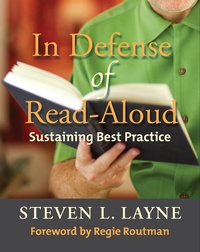
In Defense of Read-Aloud
Sustaining Best Practice
1st Edition
Published on 10. October 2023
198 pages
978-1-003-83874-6 (ISBN)
Description

As accountability measures for schools and teachers continue to grow, instructional practice is under the microscope. The practice of reading aloud to children may be viewed by some educators as an extra bit of fluff used solely for the purposes of enjoyment or filling a few spare minutes,but researchers and practitioners stand in solidarity: the practice of reading aloud throughout the grades is not only viable but also best practice.In Defense of Read-Aloud: Sustaining Best Practices, author Steven Layne reinforces readers' confidence to continue the practice of reading aloud and presents the research base to defend the practice in grades K12. Layne also offers significant practical insights to strengthen instructional practice-;answering the questions of Why should we?- and How should we? and provides practical advice about how to use read-alouds most effectively.Leading researchers in the field of literacy provide position statements, authors of professional books share insights on books they have loved, leaders of the largest literacy organizations in the United States write about their favorite read-alouds, award-winning authors of children's and young adult book (Katherine Paterson, Andrew Clements, Lois Lowry, to name a few) share the powerful behind-the-scenes stories of their greatest books, and real classroom teachers and librarians speak about books that have lit up- their classrooms and libraries around the world.Last but not least,In Defense of Read-Aloud features many great recommendations of books to share with children.Read-aloud is an essential practice in teaching literacy in grades K -12. In this book, Steven Layne has provided everything needed to support, sustain, and celebrate the power of read-aloud.
Reviews / Votes
There is something very special that takes place in classrooms where teachers spend time daily reading aloud to students. In his new book, In Defense of Read-Aloud: Sustaining Best Practice, Steven Layne clearly articulates research-based reasons why reading aloud to students benefits their literacy development. Research overwhelmingly supports the positive impact of reading aloud to students. Reading aloud increases comprehension, enhances early reading skills and speaking skills, improves vocabulary acquisition, improves parental involvement and student motivation. From a student's perspective, listening to teacher read-alouds benefits their syntactic development, vocabulary acquisition, comprehension, and fluency, as well as reading skills such as pronunciation and inflection. Read-alouds improve students' writing, engagement, attitudes, and understanding of text types. They broaden students' thinking and imagination, and improve cultural sensitivity. They build rapport between teacher and students, and they deepen emotional intelligence.Layne calls us to be prepared to intelligently respond to the question, why are you reading
aloud? In the context of high-stakes testing and accountability, every single moment of classroom life comes into focus. Teachers are often unprepared to defend the practice of reading aloud when it is implied that read-aloud is not a good use of instructional time.
"If someone asks you why you're reading aloud to the third graders and your first response is
"Because it's so much fun, and we all enjoy it," we're in trouble. Big trouble. We're not in trouble because you're wrong. No, it's fine to include that as the seventeenth bullet point of your calculated and confidence-inspiring response. We're in trouble because that's too fluffy an answer to be your first go-to when someone is questioning your pedagogy. You sound like a Smurf. Stop it. You're an educator-you need to sound like one (Layne, 2015, p. 11)."
Steven Layne provides practical and important tips to help you establish read-aloud time in your classroom. He gives practical advice about selecting appropriate read-aloud texts and suggests ways to structure read-aloud time that protect the integrity of the activity and build a positive, respectful classroom climate. Layne also offers suggestions for launching a new read-aloud book and integrating read-alouds into the daily routine of the classroom. He sprinkles the book with expert testimonials, expert position statements, letters between teachers and authors, and practical application of solid research. This wide variety of voices blends together seamlessly to support the love of reading aloud.
Layne's voice is strong and clear in this book-you can feel his passion for this topic. His sense of humor is refreshing and it rings true-so much that I found myself laughing and refreshed, as if I were reading a great beach book. Moreover, the book is so comfortably written it feels more like you are having a conversation in a cozy coffee shop, sitting in a big overstuffed chair next to the fireplace. All the while, Layne provides a great reminder of the value and importance of reading aloud daily to students of all ages: "The single most important activity for building the knowledge required for eventual success in reading is reading aloud to children (Anderson et al., 1985)."
Michigan Reading Journal, Aug 2016
More details
Edition
1. Auflage
Language
English
Place of publication
London
United Kingdom
Publishing group
Taylor & Francis Ebooks
Target group
Professional and scholarly
ISBN-13
978-1-003-83874-6 (9781003838746)
Copyright in bibliographic data and cover images is held by Nielsen Book Services Limited or by the publishers or by their respective licensors: all rights reserved.
Schweitzer Classification
Other editions
Additional editions
Book
01/2015
1st Edition
Stenhouse Publishers
€35.00
Shipment within 3-4 weeks
Person
Steven L. Layne serves as Professor of Literacy Education at Judson University in Elgin, IL, USA where he teaches courses in children's literature and directs the university's Master of Education in Literacy programme.
Content
Chapter 1: What's All the Fuss About Reading Aloud?; Chapter 2: Establishing a Successful Read-Aloud Time; Chapter 3: Selecting the Appropriate Read-Aloud; Chapter 4: The Art of Reading Aloud; Chapter 5: The Books We Love to Read Aloud
