

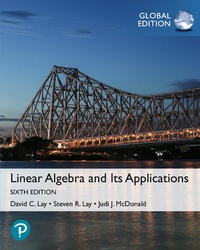
Linear Algebra and Its Applications, Global Edition
Global Edition
6th Edition
Published on 24. August 2021
670 pages
978-1-292-35122-3 (ISBN)
Description

Learn key concepts of linear algebra to equip yourself in your studies and future career. Linear Algebra and Its Applications 6th edition by Steven R. Lay, Judi J. McDonald and David C. Lay is an excellent introductory guide to the principles and foundations of practical linear algebra.
With its learner-friendly approach, the textbook starts with easier material, building confidence by introducing typically challenging concepts early on and gradually developing them. The book revisits those concepts throughout, ensuring you do not become overwhelmed when abstract concepts are introduced, as you progress with your learning.
The latest edition provides new and revised content, with a range of features, including:
A broad range of introductory vignettes, application examples, and online resources
New material and topics to consolidate and enhance your understanding of the subject
New, modernised applications to prepare your learning of the most innovative topics, such as machine learning, Artificial Intelligence, and digital signal processing
With an array of exercises and questions to support your learning, this textbook provides the tools you need to build on your understanding of linear algebra and succeed in your studies.
Also available with MyLab (R) Math
MyLab is the teaching and learning platform that empowers you to reach every student. By combining trusted author content with digital tools and a flexible platform, MyLab Math personalises the learning experience and improves results for each student.
If you would like to purchase both the physical text and MyLab (R) Math, search for:
9781292351353 Linear Algebra and Its Applications, Global Edition, 6th edition plus MyLab Math with Pearson eText.
Package consists of:
9781292351216 Corporate Finance, Global Edition, 5th Edition
9781292351285 Corporate Finance, Global Edition, 5th Edition MyLab (R) Math with Pearson eText
MyLab (R) Math is not included. Students, if MyLab is a recommended/mandatory component of the course, please ask your instructor for the correct ISBN. MyLab should only be purchased when required by an instructor. Instructors, contact your Pearson representative for more information.
This title is a Pearson Global Edition. The Editorial team at Pearson has worked closely with educators around the world to include content, which is especially relevant to students outside the United States.
With its learner-friendly approach, the textbook starts with easier material, building confidence by introducing typically challenging concepts early on and gradually developing them. The book revisits those concepts throughout, ensuring you do not become overwhelmed when abstract concepts are introduced, as you progress with your learning.
The latest edition provides new and revised content, with a range of features, including:
A broad range of introductory vignettes, application examples, and online resources
New material and topics to consolidate and enhance your understanding of the subject
New, modernised applications to prepare your learning of the most innovative topics, such as machine learning, Artificial Intelligence, and digital signal processing
With an array of exercises and questions to support your learning, this textbook provides the tools you need to build on your understanding of linear algebra and succeed in your studies.
Also available with MyLab (R) Math
MyLab is the teaching and learning platform that empowers you to reach every student. By combining trusted author content with digital tools and a flexible platform, MyLab Math personalises the learning experience and improves results for each student.
If you would like to purchase both the physical text and MyLab (R) Math, search for:
9781292351353 Linear Algebra and Its Applications, Global Edition, 6th edition plus MyLab Math with Pearson eText.
Package consists of:
9781292351216 Corporate Finance, Global Edition, 5th Edition
9781292351285 Corporate Finance, Global Edition, 5th Edition MyLab (R) Math with Pearson eText
MyLab (R) Math is not included. Students, if MyLab is a recommended/mandatory component of the course, please ask your instructor for the correct ISBN. MyLab should only be purchased when required by an instructor. Instructors, contact your Pearson representative for more information.
This title is a Pearson Global Edition. The Editorial team at Pearson has worked closely with educators around the world to include content, which is especially relevant to students outside the United States.
More details
Edition
6th edition
Language
English
Place of publication
Harlow
United Kingdom
Target group
Professional and scholarly
ISBN-13
978-1-292-35122-3 (9781292351223)
Copyright in bibliographic data and cover images is held by Nielsen Book Services Limited or by the publishers or by their respective licensors: all rights reserved.
Schweitzer Classification
Persons
David C. Lay, University of Maryland-College Park
Steven R. Lay, Lee University
Judi J. McDonald, Washington State University
Steven R. Lay, Lee University
Judi J. McDonald, Washington State University
Content
About the Authors Preface A Note to Students Chapter 1 Linear Equations in LinearAlgebra
Introductory Example: Linear Models in Economics and Engineering
1.1 Systems of Linear Equations
1.2 Row Reduction and Echelon Forms
1.3 Vector Equations
1.4 The Matrix Equation Ax= b
1.5 Solution Sets of Linear Systems
1.6 Applications of Linear Systems
1.7 Linear Independence
1.8 Introduction to Linear Transformations
1.9 The Matrix of a Linear Transformation
1.10 Linear Models in Business,Science, and Engineering
Projects
Supplementary Exercises
Chapter 2 Matrix Algebra
Introductory Example: Computer Models in Aircraft Design
2.1 Matrix Operations
2.2 The Inverse of a Matrix
2.3 Characterizations of Invertible Matrices
2.4 Partitioned Matrices
2.5 Matrix Factorizations
2.6 The Leontief Input-Output Model
2.7 Applications to Computer Graphics
2.8 Subspaces of ?n
2.9 Dimension and Rank
Projects
Supplementary Exercises
Chapter 3 Determinants
Introductory Example: Random Paths and Distortion
3.1 Introduction to Determinants
3.2 Properties of Determinants
3.3 Cramer's Rule, Volume, and Linear Transformations
Projects
Supplementary Exercises
Chapter 4 Vector Spaces
Introductory Example: Space Flightand Control Systems
4.1 Vector Spaces and Subspaces
4.2 Null Spaces, Column Spaces,and Linear Transformations
4.3 Linearly Independent Sets; Bases
4.4 Coordinate Systems
4.5 The Dimension of a Vector Space
4.6 Change of Basis
4.7 Digital Signal Processing
4.8 Applications to Difference Equations
Projects
Supplementary Exercises
Chapter 5 Eigenvalues and Eigenvectors
Introductory Example: Dynamical Systems and Spotted Owls
5.1 Eigenvectors and Eigenvalues
5.2 The Characteristic Equation
5.3 Diagonalization
5.4 Eigenvectors and Linear Transformations
5.5 Complex Eigenvalues
5.6 Discrete Dynamical Systems
5.7 Applications to Differential Equations
5.8 Iterative Estimates for Eigenvalues
5.9 Markov Chains
Projects
Supplementary Exercises
Chapter 6 Orthogonality and Least Squares
Introductory Example: Artificial Intelligence and Machine Learning
6.1 Inner Product, Length, and Orthogonality
6.2 Orthogonal Sets
6.3 Orthogonal Projections
6.4 The Gram-Schmidt Process
6.5 Least-Squares Problems
6.6 Machine Learning and LinearModels
6.7 Inner Product Spaces
6.8 Applications of Inner Product Spaces
Projects
Supplementary Exercises
Chapter 7 Symmetric Matrices and Quadratic Forms
Introductory Example: Multichannel Image Processing
7.1 Diagonalization of Symmetric Matrices
7.2 Quadratic Forms
7.3 Constrained Optimization
7.4 The Singular Value Decomposition
7.5 Applications to ImageProcessing and Statistics
Projects
Supplementary Exercises
Chapter 8 The Geometry of Vector Spaces
Introductory Example: The Platonic Solids
8.1 Affine Combinations
8.2 Affine Independence
8.3 Convex Combinations
8.4 Hyperplanes
8.5 Polytopes
8.6 Curves and Surfaces
Projects
Supplementary Exercises
Chapter 9 Optimization
Introductory Example: The Berlin Airlift
9.1 Matrix Games
9.2 Linear Programming-Geometric Method
9.3 Linear Programming-Simplex Method
9.4 Duality
Projects
Supplementary Exercises
Chapter 10 Finite-State Markov Chains(Online Only)
Introductory Example: Googling Markov Chains
10.1 Introduction and Examples
10.2 The Steady-State Vector andGoogle's PageRank
10.3 Communication Classes
10.4 Classification of States andPeriodicity
10.5 The Fundamental Matrix
10.6 Markov Chains and BaseballStatistics
Appendixes
Uniqueness of the Reduced Echelon Form
Complex Numbers
Credits Glossary Answers to Odd-Numbered Exercises Index
Introductory Example: Linear Models in Economics and Engineering
1.1 Systems of Linear Equations
1.2 Row Reduction and Echelon Forms
1.3 Vector Equations
1.4 The Matrix Equation Ax= b
1.5 Solution Sets of Linear Systems
1.6 Applications of Linear Systems
1.7 Linear Independence
1.8 Introduction to Linear Transformations
1.9 The Matrix of a Linear Transformation
1.10 Linear Models in Business,Science, and Engineering
Projects
Supplementary Exercises
Chapter 2 Matrix Algebra
Introductory Example: Computer Models in Aircraft Design
2.1 Matrix Operations
2.2 The Inverse of a Matrix
2.3 Characterizations of Invertible Matrices
2.4 Partitioned Matrices
2.5 Matrix Factorizations
2.6 The Leontief Input-Output Model
2.7 Applications to Computer Graphics
2.8 Subspaces of ?n
2.9 Dimension and Rank
Projects
Supplementary Exercises
Chapter 3 Determinants
Introductory Example: Random Paths and Distortion
3.1 Introduction to Determinants
3.2 Properties of Determinants
3.3 Cramer's Rule, Volume, and Linear Transformations
Projects
Supplementary Exercises
Chapter 4 Vector Spaces
Introductory Example: Space Flightand Control Systems
4.1 Vector Spaces and Subspaces
4.2 Null Spaces, Column Spaces,and Linear Transformations
4.3 Linearly Independent Sets; Bases
4.4 Coordinate Systems
4.5 The Dimension of a Vector Space
4.6 Change of Basis
4.7 Digital Signal Processing
4.8 Applications to Difference Equations
Projects
Supplementary Exercises
Chapter 5 Eigenvalues and Eigenvectors
Introductory Example: Dynamical Systems and Spotted Owls
5.1 Eigenvectors and Eigenvalues
5.2 The Characteristic Equation
5.3 Diagonalization
5.4 Eigenvectors and Linear Transformations
5.5 Complex Eigenvalues
5.6 Discrete Dynamical Systems
5.7 Applications to Differential Equations
5.8 Iterative Estimates for Eigenvalues
5.9 Markov Chains
Projects
Supplementary Exercises
Chapter 6 Orthogonality and Least Squares
Introductory Example: Artificial Intelligence and Machine Learning
6.1 Inner Product, Length, and Orthogonality
6.2 Orthogonal Sets
6.3 Orthogonal Projections
6.4 The Gram-Schmidt Process
6.5 Least-Squares Problems
6.6 Machine Learning and LinearModels
6.7 Inner Product Spaces
6.8 Applications of Inner Product Spaces
Projects
Supplementary Exercises
Chapter 7 Symmetric Matrices and Quadratic Forms
Introductory Example: Multichannel Image Processing
7.1 Diagonalization of Symmetric Matrices
7.2 Quadratic Forms
7.3 Constrained Optimization
7.4 The Singular Value Decomposition
7.5 Applications to ImageProcessing and Statistics
Projects
Supplementary Exercises
Chapter 8 The Geometry of Vector Spaces
Introductory Example: The Platonic Solids
8.1 Affine Combinations
8.2 Affine Independence
8.3 Convex Combinations
8.4 Hyperplanes
8.5 Polytopes
8.6 Curves and Surfaces
Projects
Supplementary Exercises
Chapter 9 Optimization
Introductory Example: The Berlin Airlift
9.1 Matrix Games
9.2 Linear Programming-Geometric Method
9.3 Linear Programming-Simplex Method
9.4 Duality
Projects
Supplementary Exercises
Chapter 10 Finite-State Markov Chains(Online Only)
Introductory Example: Googling Markov Chains
10.1 Introduction and Examples
10.2 The Steady-State Vector andGoogle's PageRank
10.3 Communication Classes
10.4 Classification of States andPeriodicity
10.5 The Fundamental Matrix
10.6 Markov Chains and BaseballStatistics
Appendixes
Uniqueness of the Reduced Echelon Form
Complex Numbers
Credits Glossary Answers to Odd-Numbered Exercises Index
