

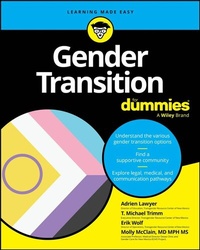
Gender Transition For Dummies
Description

Gender transition is different for everyone-get the support you need for your unique journey
Gender Transition For Dummies is an essential resource for transgender and non-binary readers who are considering the various elements of what is often called gender transition. It starts at the beginning, answering questions like, "What is transgender and what is non-binary?" and, "How Do I Know If I'm Transgender?" Learn to navigate social transition, prepare for gender-affirming surgery, tell loved ones about your transition plans, find a supportive community, and take care of your mental health.
Undertaking any of these steps is a big decision, and it isn't always easy. With this Dummies guide, you'll know that you aren't alone, and you'll get tips from experts on advocating for yourself.
- Manage gender dysphoria, find supportive care providers, and protect your mental health
- Know what to expect with hormone therapy and gender-affirming surgery
- Learn how to change your legal documents and ask people to use the name and pronouns that feel right for you
Gender Transition For Dummies is here to support and guide the transgender and gender-diverse community-and their loved ones-and help them to thrive.
More details
Other editions
Additional editions
Persons
Adrien Lawyer co-founded the Transgender Resource Center of New Mexico (TGRCNM) in 2007 to provide services, education, and advocacy for the transgender community.
T. Michael Trimm is the Executive Director at TGRCNM.
Erik Wolf is the Director of Operations at TGRCNM.
Molly McClain MD MPH MS is a board certified Family and Community Medicine physician who has been providing gender care for people of all ages for many years in New Mexico.
Content
Introduction 1
Part 1: Getting Familiar with Gender Transition 5
Chapter 1: Exploring Gender Transition Elements and Common Questions 7
Chapter 2: Looking More Closely at Gender Transition 25
Chapter 3: Planning for and Adapting with Gender Transition 37
Part 2: Managing Social Transition 57
Chapter 4: Changing Your Style and Appearance 59
Chapter 5: Changing Legal Documents 71
Chapter 6: Planning for the Future 83
Part 3: Navigating Medical Transition 93
Chapter 7: Considering Primary Healthcare 95
Chapter 8: Opting for Hormone Therapy 115
Chapter 9: Deciding to Undergo Surgery 135
Chapter 10: Changing Your Tune with Voice and Speech Therapy 155
Chapter 11: Planning a Family 165
Part 4: Finding Support for Your Journey 175
Chapter 12: Reaching Out for Transition Support 177
Chapter 13: Obtaining Mental Health Support 185
Part 5: The Part of Tens 195
Chapter 14: Ten (or So) Famous Transgender and Non-Binary People 197
Chapter 15: Ten Essential Topics to Discuss with Your Healthcare Provider 201
Chapter 16: Ten (or So) Trans-Friendly Organizations 209
Chapter 17: Ten Ways to Support Transgender and Non-Binary People 215
Index 223
Chapter 1
Exploring Gender Transition Elements and Common Questions
IN THIS CHAPTER
Uncovering terms and definitions
Grasping the elements and implications of gender transition
Addressing common questions
Finding support on your path
If you're considering transitioning, you've no doubt thought about the many ways that taking this step can change your life. For a lot of people the goal of walking down this path is what some folks today call gender euphoria (feelings of satisfaction, confidence, comfort, or even joy that come from being aligned with your gender).
At the same time, challenges and complications may arise for you along the way. You may be someone who came to this book because you are considering this path but really aren't sure yet. That is also absolutely okay.
In the end, nobody but you can know whether this is right for you. Hopefully, though, this book can fill in the gaps in knowledge that you might have, and help provide you with crucial information and perspective to help you with this, sometimes intimidating, decision process.
In this chapter, you find some of the most basic information about what's often called gender transition (an array of social, legal, and medical options that some transgender and non-binary people undertake to be more authentically themselves).
You also find definitions of the words transgender and non-binary, as well as other terms associated with gender and transitioning. (Much more detailed information about social and medical transition is sprinkled throughout the rest of the book, so this chapter is truly an overview.) Finally, we answer some common questions that arise about this topic, including an initial look at finding support and help.
You may be excited, scared, or confused right now. This book aims to give you more information and provide some pathways to connection and assistance along your journey. Remember that you aren't in this alone, and your transgender or non-binary identity, and your way of relating to it, is valid and valued.
Discovering the Meaning of Transgender and Non-binary
Transgender and non-binary: What do these words mean? Although terminology evolves, the word transgender currently refers to anyone whose gender doesn't match up completely with the sex they were designated at birth. Non-binary specifically refers to folks who don't feel like either a man or a woman.
As U.S. culture finally recognizes that a child's consistent awareness of their gender typically develops between 2 and 5 years old, it's critical that this awareness doesn't become a hard and fast expectation of ALL transgender and non-binary people. Being transgender or non-binary isn't fully understood by a lot of cisgender people (folks whose gender and sex match up 100 percent - in other words, people who aren't transgender), which means that this simple minority characteristic is still stigmatized. Discrimination and violence are strongly correlated with being trans or non-binary, and a lot of people aren't aware of the existence of trans and non-binary people until adulthood, even today! In those circumstances, it's no wonder that many folks don't come to the realization that they're transgender or non-binary, even internally, until later in life. People come out, to themselves and others, in their 20s, 40s, and even their 60s.
Some folks talk about not being able to ask the question "Am I trans?" or "Is there something different about my gender?" until they were much, much older than 5. Another specific time when people tend to start talking about possibly being trans or non-binary, or seeking help from others about gender issues, is at the onset of natal puberty (the changes and emergence of secondary sex traits associated with the designated sex at birth).
When the body starts to change in ways that can feel very "wrong" for many trans and non-binary people, those changes can set off an emotional and psychological tailspin. Not everyone experiences this gender dysphoria (a thorough definition is found in the section "Answering a Few Common Questions" later in this chapter), and each person's experience is their own. But for a lot of folks, natal puberty is a huge challenge that can worsen all types of behavioral health symptoms, including suicidal thoughts.
Even trans/non-binary people can struggle when different folks in their lives come out, for a lot of reasons. If you find yourself having a hard time with someone's disclosure about their gender, try to take them at face value. Even if you think they may have something more complex going on, be warm and accepting, and ask open-ended questions about their identity and experience. They thought you were safe enough to confide in, so prove them right!
The bottom line is that right now there's no validating test for someone's gender or for being transgender or non-binary. This means that it can't currently be proved, but it also can't be disproved. Certainly, some folks have questioned their gender and then determined that they weren't trans in the end. But in the initial conversations, it's important not to invalidate a person who needs support (this is great advice for cis folks in your life, too.).
Don't be hesitant to use any of the words in this section as identity labels - or not! While there are standard definitions for transgender and non-binary, the words people use to describe and define themselves are more like the peel-and-stick name tags folks use at formal events (see Figure 1-1 for an example). You get to write your own label or descriptor on your name tag. Whether a term is generally considered out of date, or may not be used by a majority of folks whose gender is similar to yours, it's up to you how you want to be talked to and talked about. These sticker name tags can be pulled off and exchanged for a new one, if you realize that the one you're wearing isn't working for you anymore.
FIGURE 1-1: An example of a self-adhesive name tag with pronouns.
Transgender
The word transgender is currently used to mean a person whose designated sex and gender are not the same. It's important to notice that this definition is not binary in nature - meaning that you don't have to feel the opposite of your designated sex to fall under the trans umbrella, just not the same.
When you read about non-binary in the following section, you'll see that non-binary falls under the trans umbrella using these definitions, too. But as we say above, that doesn't mean that a non-binary person has to put on a trans "name tag."
The other critical aspect to stress is that the definition of transgender is not medical in nature. We talk about gender dysphoria more throughout the book, but experiencing gender dysphoria is NOT part of the meaning of transgender. Trans is a shortened version of transgender and is appropriate for anyone to use.
Being transgender or non-binary does not mean that you dress any certain way or adhere to gender norms and stereotypes. It also doesn't indicate anything about your orientation. Trans people fall into every existing category of people, so trans folks can be gay, straight, bisexual, pansexual, asexual, or any other orientation.
Non-binary
Non-binary people have a gender that falls outside the man/woman binary. It's a common misperception that this means that someone who's non-binary is a blend of man and woman. In fact, non-binary describes a wealth of different genders and experiences. Some non-binary people do feel like a mix of man and woman, while others experience no gender at all (sometimes called agender).
There are non-binary people who experience their gender as neutral. The term genderfluid describes people whose gender shifts and changes over time. This is such a small sampling of ways to be non-binary. If you do not feel like a man, and you also do not feel like a woman, you fall under this non-binary umbrella.
The Four Aspects
For people raised in mainstream U.S. culture, these concepts can feel new and even a little confusing. In order to fully understand these ideas, you must have a grasp of four basic traits. Those traits are sex (broken down into biological sex and designated sex), gender (sometimes referred to as gender identity but not in our trainings or in this book), gender expression, and orientation. We describe these traits more thoroughly in the following sections.
Sex
Sex is a broad term that refers to physiology (how the human body works). It's important to distinguish between biological sex and designated sex, so read on for more information and to find out why.
Biological sex
Biological sex is a complex system formed by five component parts:
- Sex chromosomes are packets of DNA containing the genes that determine someone's sex. XX (female) and XY (male) are the most common examples, but they aren't the only ones humans have.
- Sex hormones are steroid hormones produced by the gonads that cause the development of other secondary sex characteristics. Estrogen and testosterone are the most common...
